
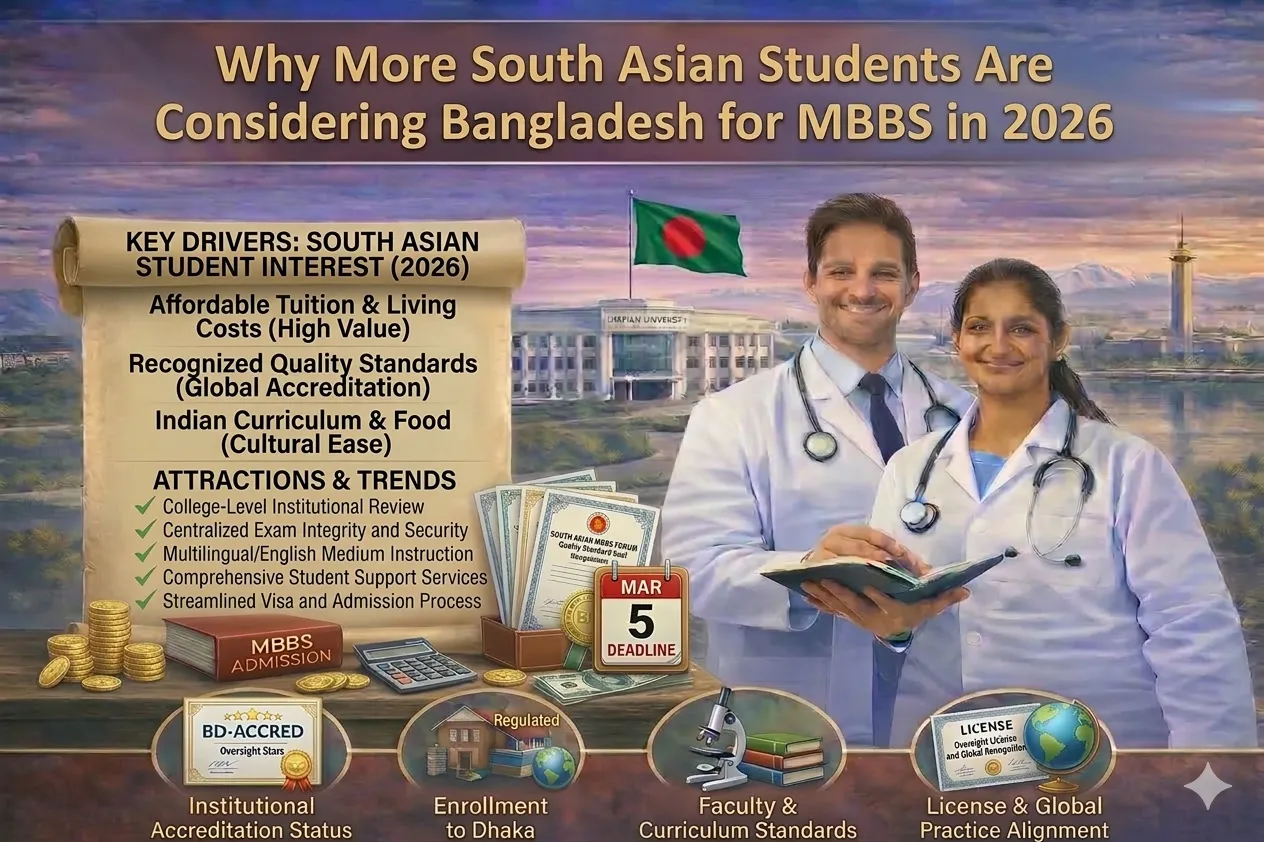
Especially for the students of South Asia, medical education abroad has been a trend among them. The raw figures of medical aspirants in India, Nepal, Sri Lanka and Bhutan run into thousands every year each due to meagre availability of medical seats in their countries. Hence, many of the students are now looking out for international destinations that provide quality medical education at affordable costs.
Bangladesh has become an emerging hub for South Asian students seeking medical education. MBBS in Bangladesh is gaining popularity not suddenly, but due to many academic advantages, regulatory advantages and also economic advantages of MBBS abroad.
Students throughout South Asia are realizing that Bangladesh provides the right mix of solid academic training with global recognition and familiar culture. Due to these factors increasing numbers of students are considering Bangladesh as their medical education destination.
1. Increase in Competition for Medical Seats in South Asia
The intense competition for medical seats in their native countries is one of the primary drivers of student demand for overseas medical education.
In India, for instance, every year millions of students take medical entrance tests, while the number of seats in government medical colleges is drastically limited. Other countries in South Asia also see a similar situation as the demand for medical education outstrips available seats.
This demand-supply gap, leads many students to go through international medical universities.
Bangladesh has emerged as a feasible answer for those looking to pursue a medical program because it provides international standard structured programs at cost effective fees for overseas students.
2. South Asian Medical System Academic Structure
One of the reasons students from neighboring countries choose to study medicine in Bangladesh is because the medical education system here closely resembles that of other South Asian countries.
After completing the MBBS course in Bangladesh, a 5-year academic period followed by an - year clinical internship. Similar subjects, examination patterns and training methods are followed in a few South Asian medical schools as well.
Due to this academic cohesion students from countries such as India and Nepal can smoothly transition into the curriculum without much struggle academically.
This familiarity allows students to concentrate on studying medicine, instead of adapting to an entirely new educational system.
3. Recognition by Global Medical Directories
A medical school that has international recognition of their medical degrees is a considerable factor in students’ decisions when looking for universities abroad.
There are several medical colleges in Bangladesh who has entered the World Directory of Medical Schools (WDOMS). It lists accredited medical schools worldwide.
Graduates of WDOMS-listed applicants would be eligible to apply for licensing examinations and postgraduate training programs in other countries, subject to local regulations.
Such recognition is critical for the students who hope to pursue degrees in medicine abroad.
4. Compliance With Indian Medical Regulations
Bangladesh hosts a significant number of Indian students pursuing medicine. It is therefore vital that medical degrees undertaken abroad in good faith by these students are recognised within the established regulatory framework for India.
To practice medicine in India, medical graduates need to meet the requirements mentioned by the National Medical Commission (NMC).
Bangladesh’s MBBS program structure generally meets these requirements, thus ease the way of graduates who continues their professional journey after studying.
It is the reason why, due to this integration for medical education overseas students from India consider Bangladesh as a safe and affordable option.
5. Strong Clinical Training Opportunities
One of the most vital parts of preparing to be a physician is medical training in practice. Students need time in hospitals, among patients, observing medicine practice under real and not simulated conditions.
All medical colleges in Bangladesh run big teaching hospitals whose enormous patient turnout reaches to a large number of patients every day. This gives students a welcome clinical experience while in school.
Training involves rotating in hospitals and clinical postings where students learn to diagnose diseases, interpret patient symptoms and support experienced doctors with treatment procedures.
Such testimony is integral to developing competent medical professionals.
6. Affordable Medical Education
Another key contributor to the rising popularity of Bangladesh among South Asian students is affordability.
The price of studying medicine in Bangladesh is not high compared to those of a large number of other medical colleges abroad.
And many students and their families maintain manageable tuition, housing, and living expenses. Affordable in this manner, searching for medical education without draining the pocket typically involved going to abroad.
Bangladesh has come up with a solution for students who want to pursue quality education in reasonable costs.
7. English-Medium Medical Education
Language is the biggest barrier for students studying abroad. But a majority of Bangladeshi medical colleges offer MBBS studies in English.
This also enables international students to comprehend lectures, engage in clinical discussions, and read medical textbooks without being impeded by language barriers.
As an added benefit, English education also prepares students to pursue international medical licensing exams and postgraduate training programs.
This ease of accessibility allows students from neighbouring countries in South Asia to merge more easily into their academic surroundings.
8. Cultural Similarities and Comfortable Environment
Bangladesh has many cultural similarities with the rest of country in South Asia. Students can often find familiar food, traditions and social customs there, which helps them acclimatize quickly to life in the country.
The cultural environment also enables students to make friends and build supportive communities with their peers who come from similar backgrounds.
Such familiarity can be especially meaningful for students who are living in another country for the first time.
A supportive setting helps students focus on their academics and growth as individuals.
9. A Long Time in the Making — Increasing Emphasis on Quality of Medical Education
With a view to aligning with the global standard, Bangladesh has taken several initiatives to strengthen its medical education system.
The authorities should concentrate on simplifying accreditation processes, building infrastructure and ensuring that medical colleges maintain quality of teaching.
In building effective healthcare systems, global health organizations frequently consider high-quality medical education as an essential component. And many WHO supported initiatives demonstrates that there is a need of good quality doctors who are capable enough to address burning issues in the field of global health.
This adherence to global standards in medical education only adds to Bangladesh's reliability as a destination for medical training; it reinforces the country's credentials on the world stage.
10. Raising Awareness of South Asian Students
Bangladesh as a destination for medical education has gained plenty of awareness in the last few years.
Educational consultants and alumni groups have also played a role in disseminating information on opportunities available at Bangladeshi medical colleges through digital platforms.
Existing students from these universities will also share their experience with prospective applicants, discussing the benefits of education and clinical training at that institution.
Such a rising awareness has led to an increasing number of students picking Bangladesh for their medical studies.
Bangladesh Medical Universities: Linking to Bangladesh Education Institutions
The increasing demand for admission in Bangladesh’s medical colleges by students from south Asian countries indicates a bright future for that sector of the country.
Medical colleges will grow their infrastructure, quality of training and strength of academic programs as the demand keeps growing.
Bangladesh would perhaps also keep pursuing policies that had been targeted at ensuring quality of medical education while being open to foreign students.
If this trend continues, the country can emerge as one of the major centers for medical education in South Asia.
Conclusion
Increased interest among South Asian students to pursue a medical degree in Bangladesh is reflected by the country becoming commonplace for students studying medicine.
There are many reasons why students pursue MBBS in Bangladesh.
Added to this, a cultural familiarity and English-medium instruction means that Bangladesh is becoming an increasingly attractive option for prospective doctors all over South Asia.
With the increasing need for medical graduates, Bangladesh is poised to emerge as a key player in educating the next generation of healthcare providers across the region.