
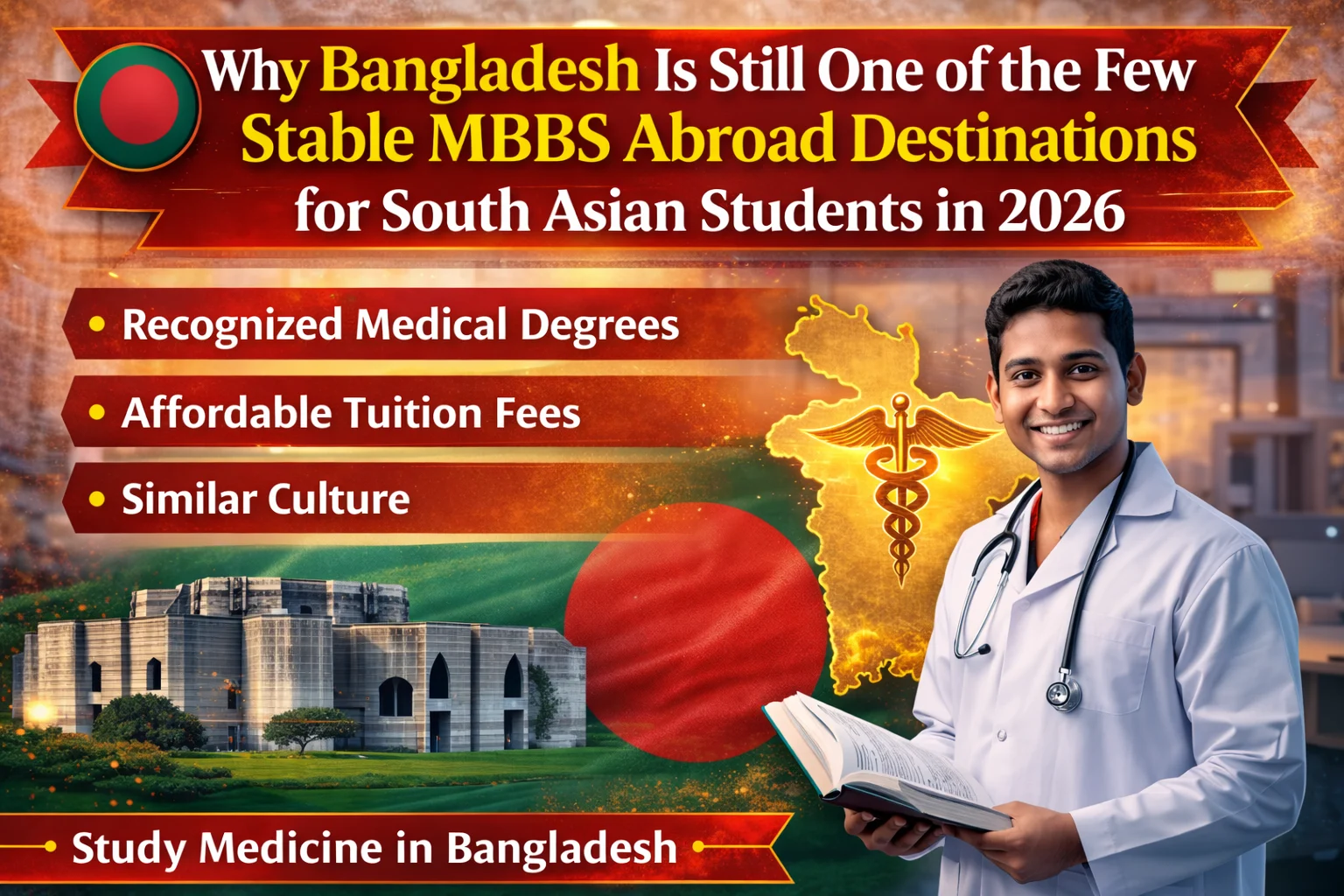
The international medical education landscape has undergone significant changes in the past few years. Political turbulence, visa restrictions and regulatory changes have created obstacles for many students wanting to study medicine overseas. At the same time, many of the countries that once attracted students to international medical schools are dealing with questions of safety, a lack of certain policies or just recognition problems.
MBBS in Bangladesh remains one of the most stable and reliable destinations for South Asian students (particularly Indian, Nepalese and other neighbouring students) during these global changes.
As of 2026, Bangladesh remains one of the few countries where international students can pursue their medical education with reassurance. So now, let’s discuss the reasons why Bangladesh continues to uphold this reputation and a plethora of South Asian students continue to practice the country for MBBS studies.
Mature Education System with Consistent Policies
Constant academic policies and stable education system is one of the greatest reasons why Bangladesh still remains one of the trusted countries for medical education.
Most of these MBBS programs abroad have:
- an ever-changing admission policy
- visa rules
- state medical licensing
Such changes can create uncertainty for students who invest years of study in those systems.
In stark contrast, Bangladesh has had a systematic and stable medical education system for decades. The syllabus, duration of the course and examination pattern has continued to be mainly unchanged.
Students who join the medical colleges in Bangladesh generally end up completing:
- 5 year academic MBBS course
- 1 year of compulsory internship
This structure is in line with international medical educational practice and helps students have a clear academic path.
Similar to Indian MBBS System Curriculum
The similarity between Bangladeshi and Indian medical curricula is another advantage.
The structure of MBBS in Bangladesh is similar to the structure followed in Indian medical colleges. Disciplines such as:
- anatomy
- physiology
- pharmacology
- pathology
- clinical medicine
are taught along similar academic lines.
The similarity between the syllabus makes it easier for Indian students to adapt and understand the curriculum while pursuing MBBS in Bangladesh.
This also gets students ready for medical licensing exams conducted in India post-graduation.
Recognition by Global Medical Directories
Before selecting any medical college abroad, one of the most important things that students need to keep in mind is International recognition.
Of all medical universities in Bangladesh, several are listed on:
This is a critical global database for recognized medical institutions.
To be listed in such directories means that the qualification obtained is accepted internationally.
Other organizations, most notably:
- WHO which aims to bolster health care systems and medical training around the globe, influence medical education systems worldwide.
The MBBS is recognized across the globe, so students can opt for additional training or a licensing exam in other countries after MBBS, as per international education standards followed by Bangladesh.
Compliance with Indian Medical Regulations
Getting recognized by the National Medical Commission (NMC) holds utmost significance for Indian students.
The NMC also regulates the study of medicine abroad for Indian students.
As per these guidelines:
- students need to clear NEET examination
- before they get admission in any overseas medical program
Academic year of recognition of medical colleges in Bangladesh most proportionate with NMC guidelines, and recognized by the Government & Ministry of Health.
This makes Bangladesh one of the safer markets for Indian students compared with destinations where adherence to regulation is already under a cloud.
Lower Tuition Fees Than Other Countries
Cost is also a big consideration for students choosing to study medicine overseas.
Education in medical fields in countries such as:
- US
- UK
- Australia
can get quite costly.
Some European med schools charge high tuition fees and living costs too.
On the other hand, medical education costs in Bangladesh are still affordable.
The total expense of finishing MBBS in Bangladesh is considerably less expensive than through their private medical colleges in India as well as Western nations for the majority of South Asia families.
This low cost of living ensures an easy life for students, making it all the more affordable for prospective medical students around the world.
A strong clinical exposure in teaching hospitals
Owing to the very nature of clinical training, it is an integral part of medical education.
Bangladesh provides powerful clinical exposure, as most of the country’s medical colleges are affiliated with big teaching hospitals treating thousands of patients a day.
While enrolled in med school, students undergo:
- hands-on clinical training
- practical skills development
- communication with patients
In addition, government and teaching hospitals experience a high patient flow, which offers good exposure for medical students.
Familiarity and Geography for South Asian Students
Cultural familiarity is one of the unique advantages for South Asian students, particularly in Bangladesh.
Subjects from:
- India
- Nepal
- other neighboring countries
tend to have the atmosphere in Bangladesh incredibly relaxing.
A few things make them feel comfortable doing this:
- Similar food habits
- Comparable climate
- Cultural and social similarities
- Shorter travel distances to home countries
These similarities help many students adjust easily to life in Bangladesh compared with countries situated far away.
English-Medium Medical Education
One of the biggest challenges that students face while studying abroad happens to be the language barrier.
In multiple states, the medical education is partially or completely delivered in the dialect of the country. This can pose challenges for international students facing the same thing in that they need to learn different languages as they study complex medical content.
MBBS is taught in English here in Bangladesh which also make academic learning easier for students internationally.
After conducting years of medical school tuition in the English medium, students can examine in their actual surroundings without being hampered by the boundaries imposed on an unfamiliar language.
Growing Infrastructure and Medical Institutions
In the past few years, Bangladesh has extended its medical education system.
To strengthen the country’s medical education system, the following developments are taking place:
- new medical colleges
- teaching hospitals
- healthcare facilities
Such advancements do not just benefit healthcare delivery through Bangladesh; they also provide scaffolding for medical students.
This growth shows a promising future of medical education in Bangladesh for international students as well looking for MBBS.
Safety and Regional Stability
There have been geopolitical global events affecting multiple nations that had emerged as popular destinations for international medical education.
Some of the challenges include:
- political uncertainties
- conflicts
- visa restrictions
Conversely, Bangladesh has possessed a degree of political and social stability that permitting international students to continue their education largely unhindered.
Such stability helps uphold Bangladesh’s status as a reputable place to receive education in medicine.
Final Thoughts
The global environment around international medical education has changed, too — specific country templates are different in 2026 than they were just three years before. Safety, regulations, or cost considerations mean that some countries simply cannot support a burgeoning cohort of students wishing to study medicine there.
In the backdrop of all this uncertainty, MBBS in Bangladesh remains one of the very stable and reliable options for students from South Asian countries.
Overall, Bangladesh remains a practical option for aspiring medical professionals from all around the region due to:
- its stable education policies
- globally acknowledged medical colleges
- reasonable tuition fees
- challenging clinical training
For those students seeking a perfect blend of quality education, cultural environment, and academic rigour, Bangladesh remains one of the most reliable MBBS destinations in 2026.