
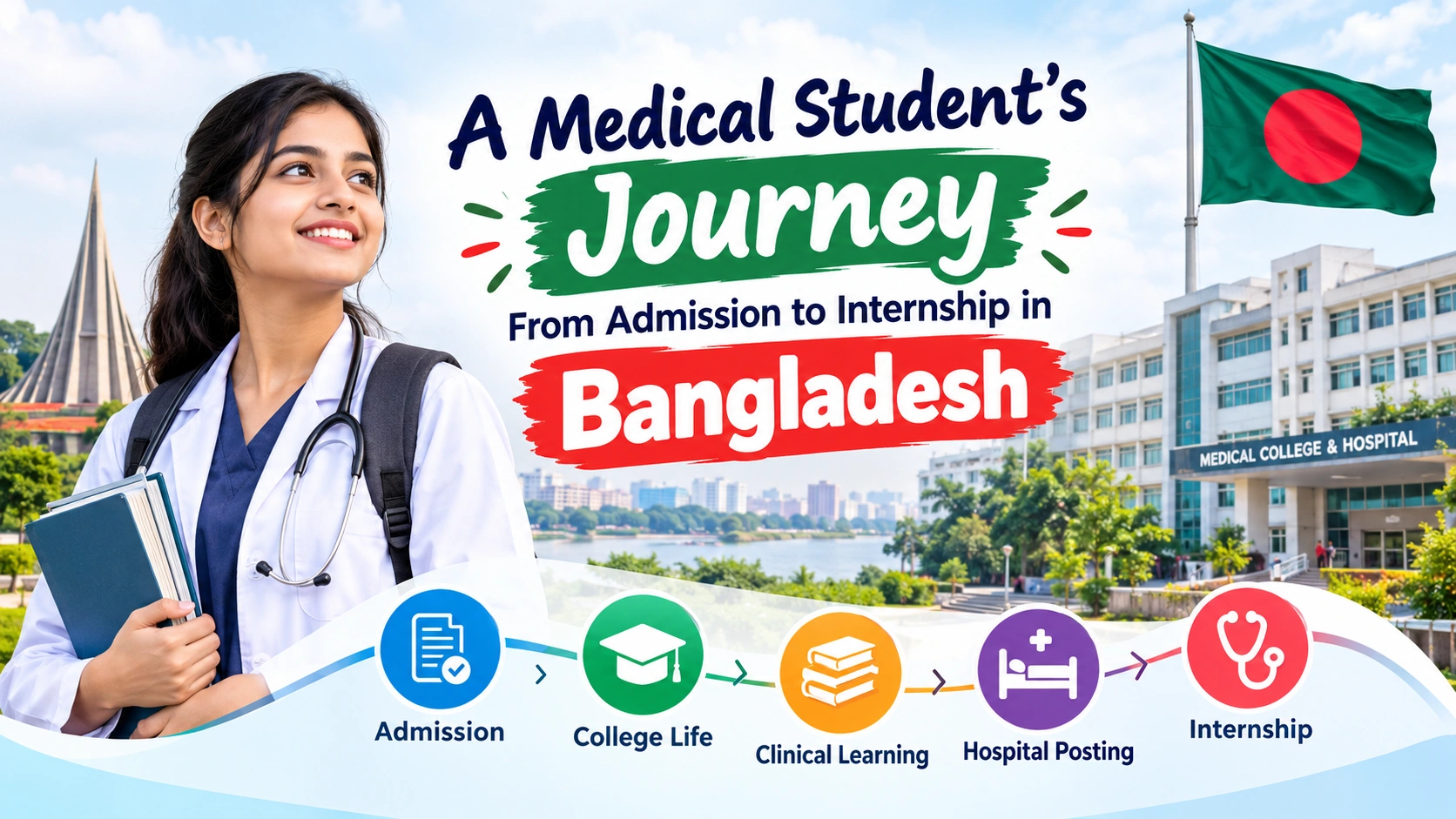
For an Indian student, choosing MBBS in Bangladesh can feel exciting at first, and then slightly overwhelming once the paperwork starts. There are applications, eligibility rules, NEET, college selection, visas, classes, practicals, hospital postings and, finally, internship. It’s a long road. But it becomes much easier to understand when you look at it as a series of stages rather than one huge process. Bangladesh’s Directorate General of Medical Education (DGME) publishes separate admission circulars for foreign students, including SAARC and non-government institutions, so the exact process can change by admission session.
Starting Point: Checking Eligibility for MBBS in Bangladesh
Before looking at college fees or hostel photos, check whether you actually meet the admission requirements. Indian applicants generally need to have completed Class 12 with Physics, Chemistry and Biology, along with English, and must satisfy the foreign-student requirements applicable to the relevant Bangladesh admission session. Academic documents may also need verification or marked equalisation under the applicable rules. For the 2025–26 session, DGME issued a dedicated foreign-student MBBS/BDS admission circular.
For students planning to return to India after graduation, there’s another box to tick: NEET. Indian students seeking to study medicine abroad need to meet the applicable NEET requirement, and the qualifying benchmark can change from year to year. So, don't use an old cutoff screenshot from a coaching group as your final source. Check the current information on the official NEET portal and the latest rules from the National Medical Commission.
Choosing the Medical College
This is probably the most consequential part of the early journey. Two colleges may both offer MBBS, yet their hospital facilities, clinical exposure, tuition structure, location and student support can be quite different.
A sensible shortlist should include:
- Government or private status
- Current academic affiliation
- Teaching hospital and clinical facilities
- Course duration and internship structure
- Foreign-student admission rules
- Total tuition and other charges
- Hostel and living arrangements
- Current regulatory information
- Availability in recognised medical-school directories
The World Directory of Medical Schools (WDOMS) is useful for checking whether a particular medical school is listed, but WDOMS itself clearly states that listing does not by itself mean recognition, accreditation or endorsement. That distinction matters. A lot. For example, WDOMS currently lists Bangladeshi institutions such as Enam Medical College and Hospital, Rajshahi Medical College and Popular Medical College, with individual information about their programmes and clinical arrangements.
Admission, Documents and Getting Ready to Move
Once a student receives an admission offer, the journey becomes much more practical. Passport, academic certificates, photographs, admission documents and other paperwork need to be kept ready, while visa requirements should be checked with the relevant Bangladeshi authority. Don't underestimate this stage. One missing document can create an irritating delay just when you're trying to arrange flights, accommodation and university reporting dates.
Students should ideally keep both digital and printed copies of:
- Passport
- Class 10 and Class 12 certificates
- NEET documents
- Admission letter
- Passport-size photographs
- Medical documents, if requested
- Financial or sponsorship documents, where applicable
- Visa paperwork
Once you reach Bangladesh, the first few weeks are usually about registration, accommodation, orientation and getting used to the college routine.
The First Years of MBBS
Then comes the part students actually signed up for: medical school. The early years are heavily focused on foundational medical sciences, practical classes and examinations. Anatomy, physiology, biochemistry and related subjects demand regular study because trying to learn everything two weeks before exams is, honestly, a rough strategy. A typical day may involve lectures in the morning, practical sessions later, self-study in the evening and another round of revision before sleeping. Not every day looks like that, of course. Some are easier. Some aren't. For Indian students pursuing MBBS in Bangladesh, the relatively close geographical and cultural setting can make adjustment easier than in some distant study-abroad destinations. Food, climate and travel access can feel familiar, although students still need time to settle into a new academic and social environment.
Clinical Training Changes Everything
The experience starts feeling very different once hospital postings become a major part of the course. Instead of studying a disease only from a textbook, students begin seeing patients, observing doctors, taking histories under supervision and understanding how departments actually function. Medicine suddenly feels less theoretical.
Clinical training is also where communication becomes important. English may be the academic language, but students can hear Bengali in hospital settings, especially during patient interactions. Learning a few everyday Bengali expressions can make communication more comfortable. WDOMS school profiles can provide useful information about whether a particular institution has access to clinical teaching facilities and how clinical training is structured. But students should still verify the current details directly with their college before admission.
How Much Does the Journey Cost?
There isn't one universal Bangladesh MBBS fee. Private colleges can have substantially different fee structures, while government/SAARC arrangements may follow different rules from non-SAARC or private admissions.
Rather than relying on a single internet figure, students should request a complete fee schedule from the college covering:
|
Expense |
What to Check |
|
Admission fee |
One-time or refundable amount |
|
Tuition |
Annual or semester-based |
|
Hostel |
Room type and duration |
|
Internship charges |
Whether included in the package |
|
Examination fees |
Separate or included |
|
Books and equipment |
Approximate yearly cost |
|
Food |
Monthly estimate |
|
Travel |
Home-to-campus and local transport |
|
Visa/document costs |
Application and renewal expenses |
The official 2025–26 DGME foreign-student circulars should be treated as the starting point for session-specific admission information rather than relying on old fee articles.
The Internship Year
After years of lectures, practical classes, exams and hospital postings, internship is where the student gets much closer to real clinical work. Internship normally involves supervised rotations through departments such as medicine, surgery, obstetrics and gynaecology, paediatrics and other required areas, depending on the institution's structure. The exact rotation schedule can differ, so students should obtain the current internship plan from their medical college.
And here's something Indian students really need to understand. The internship isn't just another academic formality if your plan is to return to India. The NMC's Foreign Medical Graduate Licentiate framework sets requirements concerning the duration of medical education, clinical training and internship. NMC's current materials also warn students that deviations involving course duration, medium of instruction, curriculum, clinical training or internship arrangements can affect eligibility for registration in India. So before admission, don't simply ask, “Is this college recognised?” Ask about the entire programme structure.
What Happens After Internship?
Graduation doesn't automatically mean you can start practising medicine in India the next morning. Indian graduates of foreign medical institutions have to follow the applicable NMC and registration requirements in force at that time. The regulatory framework has changed over the years, and students should follow current NMC notices rather than relying on advice from seniors who graduated under older rules.
The NMC currently publishes both its Foreign Medical Graduate Licentiate Regulations and related FAQs/advisories on its official website. For an Indian student, the broader post-MBBS path may involve fulfilling Indian registration requirements, completing the applicable licensing/assessment process, and then considering postgraduate education or clinical practice according to the rules applicable to that graduating batch.
Pros and Challenges Along the Way
The journey has genuine advantages, but it isn't effortless.
Potential advantages include:
- Geographic proximity to India
- Relatively familiar food and culture
- English-medium medical education at many institutions
- Access to established teaching hospitals
- Multiple government and private medical colleges
- Easier travel home compared with many distant destinations
Challenges can include:
- Limited foreign-student seats
- Different fee structures between colleges
- Adjustment to hospital communication
- Academic workload
- Living expenses beyond tuition
- Need for careful recognition and regulatory checks
- Meeting Indian requirements after graduation
Honestly, the biggest mistake is treating admission as the finish line. It isn't. College selection, course structure and internship arrangements can affect what happens several years later.
Frequently Asked Questions
Is NEET required for Indian students studying MBBS in Bangladesh?
Indian students planning to pursue medical education abroad generally need to meet the applicable NEET requirement. The exact qualifying criteria can change, so students should verify the current NEET and NMC rules for their admission year. The official NEET website should be used for current examination information.
How long does MBBS in Bangladesh take?
The medical programme itself is commonly structured around five years of academic medical education, followed by the required internship arrangement. However, Indian students should check the complete programme duration and internship structure against current NMC requirements before admission.
Is every medical college in Bangladesh suitable for an Indian student?
No. A college should be checked individually. WDOMS listing is useful, but WDOMS itself says that being listed does not automatically establish recognition or accreditation.
Can students return to India after completing MBBS in Bangladesh?
They can seek medical registration in India by following the rules applicable to foreign medical graduates at that time. Requirements can include conditions related to the medical course, clinical training, internship and the applicable licensing or registration process. NMC's current regulations and advisories should be checked before and during the course.
Is internship important for Indian students?
Very much. Internship is not something students should treat as an afterthought. Its duration, location, supervision and structure can matter for later registration in India, so these details should be verified before admission.
Conclusion
A medical student's journey through MBBS in Bangladesh isn't just about getting an admission letter and reaching campus. It starts with eligibility, moves through college selection and documentation, then becomes years of lectures, practical work, clinical postings and examinations before reaching internship. The smart approach is to check things early. Verify the college, understand the complete fee structure, review the course and internship arrangements, and keep an eye on the latest NMC requirements throughout the degree. For students comparing colleges and planning their next step, MBBS in Bangladesh can be a useful starting point for understanding the admission process, costs and study options. Just remember: the final check should always be against the latest official regulations and the medical college's current information.