
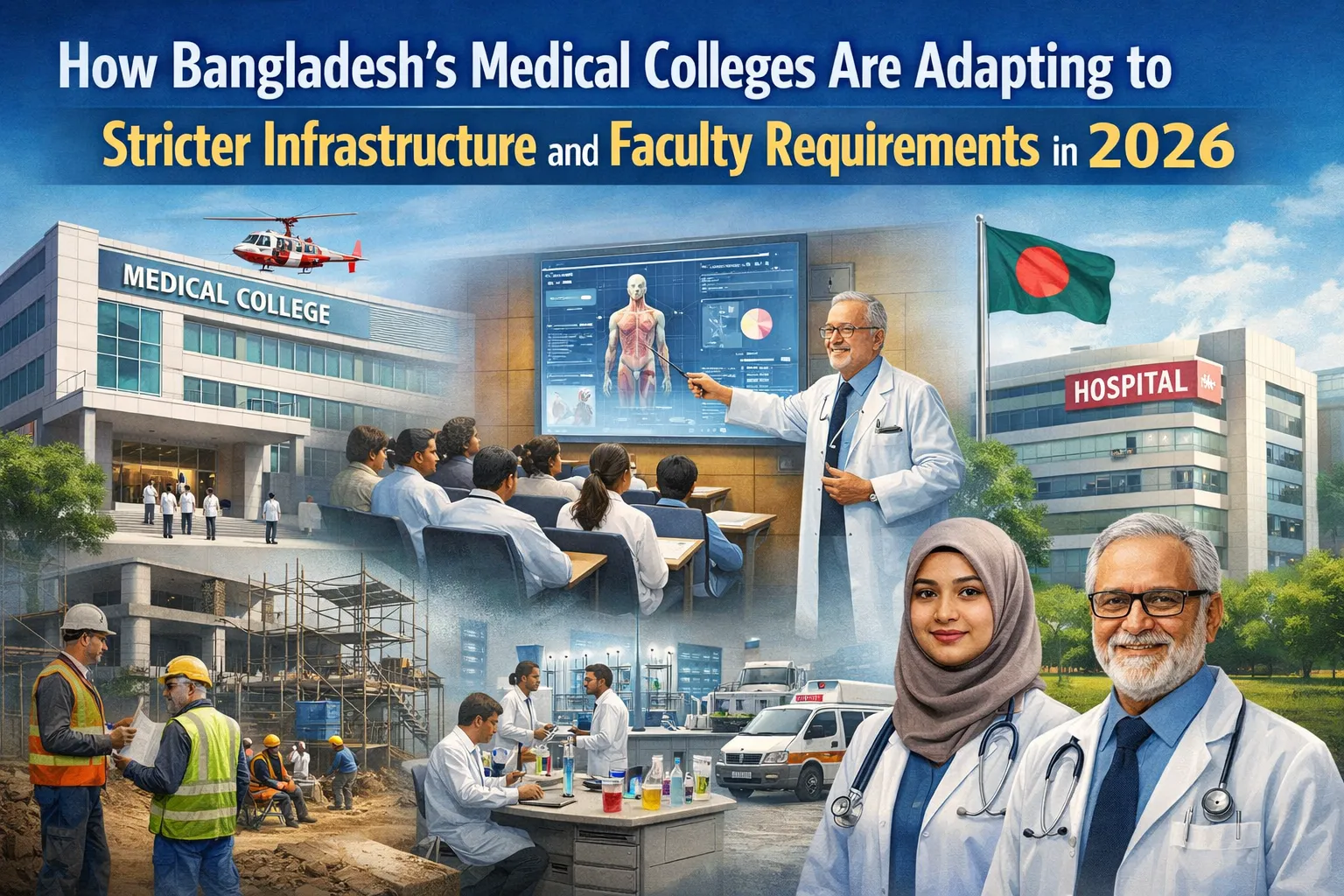
Bangladesh’s medical education system is currently undergoing one of its most important transitions in recent years – a transition that started in 2026. The stricter requirement of accreditation standards in medical colleges significantly increased across the county are fostering to enhance their infrastructure, improve faculty quality and knowledge dissemination at large.
These changes are very important for the MBBS aspirant students from Bangladesh. They have a direct influence not only the standard of education but also credibility and global acceptance of medical degrees offered in Bangladesh.
Why Stricter Standards Were Introduced
In the past ten years, Bangladesh has fast-tracked its number of medical colleges. Though this expanded access to medical education, it also promoted concerns about variable quality between institutions.
Issues such as:
- Inadequate infrastructure
- Shortage of qualified faculty
- Limited clinical exposure
became significant obstacles to maintaining education standards.
It is well documented that with infrastructure gaps and faculty shortage, quality of medical education continues to suffer, thus making the reforms in medical education essential.
In response, the government has brought in a centralized accreditation system to ensure that every medical college adheres to minimum standards before students are admitted.
What Are the New Requirements?
Medical colleges will have to apply six years after the implementation of this new accreditation framework that includes rigorous criteria corresponding to infrastructure along with faculty.
Infrastructure Requirements
Medical colleges are now to have themselves:
- Fully functional teaching hospitals
- Sufficient number of hospital beds (generally 250 or above)
- Modern laboratories and classrooms
- Sufficient hostel and campus facilities
A few even specify minimum hospital capacity, to guarantee that clinical training is adequate.
Faculty Requirements
Colleges must also ensure:
- Qualified and experienced teaching staff
- Proper student-to-teacher ratio
- Professors in all major departments are available
- Continuous faculty training and development
Nonetheless, faculty shortage has remained a perennial problem with previous studies depicting deficits in teaching availability across medical colleges.
How Medical Colleges Are Adapting
To comply with these new, more stringent standards medical colleges in Bangladesh are currently implementing various changes.
Infrastructure Upgrades
A lot of organizations are putting a lot in:
- Expanding hospital facilities
- Upgrading laboratories with modern equipment
- Surfaces scrubbed and lecture halls morphed with digital tools
Many universities are also constructing new hostels and enlarging campuses to house students in greater comfort.
These improvements are critical because colleges that don't meet those infrastructure requirements can lose accreditation or be limited in who they admit.
Increasing Faculty Recruitment
One of the biggest challenges is a lack of qualified faculty.
To remedy this, medical colleges are:
- Appointed experienced doctors as faculty
- Offering better salaries and incentives
- Attracting specialist doctors into academic careers
A greater emphasis is also being placed on faculty development programs to enhance the standard of teaching.
Strengthening Clinical Training
Clinical exposure plays a vital role in medical education. Under the new standards, colleges must ensure that students receive enough hands-on training.
As a result, institutions are:
- Expanding hospital partnerships
- Patient flow in teaching hospitals
- Improving supervision during clinical rotations
It also guarantees that students studying MBBS in Bangladesh receive practical training alongside hypothetical studies.
Internal Quality Monitoring
Medical colleges are also establishing internal quality control systems.
These include:
- Regular academic audits
- Student feedback systems
- Performance evaluations for faculty
Earlier quality checks were informal but now institutions are following more systematic monitoring mechanisms.
Challenges Faced by Medical Colleges
Adaptation is taking place, but not without struggles.
Financial Pressure
Outfitting in infrastructure and hiring faculty comes with a cost. Smaller private colleges, especially, may find meeting those requirements challenging.
Faculty Shortage
On top of that, it can be challenging to find experienced medical educators even when recruitment efforts are undertaken. Moreover, the system already has long grappled with faculty shortages.
Seat Reductions
Inability to meet standards also means reduction in MBBS intake which directly affects revenue and student admissions for colleges.
But the reforms are moving institutions toward a more gradually better state through these struggles.
Impact on Students
These changes come with both opportunities and challenges for students — particularly for international applicants.
Benefits
- Better infrastructure and facilities
- Improved teaching quality
- Stronger clinical exposure
- More globally recognized degrees
Bangladesh is proposing to have a more structured and quality driven system of education for students opting MBBS now.
Challenges
- Wider competition because the number of seats are little
- Talk about your college selection being more cautious
Students must now check that they have chosen a properly accredited institution.
Importance of International Standards and Recognition
The new accreditation system is very much in line with global standards of medical education.
The World Directory of Medical Schools (WDOMS) plays a significant role in this regard and medical colleges know that they must adhere to certain criteria in order to maintain recognition of their status.
Health organizations such as the World Health Organization (WHO) have emphasized the need for either robust healthcare education systems in the world.
For Indian students, the guidance provided by NMC is very vital information that is to be adhered to if the student has ultimate plans of practicing medicine in India after completing their degree.
These reforms assist in ensuring that degrees offered by Bangladesh meet these global and national standards.
Long-Term Outlook
Despite short-term challenges that may arise from the transition phase of implementation, the overall outlook is a positive one where there will be more seats in play on average than before.
In the coming years:
- More colleges will comply with accreditation standards
- Infrastructure will continue to improve
- Faculty quality will increase
To grow international trust in Bangladesh’s medical education.
It clearly indicates a transition of medical education in Bangladesh from rapid expansion to sustainable and high quality growth.
Conclusion
In 2026, the medical colleges in Bangladesh are going through a major change, making their infrastructure more strict as well as focusing on shaping the faculty appropriately.
But while the process can be hindered by financial costs and faculty shortages, it is ultimately intended to improve the quality of medical education.
These reforms are a positive sign for the students who dream of pursuing MBBS in Bangladesh. They also provide improved learning environments, enhanced clinical training and internationally recognised qualifications.
The Bangladesh Medical Education futureCurrently, Bangladesh is in the middle of this dynamic change process and by these trustable medical quality establishments it is becoming a prospective destination for health educational endeavors.