
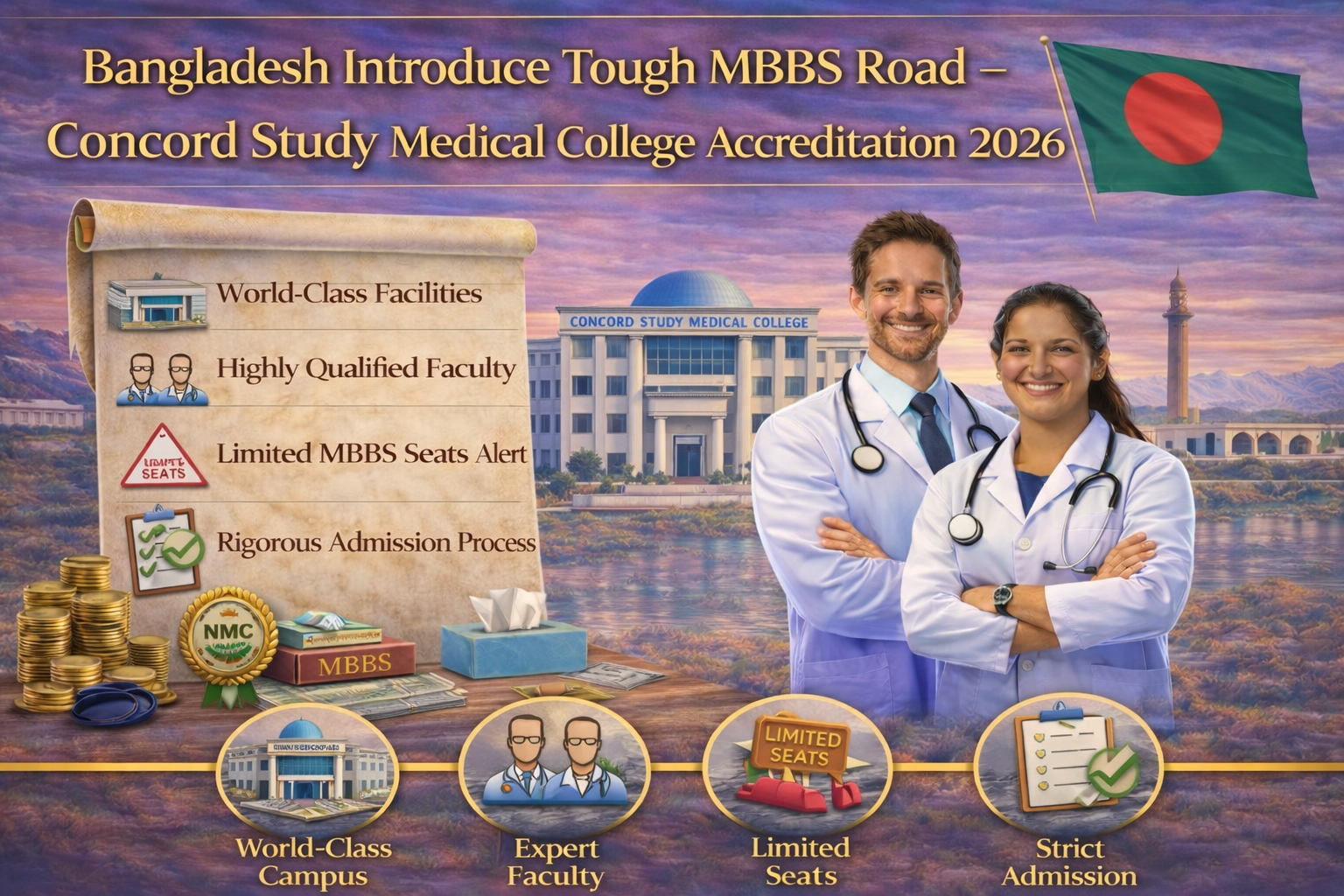
That's Expected to Improve the Overall Quality of MBBS Education and Reputed as Hottest Country For Indian Students
The new guidelines aim to promote transparency and quality of medical courses in India, therefore making the medical degrees globally acceptable as well (aligned with global standards set by NMC (National Medical Commission), WHO (World Health Organization) and WDOMS (World Directory of Medical Schools).
Why Accreditation Reform Was Needed
The number of private medical colleges in Bangladesh has increased rapidly over the past decade. While several institutions maintained high standards, some others had inadequate infrastructure, experienced faculty and clinical exposure. This resulted in variations in the quality of medical education.
To combat these issues, the state and governing agencies have put in place stringent accreditation requirements that are as follows:
- Standardization of medical education system for all institutions
- Eliminate substandard colleges
- Improve clinical training facilities
- Follow international best practices such as listing in WHO and WDOMS
2026 Accreditation Policy — Top Takeaways
Rating medical education: the new accreditation frameworkAttention to multiple dimensions of EDU.
Infrastructure Standards
Now colleges must meet basic requirements for:
- Advanced laboratories
- Digital learning tools for modern classrooms
- Hospitals that have all necessary medical instruments and enough public hospital with sufficient number of bed to accommodate large patients
Faculty Qualifications
Institutions are required to maintain:
- Qualified and experienced teaching staff
- Proper student-to-faculty ratio
- Continuous faculty training programs
Clinical Exposure
So, hospitals affiliated to medical colleges need to:
- Handle a high patient inflow
- Provide hands-on clinical training
- Offer exposure across multiple specialties
Mandatory Accreditation Reviews
- Ongoing compliance will be ensured through regular inspections and audits. Colleges not up to snuff risk losing recognition.
Impact on MBBS Students
There are many ways in which the strict accreditation norms would benefit students directly:
- Increased Access to Education: More students gaining benefits of teacher training and curriculum improvements
- Improved Clinical Training: More exposure in hospitals
- International Accreditation: Degrees meet NMC, WHO, and WDOMS criteria
- Strong Academic Foundation Higher FMGE/NExT Success Rates
What does this mean for Indian students specifically; and how can they further my degree confidence that a their degree will not only be valid in India but also respected in global level.
Role of NMC, WHO, and WDOMS
The new accreditation system closely parallels international medical education frameworks:
- NMC (National Medical Commission): Making sure that Indian students who pursue their undergraduate medical education abroad to practice in India are eligible.
- WHO (World Health Org): Sets international standards in medical training and health workforce education
- WDOMS (World Directory of Medical Schools): Provides names and locations of recognized medical institutions globally
Institutions meeting these criterion can continue to attract international students and maintain credibility.
Implications for 2026 MBBS Admissions
So, the students who want to pursue MBBS in Bangladesh from 2026Onwards will have to be more mindful and choosy while selecting a college. It is now essential to:
- Find out if the college is an accredited institution
- Check its listing in WDOMS
- Confirm approval under NMC guidelines
- Check the hospital facilities and patient flow
The change effectively “decouples” the admission process and leaves only good institutions.
Benefits for Indian Students
Indian students have enlisted Bangladesh among their top choices for its affordability and with a similar curriculum. With the new accreditation rules:
- Students get access to enhanced academic infrastructure
- Degrees hold stronger global value
- Prevents the risk of enrolling into low-quality colleges
- Career opportunities improve significantly
Challenges for Medical Colleges
These changes, while good for students, create headaches for some institutions:
- Increased investment in infrastructure
- Need for better faculty recruitment
- Continuous compliance with strict inspections
Institutions that can't meet these requirements may be suspended or closed, resulting in a more competitive and higher quality education system.
Dhaka, Bangladesh: Ominous Significance of COVID-19 on Medical Education in Bangladesh
The implementation of strict accreditation is going to:
- Enhance Bangladesh’s position in the international ranking of medical education
- Attract more international students
- Improve healthcare systems with better trained physicians
- Develop trust between regulatory agencies such as WHO and NMC
It is not merely an improvement for now but also a long-term strategy to set Bangladesh as a global hub for medical education.
Final Advice for Students
For the study of MBBS in Bangladesh in 2026:
- Only attend accredited and recognized colleges
- Complete admission formalities early
- Keep following NMC, WHO and WDOMS guidelines
- Prepare Academically Before Classes Start
Conclusion
In 2026, the strict medical college accreditation in Bangladesh will have started its arrival Into the quality of MBBS education. This growing trend is sanctioned by country's NMC, WHO and WDOMS aligned with international standards making sure students avail world class quality education programme, better clinical exposure and globally recognized degree from the university.
This is a good thing for future doctors too as this improves learning outcomes and prospects in future careers.