
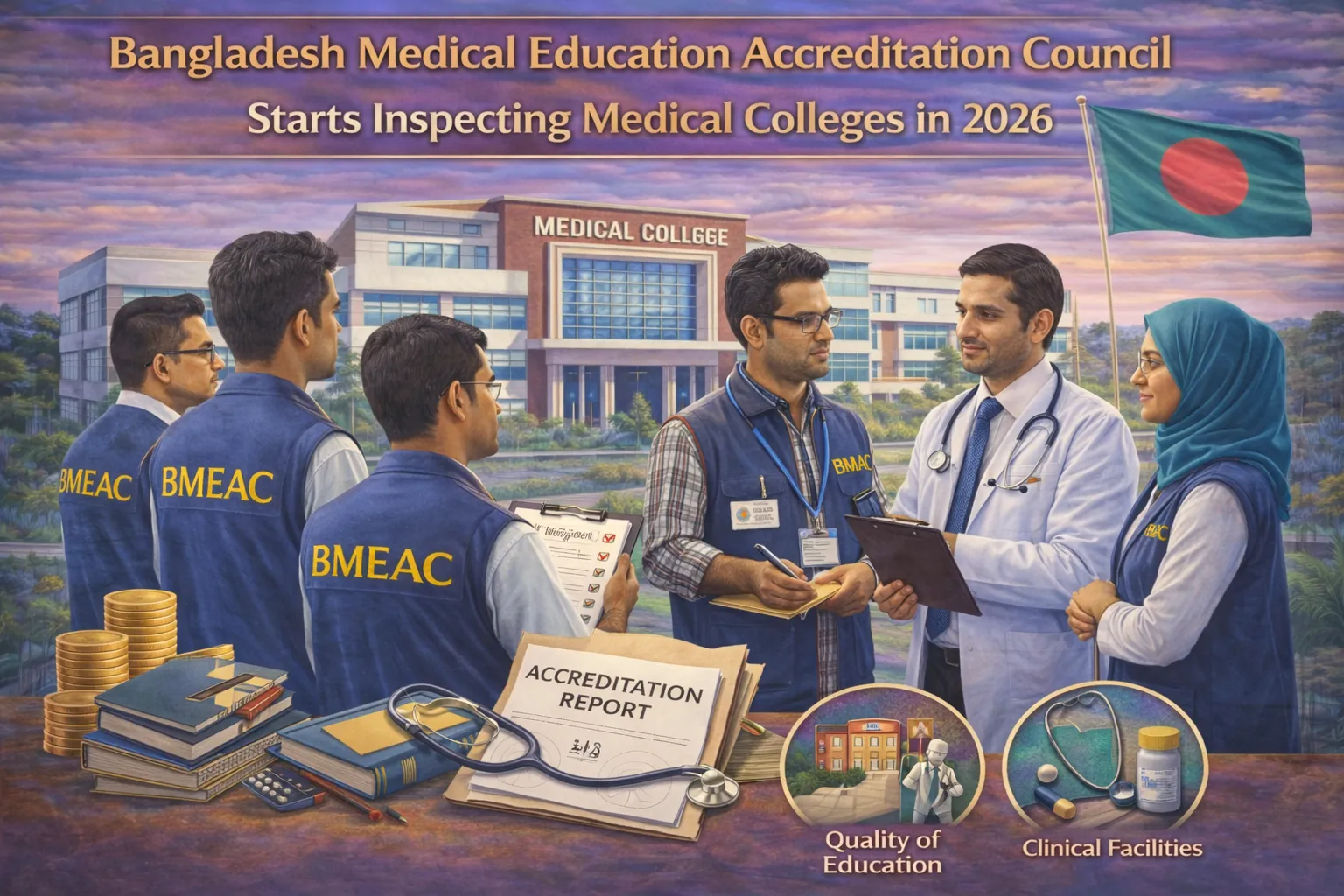
In 2026, the Bangladesh Medical Education Accreditation Council (BMEAC) started an organized inspection process of all medical colleges in Bangladesh. This step forms part of the government's larger effort to enhance academic standards, improve infrastructure and ensure that the medical graduates are trained on par with international benchmarks in healthcare education.
This is a very important development for foreign students who wish to pursue MBBS in Bangladesh. Under the new inspection and accreditation system, required facilities to train competent doctors must be provided by all medical colleges, teaching standards raised and transparency ensured.
These reforms will affect admission policies, clinical training standards and holistic standing of Bangladesh’s medical education system.
Reasons Why a Medical Education Accreditation System was Introduced in Bangladesh
In the last twenty years, the number of medical colleges in Bangladesh grew rapidly. Today medical education is provided by more than a hundred public and private institutions across the country. But alongside this expansion came worries about keeping consistent standards of academic quality and infrastructure.
Some institutions were reported to have a shortage of qualified faculty members, hospital facilities, and clinical training infrastructure. In response, the government started to reinforce quality assurance mechanisms in order to uphold high standards of medical education.
To accommodate these apprehensions, Bangladesh established an independent accreditation system by passing the law creating Bangladesh Medical Education Accreditation Council. The primary objective of this council is to oversee, assess and accredit medical colleges as per well-defined educational benchmarks.
What the Accreditation Council Is Doing in 2026
The accreditation council began inspecting medical colleges across the country in 2026. These inspections are conducted to assess if institutions adhere to national and international standards for medical education.
During these evaluations, the following primary areas are assessed:
- Faculty qualifications and teaching experience
- Classroom and laboratory facilities
- Student–teacher ratios
- Hospital infrastructure and patient exposure
- Availability of modern medical equipment
- Clinical training opportunities for students
Accreditation is granted to institutions that meet the criteria, while those with shortcomings may have to finally enhance their facilities before continuing admissions.
This inspection process is an important step towards strengthening Bangladesh’s medical education system and preserving its academic viability.
Bolstering Quality Assurance in Medical Education
Quality assurance forms one of the crucial aspects in all modern medical education systems across the globe. Hence, national guidelines and quality assurance schemes have been embedded in order to ensure high teaching standards maintained by the medical institutions.
The guidelines cover different aspects of medical education, including academic delivery, clinical training and infrastructure and ethical practices. The aim is to better prepare graduates of such programs to serve patients and contribute effectively within the health care systems.
These initiatives are aimed at bringing the medical education of Bangladesh up to international standards and producing quality healthcare professionals.
Impact on International Students
These fresh inspection for accreditation holds dire importance for students of medical department from overseas studying in Bangladesh.
Every year, thousands of students from India, Nepal, Sri Lanka and various other countries go to study in Bangladeshi medical colleges. Most of them come to Bangladesh for the low tuition fees and internationally recognized medical degrees.
For these students, the accreditation process adds an extra layer of assurance. It guarantees that medical college they select satisfies the scholarly and clinical preparing models needed for proficient therapeutic practice.
This new system increases confidence for students wishing to have MBBS in Bangladesh about the quality and credibility of Bangladesh’s medical health institutions.
Importance for Indian Medical Aspirants
As per the statistics, Indian students are amongst the largest contributing groups with medical students in Bangladesh. It's very essential for them to be acknowledged by the regulations.
Foreign medical universities that are recognized by the NMC in India also allow graduates to complete their post-studies requirements for practicing medicine.
Establishing accreditation in Bangladesh can help ensure the adherence of medical colleges to structured curricula, appropriate duration and adequate clinical exposure. Such elements are coveted for international recognition and licensing capability.
Therefore, the Bangladeshi medical colleges accredited will allow Indian students to adjust to regulatory requirements better after graduation.
Global Recognition in Medical Education
International recognition is considered one of the best factors while going for a medical university abroad. Many medical graduates wish to have options for postgraduate training or licensing examinations in other countries.
WDOMS stands for World Directory of Medical Schools, and it is the global directory of countries having medical colleges.
Graduates' eligibility to apply for different international medical licensing examinations according to the regulations of each country is based on inclusion in this directory.
These institutions are made more credible through the implementation of stricter accreditation inspections.
Improving Clinical Training Facilities
The quality of clinical training is among the areas that are closely evaluated during accreditation inspections.
Medical education is not confined to the classroom. As part of their training, students need to spend time in hospitals, following cases with patients and working with doctors to learn practical procedures.
Teaching hospitals associated with medical institutes need to ensure a good volume of patients flow and adequate availability of modern diagnostic equipment as well as clinical departments having the latest treatment facilities.
Accreditation inspections back this up as the authorities ensure these hospitals provide adequate clinical exposure where the students get enough practicality to become competent doctors.
Medical Education and Global Healthcare Standards
Similar to global healthcare standards, reforms in medical education in Bangladesh which are highly emphasised. Education and training on all levels have to be of high quality to help build the foundation for a healthy society!
Compliance with internationally accepted medical education regulations within institutions ensures the production of physicians who possess the requisite knowledge and skills to tackle contemporary challenges in healthcare.
High-quality medical education systems can increase the global health workforce in accordance with organizations like WHO.
Reference: [Nov 1, 2023: Bangladesh barrels ahead with accreditation systems to make the case for medical graduates on the world stage]
Process Contours the Path Providing Long-Term Influence
The recently introduced inspection and accreditation process is expected to bring a large number of long-term benefits for Bangladesh’s medical education:
- Encourage colleges to modernize infrastructure and clinical education facilities
- Ensure students get the same quality of education across institutions
- Help Bangladesh gain an international reputation as a reliable destination for medical education
- Attract more international students in the future
A Glimpse of Future Medical Education in Bangladesh
A formal accreditation inspection system is a critical milestone in education reforms of Bangladesh.
The country institutions of wise academics and a continued qualitative as well as quantitative improvement midst the status quo is anticipated with modern teaching- learning process.
This progress will be beneficial not only for local students but also establish Bangladesh as an emerging centre for international medical education.
MBBS in Bangladesh might have some solid infrastructure and excellent clinical exposure within an added year or two for future students.
Conclusion
Bangladesh Medical Education Accreditation Council will start inspections in 2026.
The council hopes to achieve this by continuously assessing medical colleges and ensuring that they have the basic infrastructure, full-time faculty, and good clinical training on offer.
These reforms are a reassurance for those taking MBBS abroad, especially the foreign students that Bangladesh is dedicated to uphold high levels of medical education.
As accreditation systems evolve, Bangladesh will finally position itself as a reliable destination for students who want to emerge as decent doctors with global narrative.