
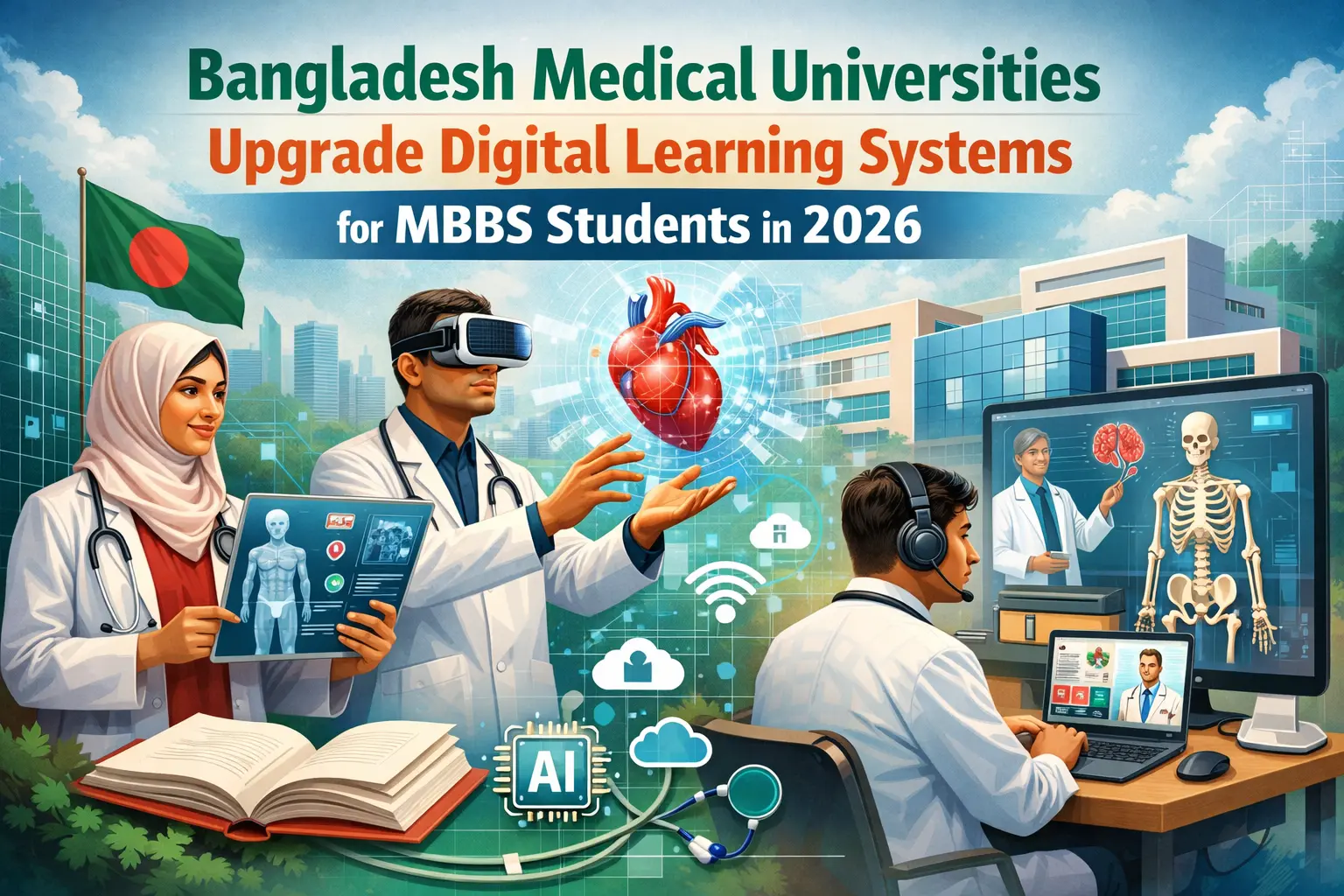
Digital Transformation in MBBS in Bangladesh (2026)
You are reliance on data till October 2023.
In 2026, the domain of MBBS in Bangladesh is unbelievably different now and we are providing increasingly towards digital learning systems. No longer relying solely on traditional classroom teaching, medical universities are gradually adopting advanced technology, smart classrooms, virtual simulations, and AI-based learning tools to aid their students in better understanding the subject.
These advancements are in line with the international norms directed by NMC, WDOMS, WHO and ensuring global competitive medico training for students. Before zeroing in on a medical college abroad, NEET aspirants using NEET Rank Predictor will need to appreciate these digital changes.
The Importance of Digital Learning in MBBS
Medical education is undoubtedly a complex and adaptive system. The standard techniques of teaching no longer suffice.
Digital learning systems help students:
- Visualize complex medical concepts
- Access learning materials anytime
- Practice through simulations
- Improve retention and understanding
Medical education worldwide is now diligently turning to technology-based learning, and Bangladesh is also working according to that trend.
Introduction of Smart Classrooms
Smart classrooms are one of the biggest upgrades in Bangladesh medical universities.
These classrooms include:
- Interactive smart boards
- Digital projectors
- Audio-visual teaching tools
- Live demonstration systems
This infrastructure has added value to the learning, making lectures more interactive and engaging. Global trend and similar data indicates that smart classrooms enhance understanding through visualization and demonstrations in real-time.
This could give students pursuing MBBS in Bangladesh a better understanding of anatomy, physiology, and pathology.
Learning Management Systems (LMS)
In present, medical universities are using Learning Management Systems (LMS) for online academic management of activities.
LMS platforms allow students to:
- Access lecture notes and recordings
- Submit assignments online
- Track attendance and performance
- Take online assessments
Making this process more organized and readily available creates a centralized learning environment.
Virtual Labs and Simulation-Based Learning
An exciting upgrade is the application of virtual labs and simulation tools.
Students can now:
- Practice surgeries in virtual environments
- Learn anatomy using 3D models
- Simulate emergency medical situations
Advanced methods such as virtual reality (VR) and simulation modules are being globally used for teaching of medical students.
Such tools are especially beneficial in the early years, when students have little real patient exposure.
Digital Libraries and E-Resources
Teaching hospitals and medical universities in Bangladesh are involved with upgrading their libraries into digital hubs of knowledge.
Students now have access to:
- E-books and journals
- Online research databases
- Recorded lectures
- International medical resources
It also allows students to keep up with current medical research and practices around the world.
AI-Based Learning and Analytics
AI in Medical Education: The Coming of Age
AI systems help in:
- Personalized learning paths
- Performance tracking
- Identifying weak areas
- Suggesting study plans
A study in Bangladesh showcases the use of AI in healthcare and diagnostics, with emphasis on technology integration being such research topic.
This helps prepare students for the future of digital healthcare.
Integration with Hospital Digital Systems
It is not just in classrooms either: it also has to do with hospitals’ training.
Students get exposure to:
- Electronic Health Records (EHR)
- Digital patient management systems
- Telemedicine platforms
Bangladesh is also working on digital health care systems, improving data sharing and medical efficiency.
This, of course, ensures that students are trained in life-like digital medical situations.
Dynamic Teaching, Flexible Learning − An Era of Online Classes
Bangladesh universities are leaning towards hybrid learning models after the world of education received a wake-up call.
This includes:
- Online + offline classes
- Recorded lectures for revision
- Remote learning options during emergencies
In this context, hybrid learning is a systematic approach which takes care of learner engagement and at the same time ensures that education continues without any further disruption.
Gamified and Interactive Learning Methods
Some institutions are also experimenting with gamified learning techniques.
These include:
- Interactive quizzes
- Case-based simulations
- Game-based medical scenarios
There are many studies which claim that having a gamified system can lead to next-level engagement of students and learning outcomes.
It also makes teaching more fun and less stressful!
Faculty Training for Digital Teaching
It’s not just systems that need to be upgraded—faculty members do as well.
Medical universities are:
- Training teachers in digital tools
- Conducting workshops
- Encouraging tech-based teaching methods
Start conducting faculty development for effective delivery of education in digital format.
Alignment with NMC Guidelines
For Indian students studying abroad there are stringent requirements put forth by the NMC (National Medical Commission).
These standards are met in the best way possible with digital upgrades:
- Proper academic tracking
- Transparent assessment systems
- Structured learning processes
👉 But, NMC still needs physical clinical training, so there’s digital learning as an accompaniment—not a substitute.
WDOMS and WHO Standards
WDOMS Recognition
Medical universities in WDOMS need to ensure quality education, which includes having novel teaching systems.
WHO Guidelines
The WHO emphasizes:
- Technology integration
- Evidence-based learning
- Continuous skill development
Upgrades in digital learning in Bangladesh are consistent with such global expectations.
Benefits for Indian Students
Digital learning has myriad benefits for Indian students pursuing MBBS in Bangladesh:
- ✔ Better Concept Understanding — Templates make complicated topics easier
- ✔ Flexible Learning — Students can study anytime, anywhere
- ✔ Improved Exam Preparation — Self-assessment is aided with online tests and analytics
- ✔ Global Competitiveness — Students learn about international medical systems
Importance of NEET Rank Predictor in College Selection
A NEET Rank Predictor is often used by the student who plans to pursue MBBS abroad to:
- Estimate their admission chances
- Choose suitable countries
- Compare colleges
For a student with an average NEET score, Bangladesh is a more reachable destination due to sophisticated digital learning systems.
Challenges in Digital Transformation
Progress has been made, but there are still some challenges:
- ❗ Infrastructure Gaps — Not all colleges have equal access to cutting-edge technology
- ❗ Internet Connectivity Issues — There are connectivity issues in some rural areas
- ❗ Learning Curve — It takes time for students and faculty to learn how to leverage digital tools
Digital Medical Education in Bangladesh: The Road Ahead
Data is large with the effective training of up to October 2023.
Expected developments include:
- AI-powered medical training
- Fully digital hospitals
- Advanced VR-based surgery training
- International collaborations
With the continual upgrades, MBBS in Bangladesh is on its way to being a global front-runner in tech-based medical education.
Conclusion
Dhaka city may simply see dominance in MBBS in Bangladesh due to the major transformation of digital learning systems upgrading to 2026.
With the integration of:
- Smart classrooms
- Virtual labs
- AI-based learning
- Digital hospital systems
All medical universities are complying with global standards of NMC, WDOMS, and WHO.
So for those students who are planning their journey using NEET Rank Predictor, Bangladesh now provides:
👉 Affordable education
👉 Strong clinical exposure
👉 Modern digital learning
It's a combination that makes it one of the best MBBS abroad destinations in 2026.