
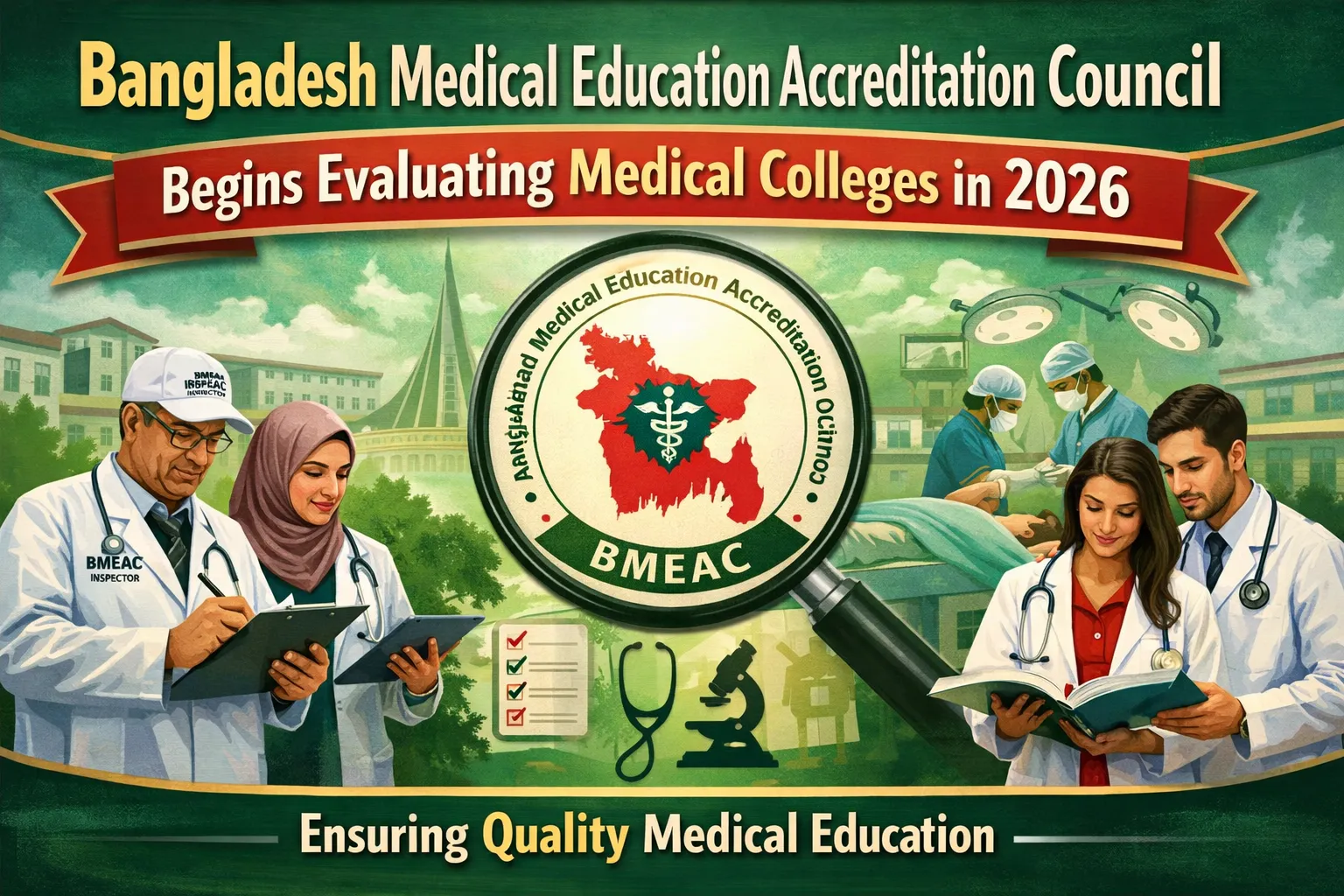
So, Bangladesh is moving towards the second wave of medical education reforms after the formation of Bangladesh Medical Education Accreditation Council (BMEAC) in 2023 with the salient role for this council to evaluate medical colleges in the country from 2026. This step is a part of the government’s larger move to improve the standards of medical education, accountability and align Bangladesh’s med schools with international ones.
This news is especially significant for those international students who want to study MBBS in Bangladesh. This evaluation process will have a direct impact on the quality of education, infrastructure, and clinical training that medical colleges will provide in the future.
By understanding how this accreditation system works, students can make better informed choices about studying abroad for medical education.
Why Bangladesh, a Bubble Economy, Introduced a National Accreditation Council
In the last 10 years, Bangladesh has seen an unprecedented increase in medical colleges. As the number of MBBS programs offered by more than 100 institutions continued to rise, so did the need for quality control and oversight.
In response, the government repealed the Medical and Dental Council Ordinance of 1980, enacting a new regulation entitled Bangladesh Medical Education Accreditation Act 2023 to create an entity called the Bangladesh Medical Education Accreditation Council. This council gives a single university body that assesses and recognizes all medical universities in India.
Historically, quality assurance has been largely based on internal reviews and voluntary assessments carried out by the institutions themselves. The new system replaces direct government involvement with a structured accreditation mechanism supported by the law to enhance transparency and educational standards.
Bangladesh Medical Education Accreditation Council (BMEAC)
The BMEAC is the National Body that oversees the academic standards of medical education.
Its responsibilities include:
- Assessing Medical Colleges on Defined Quality Credentials
- Inspections of teaching facilities and hospitals
- Accrediting institutions that meet required criteria
- Similar recommendations for improvement with institutions that fall short
The council functions on international standards of medical education such as those used by international organizations concerned with medical education quality assurance that guide accreditation frameworks.
The goal of this exercise is for every medical college in Bangladesh to be able to provide proper academic instruction and clinical training.
How the Evaluation Process Works
The Bangladesh Medical Education Accreditation Council has a comprehensive process of accreditation that encompasses multiple steps.
First, every medical college must submit a self-assessment report that outlines its infrastructure, teaching resources, faculty competence and clinical training facilities.
Expert reviewers then scrutinize these reports to decide if the institution complies with national accreditation standards.
Lastly, the teams inspect both the college and attached hospitals to confirm what has been reported. After these assessments, the council can either give accreditation as is, require improvements or suggest restrictions on students.
This multi-stage process is designed to ensure that accreditors do not base their decisions merely on documentation but also on actual inspections of the facilities.
New Medical College Evaluation Areas of Focus
The evaluation process centers on key elements of medical education.
Academic Curriculum
The medical colleges have to prove that their course complies with accepted norms of medical education and imparts adequate theoretical grounding.
Bangladesh already has this model embedded in therapeutic education but it had not been recognized since Bangladesh MBBS curriculum evolved like the Indian medical education system that was extended and up-scaled till the FRCS time.
Faculty Strength and Teaching Quality
The other large consideration for accreditation is the quality and quantity of teachers. It is important for medical colleges to ensure that there are adequate professors and lecturers to teach the students at any point in time.
Monitoring of the quality of teaching gives students the education that they all expect from a medical school.
Clinical Training and Hospital Facilities
One of the most important parts of medical education is clinical exposure.
Accreditation regulators assess whether a college has access to appropriately outfitted teaching hospitals and adequate patient flow. Students can gain real-world medical experience before graduation with strong clinical exposure.
Infrastructure and Student Resources
Medical colleges should also have proper infrastructure like laboratories, libraries, lecture halls and hostel facilities.
This becomes more rigorous as the institution scales up admissions which guarantees that there are sufficient resources available in a particular institution.
Effect on Students Pursuing MBBS in Bangladesh
Overall of the new evaluation system for international students in mbbs being conducted in bangladesh
Higher Education Quality
Stricter accreditation standards state that medical colleges maintain modern facilities, qualified faculty members and structured clinical training.
As a result, students are able to grow better academically and professionally.
Stronger Clinical Exposure
Because hospital facilities and patient flow are assessed as part of the accreditation process, students were more likely to receive better clinical exposure during their medical education.
But you need hands-on training to gain practical skills in medicine.
Greater Institutional Accountability
The new system makes medical colleges more accountable to uphold educational standards.
Institutions that do not meet the criteria risk supplementary visits to ensure improvements, and in some cases can lead to new facility upgrades or a decrease in students recruited.
Improved Global Recognition
Such accreditation increases the international credibility of medical colleges that qualify.
Note many of the institutions in Bangladesh are already listed in the World Directory of Medical Schools (WDOMS) and recognised by global health authorities like World Health Organization.
Indian students must also ensure that the Medical School is recognised by the National Medical Commission (NMC), which provides licensure to practice medicine in India.
MBBS Seats And Their Possible Changes
The period of accreditation evaluation might have had an impact in adjusting the number of students intake in certain med schools.
In case the college lacks required infrastructure and clinical training, then, the accreditation council can ask to decrease MBBS seats too.
Though this may temporarily reduce seating capacity, it is in the interest of good instruction and clinical education for students.
In the end, the reform doesn't aim for quantity; it aims at the quality of medical education to be better than make more people enter medical school ever.
Bangladesh: The Place To Be For Medical Education
Although stricter accreditation standards have been enacted, Bangladesh remains a favored destination for many international medical students.
There are few reasons for this popularity:
- Similar curriculum as per Indian MBBS system
- English-medium medical education
- Relatively cheaper fees than private medical colleges in India
- Headstrong clinical exposure with all the government affiliated hospitals
These advantages are among the reasons thousands of students opt for MBBS in Bangladesh every year.
What to Check Before You Apply
Certain factors must be thoroughly scrutinized to find the proper medical colleges in Bangladesh for admission.
They should ensure that:
- The medical college is recognised by the concerned authorities
- The school is registered with the World Directory of Medical Schools
- Well, the college has affiliated hospitals where proper clinical training is provided
- The program is recognized by the National Medical Commission as per eligibility criteria
By doing so, students can sidestep complications that may arise when applying for medical licensure or pursued postgraduate education.
The Future of Medical Education in Bangladesh
Medical colleges in Bangladesh evaluated: A landmark event in upholding medical education standards
Through an organized accreditation system, Bangladesh hopes to provide quality assurance to enhance clinical training in international forums where medical institutions take pride.
In Bangladesh, these enhancements are good news for MBBS abroad students; ensuring that the country will continue to provide well-educated health professionals in types of conduct and trained doctors.
With the accreditation process continuing in 2026 and after, Bangladesh’s medical educational system is to add up to be additional competitive and famous globally.