
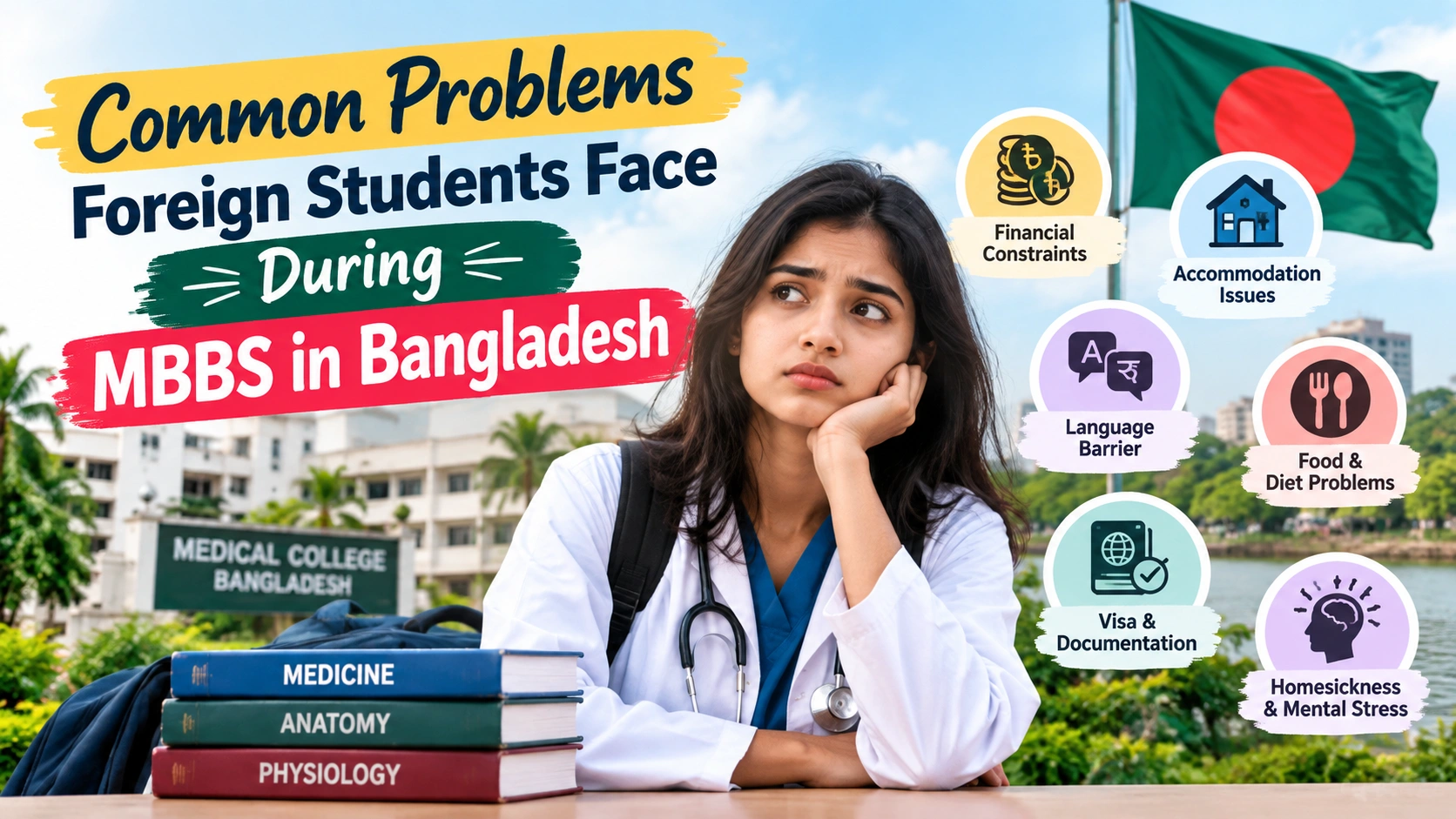
Choosing MBBS in Bangladesh can look fairly straightforward from the outside. The country is close to India, many colleges have English-medium medical education, and the academic system is familiar in several ways. But ask students who have actually spent months there and you’ll hear a different side too. Adjusting to a new city, managing hostel life, understanding local procedures, keeping up with medical classes and dealing with paperwork can get tiring. None of these problems means Bangladesh is a bad destination. It simply means students need to know what they’re signing up for before paying a large admission amount.
1. Adjusting to a New Academic System
The first few months can feel confusing. A student may be academically prepared for MBBS but still struggle with differences in teaching style, internal assessments, attendance rules, practical classes and examination procedures. Bangladesh follows its own medical education and university administration systems, so students shouldn’t assume everything will work exactly like their school or coaching experience in India. The basic MBBS journey is generally around five years of academic study followed by internship requirements, but the exact academic calendar and institutional arrangements can vary. Give yourself some time. It usually takes a while to understand how a particular college actually operates.
2. Language Can Become an Issue Outside the Classroom
Most foreign students choose English-medium programmes, so classroom teaching itself may not be the biggest language problem. The difficulty often starts outside the lecture hall. Patients, hospital attendants, shopkeepers, transport workers or local staff may communicate primarily in Bangla, especially during clinical exposure. A student doesn't need to become fluent overnight, but learning common Bangla words and basic medical communication can make hospital rotations much easier. Honestly, this is one of those small things that can save a lot of frustration later.
3. Clinical Communication With Patients
Medical college isn't only about textbooks and lectures. Clinical exposure matters, and foreign students eventually have to interact with real patients. A student who understands the theory perfectly can still feel awkward during the first few patient interactions because of language, communication habits and differences in clinical settings. This becomes especially noticeable during history-taking and routine patient interviews. Students should ask their clinical teachers how foreign students are included in ward work rather than assuming that every college provides the same level of hands-on exposure.
4. Hostel and Food Adjustment
Hostel life sounds simple until you actually live there for months. Room sharing, food preferences, laundry, internet connectivity, study hours and hostel rules can become daily concerns. Indian students may find some Bangladeshi food familiar, while other dishes and preparation styles can take time to get used to. Vegetarian students should check food arrangements before admission rather than relying on verbal promises. Accommodation costs also vary significantly by college and room type, so students should ask for the current hostel fee, mess charges and refundable deposits in writing.
5. Managing the Total Cost, Not Just Tuition Fees
A common mistake is to look only at the advertised tuition package. The actual budget can include admission charges, tuition, hostel, food, examination fees, registration charges, books, travel, visa-related expenses and personal spending. Recent Bangladesh foreign-student admission information also indicates that non-government medical colleges may provide their tuition-fee details directly, so students should verify the current figure with the specific institution.
|
Expense |
Approximate planning range |
|
Tuition and academic charges |
Varies widely by college |
|
Hostel |
Often several hundred USD per year |
|
Food and daily expenses |
Depends heavily on lifestyle |
|
Books and supplies |
Approximately $100–$300+ yearly |
|
Travel to India |
Depends on city and frequency |
|
Miscellaneous expenses |
Keep a separate emergency budget |
These are planning figures, not official fee quotations. For MBBS in Bangladesh, always request the latest fee structure directly from the college before making a payment.
6. Choosing the Wrong Medical College
This is probably the problem that deserves the most attention before admission. Bangladesh has government and private medical colleges, and foreign-student seat availability differs between institutions. The official DGME student portal, for example, lists foreign and local seat information for individual private medical colleges. Don't select a college only because an agent says it is “famous” or “cheap.” Check the college's current status, university affiliation, hospital facilities, foreign-student seats, internship arrangements and recognition requirements. You can also use the MBBS in Bangladesh resource to compare the admission-related information you need before shortlisting colleges.
7. Recognition and Indian Registration Requirements
This is where students need to slow down. The National Medical Commission doesn't simply provide a permanent “approved foreign medical college list” for students to pick from. Its own guidance tells Indian students to verify the institution, course details, fee structure, duration and internship arrangements directly with the university. Students should check the relevant institution through the NMC requirements and also verify its listing and institutional information through the World Directory of Medical Schools. WDOMS presence by itself should not be treated as a blanket guarantee of Indian registration; the complete NMC requirements still matter.
8. NEET Is Still Relevant for Indian Students
For Indian citizens and OCI candidates planning to study medicine abroad, NEET qualification is a major requirement. NMC guidance states that Indian citizens/OCIs intending to obtain a primary medical qualification outside India must qualify NEET, subject to the applicable eligibility requirements. Students should check the current examination rules directly through the NEET official portal rather than relying on an old consultancy brochure. Rules can change, and admission decisions involve too much money to depend on outdated WhatsApp information.
9. FMGE/NExT and Returning to India
Studying medicine abroad doesn't end with receiving a degree. An Indian graduate who wants to practise in India has to satisfy the applicable NMC requirements for foreign medical graduates. The NMC currently lists the Foreign Medical Graduate Licentiate Regulations, 2021, along with later FAQs and related regulatory material. The Commission has also highlighted requirements relating to course duration, medium of instruction, curriculum, clinical training and internship. The exact licensing pathway should therefore be checked against the regulations applicable to the student's admission year. Don't rely on a statement like “the college is NMC approved, so everything is guaranteed.” That's too simplistic.
10. Admission Paperwork Can Be Surprisingly Tedious
Foreign admission involves documents. Lots of them. Academic certificates, passports, photographs, medical documents, translated or attested papers, admission forms, payment records and other supporting documents may be required depending on the route and institution. Bangladesh's DGME foreign-student admission process has included online applications, document attestation and original-document verification requirements. Keep scanned copies of everything. Keep payment receipts too. And don't send original certificates to an unknown intermediary without understanding exactly why they're needed.
11. Homesickness and Mental Pressure
This part rarely appears in admission advertisements. A medical student may be far from family for the first time while simultaneously dealing with anatomy, physiology, pathology, practical classes and examinations. Add hostel life and a new country to that mix. Some students settle quickly. Others need several months. Staying connected with family, maintaining a realistic study routine and having a few reliable friends can make the transition easier. If a college has an established Indian or international student community, that can also help new students settle in.
Pros and Cons Foreign Students Should Know
|
Potential Advantages |
Possible Challenges |
|
Geographical proximity to India |
Adjustment to a different environment |
|
English-medium medical programmes |
Local-language communication during clinical work |
|
Familiar South Asian cultural setting |
Food and hostel adjustment |
|
Multiple government and private options |
College selection requires careful verification |
|
Relatively accessible travel for many Indian students |
Travel costs still add to the budget |
|
Established medical education system |
Documentation and administrative procedures |
There isn't one universal experience. A student's college, city, budget, expectations and ability to adjust all make a difference.
How Can Students Reduce These Problems?
A little preparation before admission can prevent many headaches later. First, verify the college independently. Second, ask for the complete fee structure instead of looking at tuition alone. Third, confirm the course duration, internship and clinical training arrangements. Fourth, check the current NMC requirements for foreign medical graduates. Fifth, speak to current students if possible — not just students introduced by the admission agent. Also, keep a backup financial plan. An unexpected trip home, medical expense, document issue or hostel change shouldn't turn into a crisis.
FAQs About Problems During MBBS in Bangladesh
Is MBBS in Bangladesh difficult for Indian students?
The medical curriculum itself can be demanding, just as MBBS is demanding anywhere. The additional challenges are usually adjustment, language during clinical interactions, hostel life and understanding local academic procedures.
Do Indian students need NEET for MBBS in Bangladesh?
Yes. Indian citizens and OCI candidates seeking primary medical education abroad are required to qualify NEET under the applicable NMC rules.
Is the language a major problem?
Usually, English is used for academic instruction in programmes aimed at international students, but Bangla can be useful during hospital and everyday interactions. Learning basic local communication can help considerably.
Is Bangladesh MBBS valid in India?
Validity for practising medicine in India isn't determined simply by studying in Bangladesh. Graduates must meet the applicable NMC requirements for foreign medical graduates, including requirements concerning the course, clinical training, internship and licensing pathway.
How much money should students keep for living expenses?
There isn't one fixed figure because accommodation, food, city, transport and personal spending vary. A student should prepare a separate living-expense budget rather than assuming that the tuition package covers everything.
What should I check before taking admission?
Check the college's current status, university affiliation, foreign-student seat availability, total fee structure, course duration, medium of instruction, clinical training, internship arrangements and the NMC requirements applicable to your admission year. These checks matter more than a promotional ranking or a low advertised fee.
Conclusion
The problems foreign students face during MBBS in Bangladesh are usually manageable, but they become much harder when students discover them after admission. Academic adjustment, hostel life, language, clinical communication, paperwork and financial planning are all part of the experience. The smarter approach is simple: research the college first, verify the regulations, understand the complete cost and keep your expectations realistic. Bangladesh can offer a practical medical education route for international students, but the college you choose and the checks you make before paying can have a major impact on your experience. For students researching MBBS in Bangladesh, taking that extra time before admission is well worth it.