
Planning MBBS in Bangladesh can look fairly simple at first. You find a medical college, check the fees, submit an application and wait for the admission decision. But there’s one part students often underestimate: documents. A missing marksheet, unclear passport scan, incorrect name spelling, or an improperly attested certificate can create unnecessary delays. And honestly, this is one area where spending a little extra time before applying can save you a lot of stress later.
For Indian students, the document process also has another layer because eligibility for studying medicine abroad and the requirements for returning to practise in India need to be considered separately. The National Medical Commission (NMC) currently lists its Foreign Medical Graduate Licentiate Regulations and related 2026 FAQs, so students should check the latest rules rather than relying on an old admission checklist.
What Documents Are Required for MBBS Admission in Bangladesh?
The exact list can vary by college, admission route and academic session, so don't treat any online checklist as permanent. For the 2025–26 foreign-student admission process, Bangladesh's Directorate General of Medical Education (DGME) required applicants to submit documents including a recent passport-size photograph, passport and academic certificates and marksheets for secondary and higher-secondary or equivalent examinations.
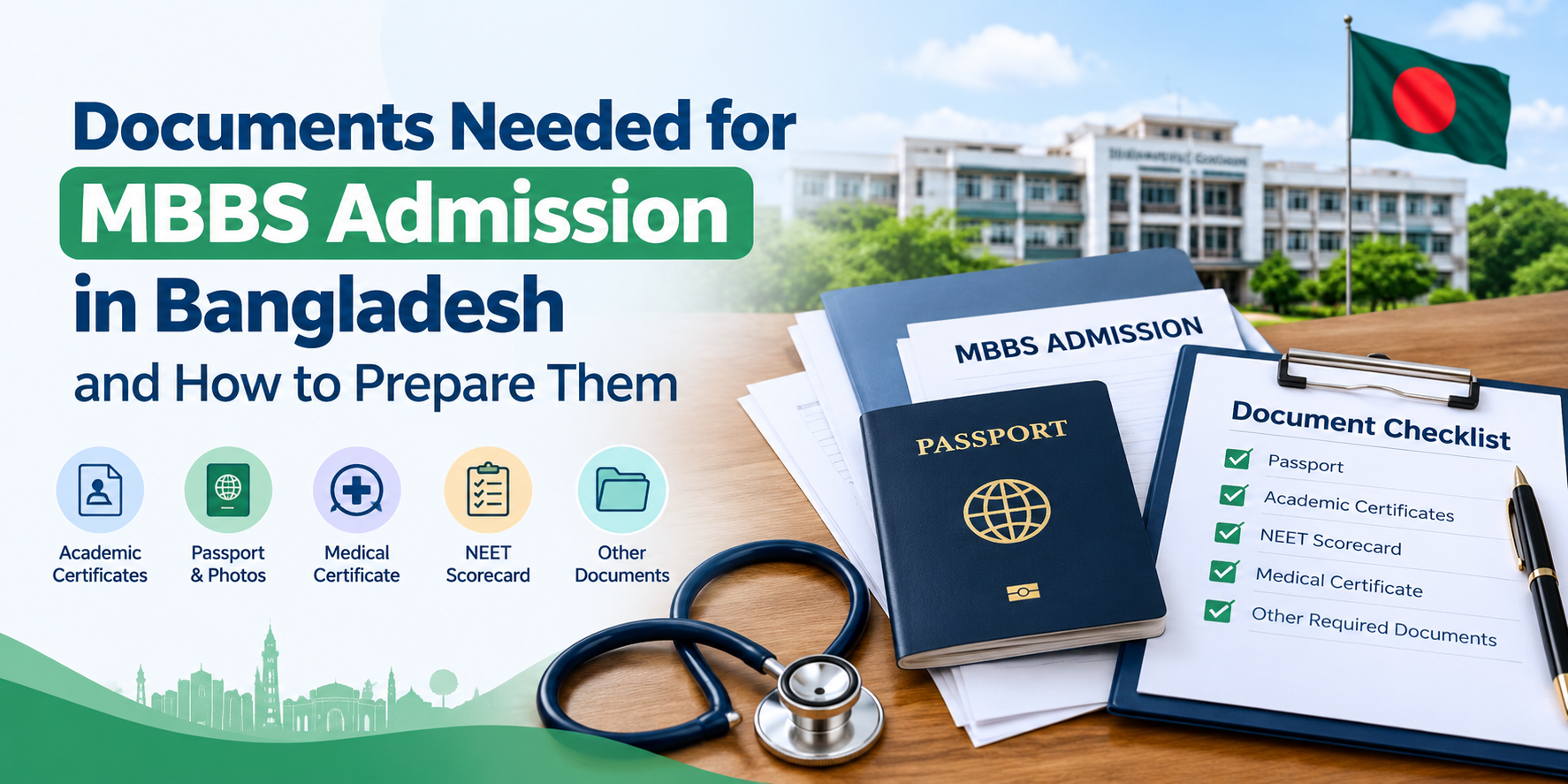
For an Indian student, keep these documents ready:
- Valid passport
- Recent passport-size photographs
- Class 10 certificate and marksheet
- Class 12 certificate and marksheet
- Physics, Chemistry and Biology academic records
- NEET scorecard and related proof, where applicable
- School leaving or transfer certificate, if requested
- Migration certificate, if required
- Birth certificate or age proof, if requested
- Medical fitness certificate, if required
- Admission/application form
- Proof of application or processing payment
- Documents required for equivalence or verification
- Attested/verified academic documents where specified
Keep both physical and digital copies. One folder on your laptop. One on your phone. And one cloud backup. Sounds excessive? It isn't.
Passport: The First Document to Get Right
Your passport is more than an identity document during the admission process. It can also be needed for university records, visa processing and travel arrangements. Check the spelling carefully. Your name should match your academic records as far as possible. Pay attention to your date of birth, father's or mother's name where applicable, passport number and expiry date.
If you don't have a passport yet, start the process early instead of waiting until you've received an admission offer. If your passport is already available, scan the information page in good quality and keep the original safely stored. For MBBS in Bangladesh, international students may need to upload the passport during online application. The 2025–26 DGME foreign-student circular specifically required a passport copy along with academic records and a recent photograph.
Class 10 and Class 12 Documents
This is the core academic file. For Indian applicants, your Class 10 and Class 12 documents usually establish your academic background and subject eligibility. Keep the original certificates and marksheets, plus clear scanned copies in PDF or image format according to the application portal's instructions. Your Class 12 record deserves extra attention because Physics, Chemistry and Biology are particularly relevant for medical admission. Don't upload cropped screenshots from a phone if the portal asks for a proper document scan. Every corner should be visible.
A useful preparation method is simple: create separate files named something like:
- Class10_Marksheet.pdf
- Class10_Certificate.pdf
- Class12_Marksheet.pdf
- Class12_Certificate.pdf
Small things. Very useful later.
NEET Documents for Indian Students
For Indian students, NEET shouldn't be treated as a separate issue from your documentation. The official NEET website states that NEET (UG) is the common entrance examination for undergraduate medical education in India, and Indian students planning medical education abroad should also check the current rules applicable to foreign medical education.
Keep your NEET documents together:
- NEET scorecard
- NEET application-related details, if required
- NEET qualification proof
- Application number or candidate details
- Any other document specifically requested for the relevant admission cycle
Don't assume that an old NEET scorecard or a random screenshot will be accepted. Use the official document downloaded from the NTA portal whenever possible. And before choosing a college, check the latest NMC requirements that apply to foreign medical graduates. Rules can change. The NMC's current regulations page includes the Foreign Medical Graduate Licentiate Regulations 2021 and later related updates and FAQs.
Passport-Size Photographs
This sounds easy. Yet students still get stuck here. Medical admission portals commonly specify photograph requirements such as recent photographs, particular dimensions, file sizes or background conditions. Follow the current application instructions instead of using a photograph that was taken several years ago. Keep around 8–12 recent photographs available in digital form and printed form. You may need them for admission paperwork, visa-related applications, university records or other administrative requirements. Use a clean, recent photograph. No filters. No casual selfie crop.
Academic Attestation and Verification
This is where the process can become a little more serious. Some foreign-student admission procedures require academic certificates to be attested by the competent authorities. Bangladesh's previous foreign-student admission criteria, for example, specified attestation of certificates by the relevant education and foreign ministries of the respective countries. The exact procedure can change between admission cycles, so don't get every document attested months in advance based on an old blog post. First download the latest official admission circular. Then identify which documents require attestation, notarisation, verification or equivalence. That's the safer order.
Documents for Equivalence and Academic Verification
Foreign students may have to go through academic equivalence or marks conversion before final admission. This matters because education systems don't always use the same grading structure. An Indian Class 12 marksheet and another country's school-leaving certificate may not be presented in exactly the same format. DGME's foreign-student process includes marks equalisation, and published eligibility information has also indicated that document validation may be requested from the original institution when necessary. So, don't alter marksheets yourself. Don't convert grades using an online calculator and submit that as an official document. If an equivalence statement is required, follow the prescribed process.
Medical Fitness Certificate
Some institutions may ask international students for a medical fitness certificate or health-related documentation during admission or before joining. If requested, get it from a recognised medical practitioner or facility and follow the college's specified format, if one exists. Avoid getting a generic certificate simply because someone online said it is "usually accepted." The current university or admission authority's instructions should come first.
Financial and Payment Documents
Admission isn't only about academic papers. You may also need evidence of application fees, processing charges, tuition payment or other required transfers. For the 2025–26 foreign-student process for non-government medical colleges, DGME's circular required applicants to upload proof of a USD 100 transfer along with the online application. Keep every payment receipt. Save the bank transfer confirmation, transaction reference, SWIFT/TT information where applicable and university payment receipt. Take screenshots too, but keep the original downloadable receipt whenever possible. Later, when several payments have been made, you'll be glad you did.
How to Prepare Your Documents Before Applying
A simple document system can make the entire process much easier.
Step 1: Collect the Originals
Put your passport, Class 10 and Class 12 certificates, marksheets, NEET documents and other relevant papers together. Don't hand over original documents to an unknown person without understanding why they're required and getting a proper acknowledgement.
Step 2: Scan Everything Clearly
Use a proper scanner or a reliable scanning app. Make sure text isn't blurry and the edges of every page are visible. Save documents as PDF unless the application portal asks for JPG or another format.
Step 3: Check Every Detail
Compare your name, date of birth and other identifying information across documents. Suppose your passport says "Rahul Kumar Sharma" while one certificate says "Rahul K. Sharma." Don't ignore it. It may not cause a problem, but it can create questions during verification. Better to clarify early.
Step 4: Create a Backup Folder
Make folders such as:
- Passport
- Academic Documents
- NEET
- Photographs
- Medical Documents
- Payment Receipts
- Attestation & Verification
Keep one backup on cloud storage and another on a personal device.
Don't Choose a Medical College Only Because the Documents Look Easy
The paperwork is only one part of the decision. Before applying for MBBS in Bangladesh, check the medical college's current status, admission conditions, clinical training arrangements and whether the institution fits the requirements relevant to your future plans. The World Directory of Medical Schools (WDOMS) maintains listings of medical schools, and its current information includes Bangladeshi institutions. For example, its 2027 pathways listing includes several Bangladesh medical schools. But WDOMS listing alone shouldn't be treated as a complete guarantee that a graduate automatically meets every Indian regulatory requirement. For an Indian student, NMC rules remain particularly important. The WHO has also worked with Bangladesh on medical education quality, accreditation and health workforce development, including support for a national medical education strategy. So check multiple sources. Not just one.
What About Fees and Course Duration?
Students often search for document requirements while simultaneously trying to understand the overall cost. The MBBS course itself generally involves several years of academic and clinical training, but the exact structure, internship arrangements and fee schedule can vary by institution. Private medical colleges can have significantly different tuition and other charges, so quoting one universal "Bangladesh MBBS fee" figure can be misleading.
The better approach is to ask the university for the current fee structure covering tuition, hostel, food, registration, examination charges and other compulsory payments. For MBBS in Bangladesh, also keep money aside for passport-related expenses, visa or travel costs, document attestation, translations if needed, insurance and everyday living expenses. The advertised tuition isn't always the final amount you'll spend.
Common Document Mistakes Students Should Avoid
A few mistakes appear again and again.
- Uploading blurry marksheets
- Using an expired passport
- Submitting an old photograph
- Name mismatch across certificates
- Missing the back side of a document
- Forgetting NEET-related proof
- Not keeping original documents safe
- Paying without saving the receipt
- Following an outdated admission checklist
- Assuming every medical college follows exactly the same process
- Waiting until the last few days to arrange attestation or verification
That last one is particularly risky. Official foreign-student admission timelines can be strict. For the 2025–26 non-government admission cycle, DGME set an online application deadline of January 15, 2026.
Frequently Asked Questions
Do Indian students need NEET for MBBS in Bangladesh?
Indian students should check the current NMC and NEET requirements applicable to foreign medical education before applying. NEET is the common undergraduate medical entrance examination in India, and the current NMC framework for foreign medical graduates should also be reviewed.
Is a passport compulsory for admission?
For the 2025–26 Bangladesh foreign-student application process, applicants were required to upload a passport copy. Requirements for future sessions should be checked against the latest DGME circular.
Do I need to attest my Class 10 and Class 12 certificates?
It can be required depending on the admission procedure and academic session. Previous Bangladesh foreign-student criteria specifically required attestation by competent authorities, so applicants should check the latest circular before preparing the final document set.
Should I submit original certificates during the online application?
Usually, online applications involve scanned copies, while originals may be required later for verification or final admission. The 2025–26 process required online uploads and specified academic documentation; always follow the current official instructions.
Can I apply if my documents have different name spellings?
Don't ignore the mismatch. First check whether the university or relevant authority requires an affidavit, correction, explanation or another form of verification.
Where should I verify the latest admission requirements?
Start with the Bangladesh Directorate General of Medical Education (DGME), the university itself, NMC for Indian regulatory requirements, NTA for NEET information, and WDOMS for medical-school listing information. Don't depend entirely on an old consultancy checklist.
Conclusion
Before pressing the final Submit button, take five minutes. Check your passport. Check Class 10. Check Class 12. Check NEET. Check photographs. Check attestation requirements. Check payment proof. Then open every uploaded file once. If everything is readable and the information matches, you're in a much better position to avoid preventable document problems. For students researching MBBS in Bangladesh, preparation isn't just about finding a medical college and comparing tuition. Your documents are part of the admission process from the very beginning. Start early, use the latest official circular, keep backups and verify the college and regulatory requirements before making payments. For university information and guidance related to MBBS in Bangladesh, students can also review the resources available at MBBS in Bangladesh, while checking official requirements directly with DGME, NMC, NTA and other relevant authorities before submitting an application.