
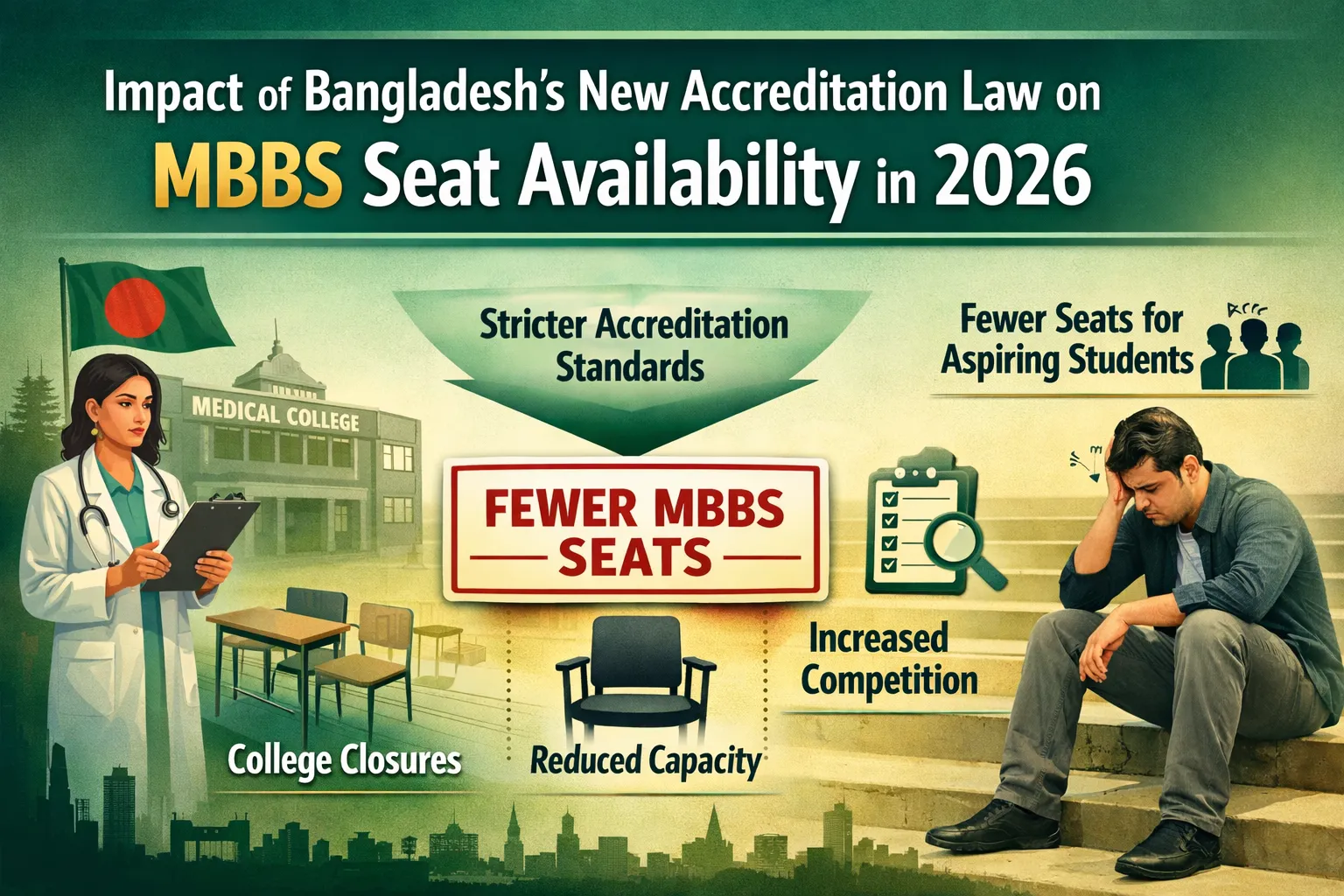
In 2026, Bangladesh's medical education academy is undergoing a radical overhaul with the enactment of its new accreditation law. This reform is not only aimed at raising the quality of medical education but has a tangible and noticeable effect on MBBS seat availability throughout the country.
This is very significant for those students who have decided to do MBBS in Bangladesh. And the new system is not merely about adding or subtracting seats — it is about being sure that every seat you offer meets appropriate standards for academic and clinical training.
What Is New Accreditation Law?
Medical Colleges were introduced in Bangladesh under the Medical Education Accreditation Act to create a system for their evaluation. Under the law one can only gain admission if they meet strict requirements on infrastructure, qualified teaching faculty & Hospital facilities and also clinical exposure.
It also established an independent accreditation body that reviews medical colleges and ensures compliance with global norms.
The main objective is simple:
👉 Quantity is fine, but quality comes first.
Seat Availability Issues and Why They Are Happening
The new accreditation system will have one of the biggest direct impacts on the number of MBBS seats in Bangladesh.
Many medical colleges were also allowed to increase their intake capacity without fulfilling proper infrastructural and faculty requisites earlier. But under the new system, authorities are rigorously judging whether institutions can accommodate the number of students they admit.
As a result, seats are being realigned to actual capacity now.
For example, reports show that:
- In the 2025–26 academic session, about 572 MBBS seats were cut because of a shortage of infrastructure and faculty.
- To ensure quality standards, more than 800 additional seats in government and private medical colleges were slashed in some estimates.
- Officials stressed that colleges should not enroll more students than their facilities can accommodate
This illustrates that the accreditation law is having a direct impact on distribution of available seats.
Quality Over Quantity Approach
The primary shift the new law makes is from “more seats” to “better seats.”
Bangladesh is now on instead of racking up MBBS seats each year:
- Proper student-to-teacher ratio
- Adequate hospital patient exposure
- Sufficient laboratory and classroom facilities
- Qualified teaching faculty
It has also been stressed that high admission numbers without appropriate facilities could result in subpar medical education.
For those students opting for MBBS in Bangladesh, this translates to lesser number of seats in few colleges — but improved quality of education across the board.
Effects on the Government and Private Agricultural Colleges
The accreditation law is already having an impact on government and private medical colleges.
Government Colleges
The government institutions are among the most regulated and being subjected to strict inspections. Seat reductions have been implemented where infrastructure or faculty gaps had been identified.
Private Colleges
Private medical colleges are under close scrutiny as well. Accredited institutions that do not meet standards may:
- Reduce intake capacity
- Delay admissions
- Be required to upgrade facilities
It helps ensure that all colleges — both public and private — follow consistent standards of quality.
What This Means for International Students
The impact for international students, primarily from India, is mixed but largely positive.
Slightly Higher Competition
With some seats cut down, might the competition for admission increase a little bit?
Better Education Quality
Students can expect improved:
- Academic infrastructure
- Clinical exposure
- Faculty support
More Reliable Degrees
You are not used to data until October 2023.
Students looking for MBBS in Bangladesh now need to focus on getting enrolled with an accredited and recognized college instead of availability only.
Role of Global Recognition
Accreditation reforms are also tied to international entry.
The need for Global Establishment: Bangladesh medical colleges are keen to become listed in World Directory of Medical schools (WDOMS) which is essential for global acknowledgment.
The World Health Organization (WHO) of global health advocates has long championed the need for robust medical education systems that can produce competent healthcare professionals.
Similarly, Indian students where going abroad is concerned need to adhere to the National Medical Commission (NMC) guidelines.
Thanks to the new accreditation law, this is bringing Bangladesh nearer harmonisation with these global norms.
Are MBBS Seats Going to Increase Again in near Future?
Yes—but in a controlled way.
The current drop in seats is part of a short-term correction to address quality problems. In the long term:
- We are building new medical colleges
- Existing colleges are upgrading infrastructure
- Faculty recruitment is being improved
Once institutions satisfy accreditation, seat supply may slowly rise again — but now under quality control.
Mnemonics for 2026 MBBS entrance aspirants
So, here are a few things to keep in mind if you are planning to pursue MBBS in Bangladesh 2026.
- Available seats may be slightly more limited than in previous years.
- Admission competition could increase
- Education quality will increased significantly
- Why it’s more essential than ever to choose an accredited college
In the long run, students will benefit more when they don’t orient themselves solely around open seats in classes.
Conclusion
Bangladesh medical education system changes with the new accreditation law, 2026 It has caused a decrease in MBBS seats in some institutions, but the main objective is to provide high quality medical training services to every student.
Bangladesh is catalysing more quality rather than quantity by strict enforcement of quality standards on infrastructure, faculty and clinical exposure.
This is an encouraging development for prospective students of MBBS in Bangladesh. It guarantees the degree they obtain is credible, internationally recognized and comes with a powerful academic backing.
These reforms are projected to boost Bangladesh’s standing as a dependable and top quality hub for medical education in the long run.