
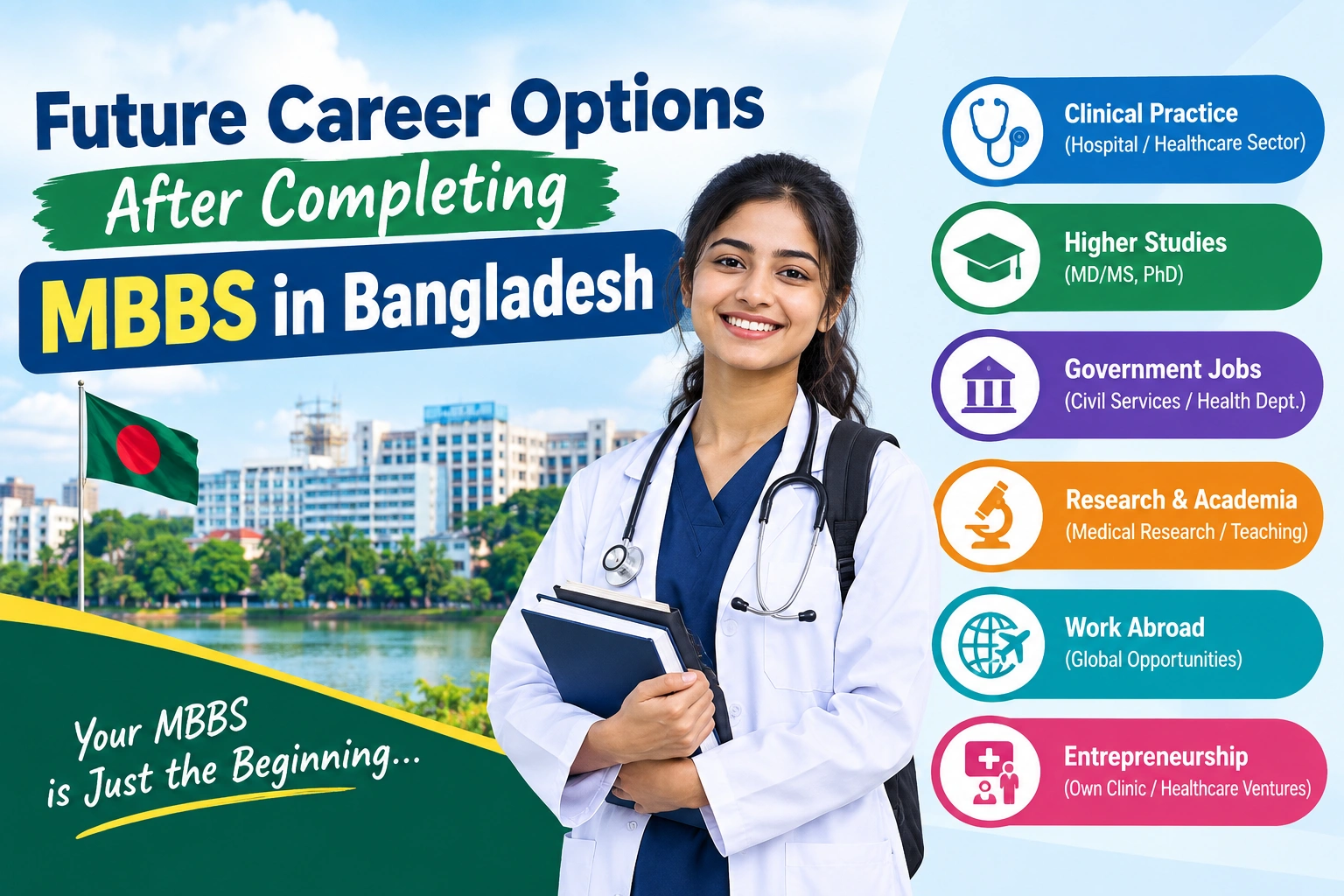
Finishing medical school is a big milestone. But for many Indian students, the real question starts after the MBBS degree: What next? If you have completed MBBS in Bangladesh, you aren't limited to just one career route. You can work toward medical practice, pursue postgraduate studies, enter research, consider healthcare management, or explore medical opportunities in other countries. The right path depends on your registration status, career goals, finances, exam preparation, and the country where you want to work. For students considering MBBS in Bangladesh, this career planning should actually begin before graduation. Your medical university, clinical exposure, internship structure, documentation and recognition status can all affect what you do later.
What Can You Do After MBBS in Bangladesh?
There isn't one standard career path for every graduate. Some students want to return to India, some want to continue their medical education abroad, while others prefer to build experience before choosing a specialty.
Common options include:
- Medical practice after meeting the relevant licensing requirements
- Postgraduate medical education
- Clinical research
- Public health
- Hospital administration
- Medical writing and healthcare communication
- Pharmaceutical and clinical-trial roles
- Teaching and academic work
- Medical careers in countries where the graduate meets local licensing requirements
That sounds like a lot. It is. But each option has different eligibility rules, examinations and registration requirements.
Returning to India After MBBS in Bangladesh
For Indian students, returning to India is one of the most common career plans after MBBS in Bangladesh. However, holding a foreign medical degree doesn't automatically give a graduate permission to practise medicine in India. The National Medical Commission has specific regulations for foreign medical graduates, including the Foreign Medical Graduate Licentiate Regulations, 2021. NMC also continues to advise Indian students choosing foreign medical institutions to check compliance with the applicable requirements before joining a course.
The licensing pathway can involve requirements relating to the foreign medical qualification, registration in the country of study, internship or clinical training, and the applicable Indian licensing examination framework. NMC's current regulations and notices should be checked before making career decisions because requirements can change. So, don't rely only on what an admission agent says. Check the current NMC rules yourself. A few minutes of verification can save a lot of trouble later.
NEET Requirement for Indian Students
NEET isn't something students should think about only before admission. For Indian students planning medical education abroad, NEET eligibility is an important part of the admission process. The National Testing Agency currently conducts NEET-UG as the common entrance examination for undergraduate medical education in India, and the applicable rules for Indian students seeking medical education abroad should be checked in the relevant year.
For example, don't assume that an old NEET rule or an old YouTube video still applies to your admission year. The 2026 NEET information is already available through the official NTA portal, so students should refer to the latest bulletin rather than relying on outdated articles.
Postgraduate Medical Studies After MBBS
For many graduates, specialization is the natural next step.
You could consider areas such as:
- Internal Medicine
- General Surgery
- Paediatrics
- Obstetrics and Gynaecology
- Dermatology
- Radiology
- Psychiatry
- Anaesthesiology
- Orthopaedics
- Pathology
- Community Medicine
The exact postgraduate route depends on the country where you want to study or practise.
An Indian graduate returning after MBBS in Bangladesh may need to complete the applicable Indian licensing requirements before pursuing certain clinical pathways. A student planning to continue abroad may instead have to sit for that country's medical licensing or postgraduate entrance examination. Honestly, this is where career planning becomes much more personal. Someone interested in surgery may have a completely different five-year plan from someone interested in public health or research.
Can You Work as a Doctor in Bangladesh?
Yes, medical graduates may pursue medical practice in Bangladesh, but professional registration and local regulatory requirements apply. Students should confirm their eligibility with the relevant Bangladeshi medical authorities and understand the registration requirements connected with their particular degree and internship. The same principle applies everywhere: having an MBBS degree and having a licence to practise are not necessarily the same thing. This distinction gets overlooked quite often.
Medical Research as a Career Option
Not every MBBS graduate wants to spend their entire career inside a hospital. Research is another route. Graduates can look at clinical research, epidemiology, medical education, public-health research, pharmaceutical research and other healthcare-related areas. Some positions may require additional qualifications, while others can be accessible through research experience, internships or postgraduate study. A graduate who develops skills in statistics, research methodology, scientific writing and data analysis can create opportunities beyond routine clinical work. This can be particularly useful if you enjoy asking why a disease behaves a certain way rather than only treating the patient in front of you.
Public Health and Healthcare Management
Public health is another field worth considering after MBBS in Bangladesh. Instead of working directly with individual patients every day, public-health professionals may work on vaccination programmes, disease prevention, epidemiology, health policy, community programmes and population-level healthcare initiatives. An MPH or related postgraduate qualification can be useful for this route. Healthcare management is another possibility. Hospitals, diagnostic companies, healthcare organisations and health-tech businesses need professionals who understand both medicine and healthcare operations. An MBBS followed by an MBA in healthcare or hospital administration can therefore create a different career direction.
Medical Writing and Healthcare Communication
This option doesn't get enough attention. Doctors and medical graduates can also work in medical writing, scientific communication, health content, medical education and related fields. Depending on the position, employers may look for strong writing skills along with medical knowledge. You might work on patient education material, medical articles, clinical documentation, educational resources or pharmaceutical communication. It isn't the traditional doctor route. But it's a genuine career option, especially for graduates who enjoy writing, research and communication.
Pharmaceutical and Clinical Trial Careers
The pharmaceutical sector offers another area for MBBS graduates. Possible roles can include medical affairs, clinical research, pharmacovigilance, clinical-trial coordination and drug-safety related work. The exact job title and eligibility will vary by employer and country. Additional training can help here. For example, knowledge of Good Clinical Practice, research methods and regulatory procedures may make a candidate more suitable for certain positions. For someone who doesn't want a conventional hospital career, this can be worth exploring.
Teaching and Academic Careers
Do you enjoy explaining difficult medical topics to other students? Teaching could become a long-term option. Graduates can build academic careers through postgraduate qualifications and relevant teaching or research experience. Medical colleges, universities, training institutes and educational organisations may offer different opportunities depending on their requirements. A career in academics usually develops gradually. First comes subject knowledge, then postgraduate training, research, publications or teaching experience, depending on the institution.
Check Your University's Recognition and Listing
Before planning your career after MBBS in Bangladesh, check the status of your medical school carefully. The World Directory of Medical Schools provides information on medical schools worldwide, but it specifically states that being listed in WDOMS by itself does not mean that a school is recognised, accredited or endorsed. That distinction matters. You should separately verify the medical school's status with the relevant national regulator and check the current requirements of the country where you eventually want to practise. The directory can be a useful starting point for checking a school, but it shouldn't be treated as the only recognition check.
What About WHO Recognition?
The World Health Organization is a major international health organisation, but students should be careful with the phrase "WHO recognised university." Medical-school recognition and professional licensing are handled through national and regional regulatory systems. WHO resources can provide useful information about health systems and medical education, but a student shouldn't assume that appearing in a general international database automatically means they can practise medicine in a particular country. For MBBS in Bangladesh, always connect the university's status with the licensing rules of your intended practice country.
How Long Does It Take to Build a Medical Career?
MBBS itself is only the beginning. Depending on the university and applicable Bangladeshi medical education structure, students generally spend several years completing academic and clinical training, followed by internship requirements. The exact structure should be confirmed with the university and relevant regulator before admission. After graduation, the timeline changes according to your chosen path. A doctor preparing for postgraduate entrance may spend another year or more preparing. Someone entering research may start working much sooner. Another graduate may need additional licensing examinations before practising in India or another country. There isn't one timeline. That's actually good news.
Career Planning Before You Graduate
Your final year shouldn't be the first time you think about your next step. If you're studying MBBS in Bangladesh, start checking licensing and postgraduate requirements well before graduation. Keep your academic records, internship documents, passport information and other certificates organised. Also maintain copies of important university and clinical-training documents. For students planning to return to India, regularly check NMC updates rather than depending on information shared by friends who graduated several years earlier. Regulations can change. NMC currently maintains dedicated information on foreign medical graduate regulations and related updates, including its 2021 FMGL regulations and later FAQs.
Pros and Challenges of Building a Career After MBBS in Bangladesh
There are several possible advantages. Bangladesh is geographically close to India, Indian students may find cultural similarities helpful, and the medical degree can provide a foundation for different healthcare careers. At the same time, foreign medical graduates have to pay close attention to licensing requirements, documentation, university status, internship arrangements and future examination rules. The biggest mistake is choosing a medical college only because admission looks easy or the fee appears affordable. Think five years ahead. A university that fits your future licensing plans is much more useful than one that simply looks attractive during admission season.
FAQs About Career Options After MBBS in Bangladesh
Can I practise in India after completing MBBS in Bangladesh?
You may pursue medical registration in India, but you must satisfy the applicable NMC requirements for foreign medical graduates and complete the required licensing pathway. Check the latest NMC regulations before graduation because the rules and implementation framework can change.
Is NEET required for Indian students studying medicine in Bangladesh?
Indian students should check the NEET requirements applicable to their admission year. NTA publishes the official NEET-UG information and eligibility requirements, so the latest bulletin should be used instead of older third-party information.
Can I do postgraduate studies after MBBS in Bangladesh?
Yes. Graduates can pursue postgraduate medical education in Bangladesh, India or other countries, subject to the eligibility and licensing requirements of the destination.
Can an MBBS graduate work in medical research?
Yes. Clinical research, public health research, epidemiology and pharmaceutical research are possible areas, although some roles require additional qualifications or research experience.
Is WDOMS listing enough for practising in India?
No. WDOMS itself says that listing does not represent recognition, accreditation or endorsement. Students should separately check the applicable national regulatory requirements and NMC rules.
Where can I learn more about MBBS in Bangladesh?
Students researching MBBS in Bangladesh can start with the information available on the programme website and then independently verify the university, admission conditions, fees, recognition and regulatory requirements before making a final decision.
Conclusion
An MBBS degree from Bangladesh doesn't have to lead to only one type of career. You could return to India, continue toward specialization, work in research, enter public health, move into healthcare management, explore pharmaceutical careers or build an academic profile. But your future options are strongly connected to the choices you make during medical school.
If you're considering MBBS in Bangladesh, don't look only at tuition fees or admission procedures. Check the university's current status, clinical training, internship structure, documentation and the licensing rules of the country where you eventually want to work. Start planning early. Keep your documents organised. Check official sources. And don't treat a five-year-old rule as if it's still valid today. That small habit can make a very big difference to your medical career.