
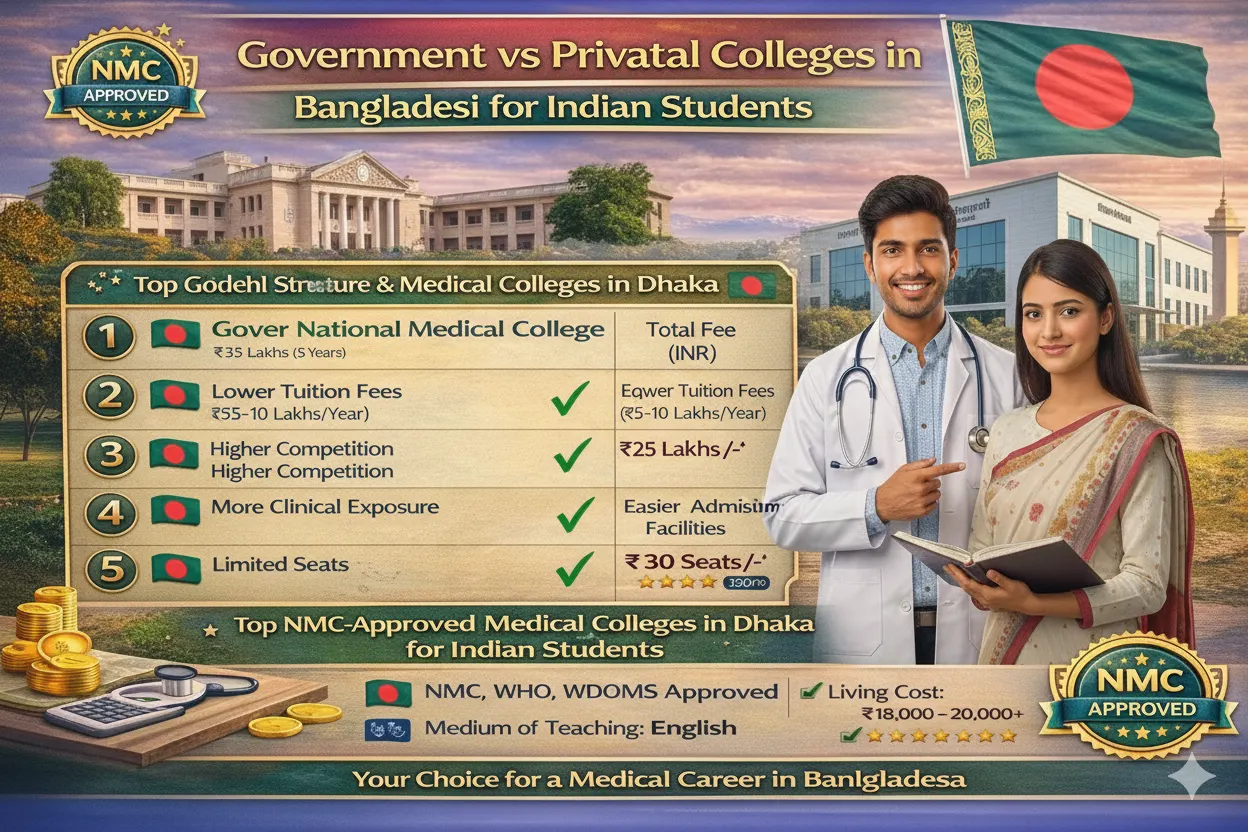
Selecting the right medical college abroad is a life-changing decision for Indian students who are preparing to make a career in medicine. A few of those who pass NEET explores for abroad options and discover that MBBS in Bangladesh provides high-quality education for an affordable cost. Government and private MBBS colleges are operating in Bangladesh, and both have their own set of benefits and considerations. In this post, we offer a comparison of the two cameras to determine which is more suited to your needs, budget and expectations.
NEET Requirement: Common Starting Point
Comparison of government and private MBBS Colleges in Bangladesh. It is important to note before comparing government and private MBBS colleges in Bangladesh that it has now become mandatory for Indian students to qualify for NEET if they want to join any foreign medical institution, including Bangladeshi medical colleges as well. As mandated by the NMC regulations, students have to pass the NEET exam to be able to practice medicine in India in future, whether they study MBBS in government or private colleges.
Recognition & Degree Validity
MBBS colleges in Bangladesh, both private and government, grant internationally acknowledged degrees. To ensure global validity:
- A number of schools are listed in the World Directory of Medical Schools (WDOMS).
- They adhere to the academic criteria in line with the WHO.
- After completion of the internship and on satisfaction of licensing requirements, a graduate would be able to take the NEXT Final for obtaining registration with NMC.
Whether you go for MBBS in Bangladesh from a government or private college, the accreditation system allows you to practice both in India and abroad.
Fee Structure: Government vs Private
Government MBBS Colleges
Low and reasonable tuition fees of MBBS in Government Colleges in Bangladesh is the most decisive aspect among Indian students who wish to study MBBS abroad.
Public funding also means that tuition is often state-regulated, which can make higher education costs more reasonable for students.
Though the students directly pay hostel, books and living costs, but for mbbs in Bangladesh fees structure are very less compared to medical study expenses at any private college of India.
Private MBBS Colleges
Tuition fees in private MBBS colleges tend to be significantly higher than those charged by their governmental counterparts, though often still lower than most Indian private medical colleges.
The range of fees can differ from college to college, and some institutions provide payment plans.
Even after increased rates, fees for MBBS in Bangladesh private colleges are still significantly affordable compared to the fees of medical schools in Europe or North America.
Bottom Line: If money is your biggest concern, then a government MBBS college in Bangladesh is the best budget option.
Admissions & Competition
Government Colleges
Seats in government MBBS colleges are, in general, very competitive, so even for foreign students.
Admission will be based on NEET score, cut off, merit list and number of available seats.
There may be a few seats available in the government colleges, hence the toughest competition among the students.
Private Colleges
Private MBBS colleges usually offer more seats to foreign students.
The admission criteria are still NEET-based and marks-based; however, the process is relatively easier and will not have as much competition as in some of the government colleges.
Private colleges in Bangladesh, such as those, also ensure faster acceptance, which is important to students who have made their plans early.
Academic Environment & Infrastructure
Government MBBS Colleges
Medical education in government organizations Iinstitutions of the Bangladesh Government, recognised educational iinstitutions inthe country have long traditions and well-established disciplines.
Most government colleges are affiliated with huge public hospitals, providing students with high patient exposure — a boon during clinical years.
Infrastructure might be modest in certain campuses, but the faculty are mostly competent.
Private MBBS Colleges
Most private colleges have state-of-the-art infrastructure, including laboratories, a library, a simulation centre and hostels.
There may be a stronger network of support for international students (e.g., mentoring, counselling, and student activities) in private institutions.
Oftentimes, classroom technology and student facilities are better kept up because of private funds.
Curricula for both tracks of MBBS education are rich in quality, but infrastructure and faculty availability can dictate the learning experience.
Clinical Exposure & Hospital Access
Clinical experience is one of the most important parts of medical education — and it differs from school to school:
- Government MBBS colleges are generally affiliated to large public hospital which have a wide variety of patients, offering the best exposure.
- Private colleges may have associated hospitals or contractual arrangements with hospitals for clinical training, some of which provide a more limited range of patients.
In terms of the government and private sector, the students studying MBBS in Bangladesh get ample clinical exposure in their later years; however, government colleges have more catchment centers for clinical exposure.
Student Life & Cultural Integration
For Indian students, living in a foreign country can cause little cultural shock:
- The way of life and food are relatively easy for most people to adjust to, so is drinking.
- There are lively Indian student communities in both state and private colleges, who organise cultural events and festivals.
- Levels of safety are high, and students make strong social networks across institutions.
In the government college hostel, as well as in the campus dorm at a private institution of higher education, accommodations are provided to provide comfortable study conditions.
Internship and Ways to Practice in India
After graduating from a medical school (MBBS), the graduate is eligible to work as a physician. The degree is valid in India if:
- The students qualified for NEET before admission
- Internship requirements are completed
- The next exam pass is the graduate of this Citizen
- They register with the NMC
This route is valid for both public and private MBBS colleges of Bangladesh, resulting in the medical degree being recognised for practice or further studies in India.
Conclusion — So, Which One is Best for You?
The decision between a government and a private MBBS college in Bangladesh is based on your preference:
Criteria
Government MBBS College | Private MBBS College
Fees
Lower | Moderate
Competition
Higher | Lower
Infrastructure
Basic to Good | Often Modern
Clinical Cases
Large Public Hospitals | Good, Hospital Attached
Seat Availability
Limited | More Seats
Student Support
Varies | Often Stronger
Bangladesh Government MBBS College: This is a great option for candidates who are looking for low fees, real-life clinical exposure and a traditional system of medical education. If one is looking for more established/recent facilities, relaxed admissions and other student services, then the preference in order for them would be private MBBS colleges.
Irrespective of the kind of instruction, doing MBBS in Bangladesh with an ideal NEET score provides you with a globally accepted level, a fantastic clinical program, along with PSUs from India offering one clearly outlined course to practice medication in India.