
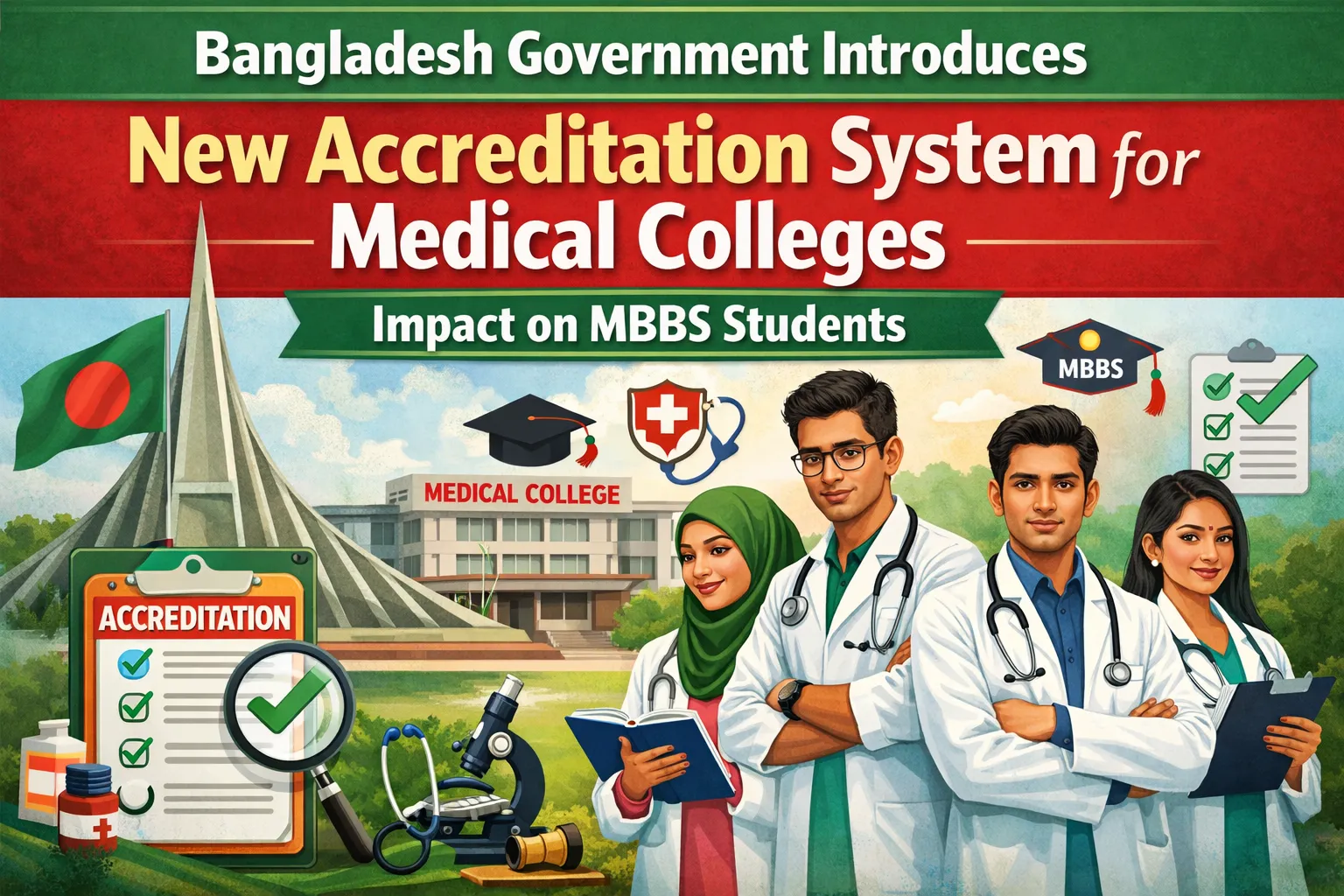
Bangladesh has embarked on a landmark journey for reinforcement of its medical education system through the implementation of a novel accreditation framework in medical colleges. This reform is designed to raise the quality of medical education and offer more clinical training for students, aligning the nation’s medical schools with international benchmarks.
This is particularly significant for thousands of foreign students that are currently pursuing MBBS in Bangladesh. The new accreditation system will prove critical in determining the evaluation process for medical colleges as well as how they are approved and monitored in upcoming years.
Knowledge of these changes will help students and parents make better decisions regarding studying medicine in Bangladesh.
Why Bangladesh Adopted a New Accreditation System
Number of medical colleges in Bangladesh has increased rapidly over the last 10 years. Currently, there are over 100 government and private medical colleges providing MBBS courses.
Though this growth created opportunities for learners, it also sparked concerns over whether levels of quality would be maintained across infrastructure, faculty, and clinical training. To tackle these problems, the Bangladesh government introduced the Bangladesh Medical Education Accreditation Act 2023, which established a centralized accreditation framework for medical colleges.
This reform aims to ensure that each and every medical college complies with specified academic and training standards before starting an MBBS course.
The top medical colleges in Bangladesh to study MBBS, are regularly assessed for quality.
Establishment of the Bangladesh Medical Education Accreditation Council
In the center of this new system is the Bangladesh Medical Education Accreditation Council (BMEAC), an authority for evaluating medical institutions.
The council was formed to provide a transparent and standardized accreditation process for medical education nationwide.
There are usually several steps in the accreditation process:
- Medical colleges are required to submit a detailed self-assessment report on their facilities, curriculum and faculty.
- The expert committees then review those documents to determine if the institution fulfills the requisite standards.
- Teams conduct on-site evaluation of the campus and associated hospitals.
- Schools that meet the requirements can earn accreditation for a set amount of time.
- Institutions that do not meet these standards may need to upgrade facilities or scale back on student enrollment.
How the New Accreditation System Operates
The new accreditation model has several main focus points for medical education.
Academic Curriculum Standards
Medical colleges must prove that their MBBS curriculum meets the standards of recognised medical education and provides adequate theoretical training.
A major goal is for students to develop a solid foundation in anatomy, physiology, pathology, pharmacology and clinical medicine [9].
Faculty and Teaching Quality
The new accreditation system requires schools to have a qualified teaching faculty, including the appropriate amount of experience in medical education.
Teachers need to regularly assess their techniques and performance for better classroom learning of MBBS students in Bangladesh.
Hospital Infrastructure and Clinical Training
Clinical training is an essential part of medical education. Accreditation authorities will check if medical colleges are attached with well-equipped teaching hospitals that have sufficient patient flow.
Students receive practical diagnostic and treatment experience; strong clinical exposure.
Institutional Accountability
Accountability is the second crucial pillar of the accreditation system.
Nobody has an inherent right to run a medical college. If any institution does not meet the prescribed conditions it would face reduction in student intake or also corrective measures.
It ensures that medical colleges do not take more students than their infrastructure can adequately support.
Conformity With International Standards for Medical Education
A major goal of the new accreditation system is to bring Bangladesh’s medical education in line with international standards.
And this accreditation framework will be in line with global guidelines from international medical education organizations.
Besides, when the medical degrees offered in Bangladesh are aligned this way with the PMDC Act, their credibility increases along with worldwide recognition of these degrees.
This is a good news for MBBS Students of Bangladesh as they will now receive better acceptance of their degree when applying for the licensing exams in other countries.
Recognition of Bangladesh Medical Degrees
Medical degrees are recognized nationally and internationally in Bangladesh, which has various accredited institutions.
Bangladesh Medical and Dental Council (BMDC) is the regulatory authority for medical education in the country, which controls the licensing of medical graduates.
A large number of medical colleges from Bangladesh are recognized by the World Directory of Medical Schools (WDOMS) and other international organizations such as World Health Organization.
It is also vital that the university fulfills the eligibility criteria laid down by the National Medical Commission, which governs foreign medical graduates wishing to practice in India.
Affect on Indian and Foreign Students
International students studying medicine in Bangladesh will benefit tremendously from the new accreditation system.
Improved Educational Quality
Tougher accreditation standards require medical colleges to have basic infrastructure, laboratories and teaching facilities.
That results in better academic training for students.
Better Clinical Exposure
We will have more stringent standards for evaluation of hospitals, thereby improving the clinical training that students receive during their MBBS stint.
This practical experience is vital to build hands-on medical skills.
Increased Global Credibility
Accreditation based on international standards enhances the global status of Bangladeshi medical institutions.
It allow graduates to take licensing exams and practice medicine in other countries.
Protection for International Students
The new system safeguards students from enrolling in subpar institutions as well.
Colleges that do not meet the criteria for accreditation could find themselves unable to enroll new students.
As a result, students facilitate experiencing the courses in good and well-organized institutions.
Possible Reduction in MBBS Seats
If colleges do not meet infrastructure or training standards, one effect of the accreditation reform could be that they will have to lower their MBBS seats.
While this can lead to fewer places in the short term, it keeps standards of education high.
For students, it translates into studying at institutions equipped to provide adequate medical training.
Based on the above conditions, why do International Student still Prefer Bangladesh to Pursue MBBS courses?
Bangladesh continues to be one of the most sought after medical education destinations in South Asia despite stringent accreditation standards.
Its popularity is interdependent upon several factors:
- Reasonably low fees as compared to private medical schools in India
- English-medium medical education
- Similar Curriculum of Indian MBBS System
- The large hospitals provide a rich clinical exposure in your medical studies.
For these reasons, MBBS in Bangladesh still remains a popular choice for Indian medical aspirants.
What Students Should Look Out For Before Applying
If a student is willing to go for MBBS in Bangladesh, he or she should check several vital points prior to submitting the application.
They should ensure that:
- Under the new system, the medical college is properly accredited
- The institution is listed in the World Directory of Medical Schools.
- The MBBS course has sufficient clinical training
- The college fulfills the eligibility criteria laid down by the National Medical Commission
For future licensing and job opportunities, picking the right institution is critical.
Conclusion
The new accreditation system of medical colleges is one of the most rigorous reforms in the history about Bangladesh medical education. The goal is to enhance educational quality, strengthen clinical training, and draw medical institutions closer to global standards through a centralized evaluation framework established by the government.
This reforms will benefits to the international students pursuing MBBS in Bangladesh such as quality education, worldwide recognition like clinical exposure etc.
With the accreditation framework improving, Bangladesh will have a more powerful role as an internationally recognised and reputable hub for medical education in this part of the world.