
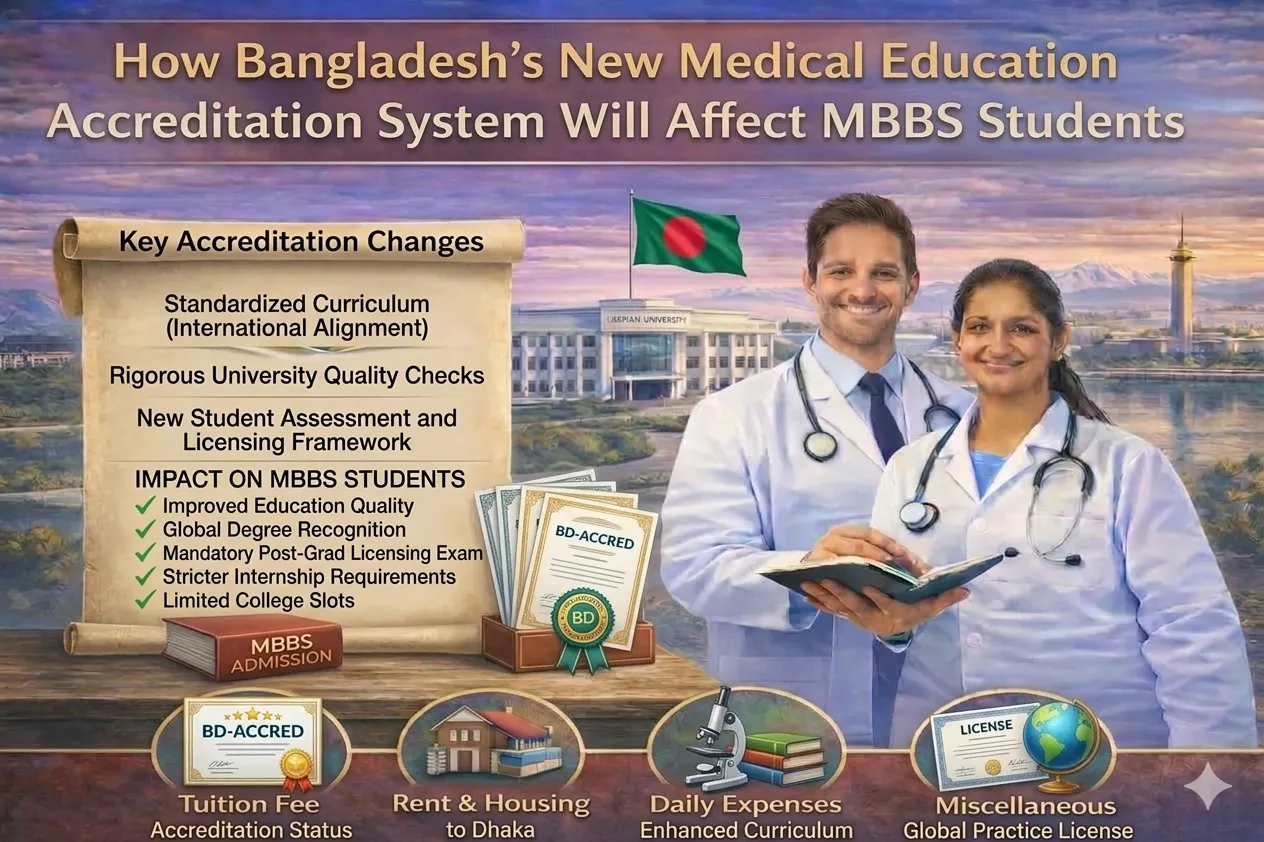
Medical education is a constantly evolving and dynamic process globally as the governments and regulatory authorities strive to enhance the quality of health-care professionals training. Bangladesh has taken a few bold steps recently to enhance its medical education system in the form of more structured accreditation and monitoring mechanism for its medical colleges.
The new accreditation system is expected to bring a significant enhancement in the quality of medical education across the country. These reforms can lead to several positive changes for students who plan to pursue MBBS in Bangladesh regarding their clinical exposure, academic environment and future career prospects.
Ensuring that graduates from Bangladeshi medical colleges are competent to thrive in healthcare systems globally, the reforms focus on upholding the standards of education.
Understanding the New Accreditation System
In medical education, accreditation is a process for the official recognition of an institution's programs that comply with well-defined quality standards for education (including teaching, infrastructure and clinical training).
This system was first introduced by Bangladesh to maintain a standard level of quality of education in every medical college across the country. As the number of medical colleges and international students rises, uniformity in standards sets a minimum.
Inspecting medical colleges, understanding the teaching facilities, evaluating faculty qualifications and hospital training programs are all parts of the accreditation framework.
The government has introduced a system through which it tries to make medical education in the country more transparent and accountable.
The Push to Improve the Quality of Medical Education in Bangladesh
Medical education in Bangladesh has grown rapidly over the past twenty years. With the increasing demand for doctors in the country and around the world, many new medical colleges have over time been established.
However, the pace of growth can sometimes lead to challenges around the consistent quality across institutions. To fix this problem, Bangladesh launched reforms to more closely monitor educational standards.
It will enable adherence to proper academic guidelines in all medical colleges, make sure qualified teachers are in place and adequate student facilities are provided.
Such measures protect the reputation of the country’s medical education system and enhance the training of future doctors.
Better Infrastructure and Learning Facilities
Infrastructure: One of the strengths of the accreditation system. Medical colleges are expected to have modern classrooms, laboratories, libraries and digital learning facilities.
Those institutions that fall short on such fronts may then be needing to have their infrastructure upgraded if they are hoping for accreditation.
For students, this translates to easier access to learning resources and more conducive academic environments.
Students can gain hands-on experience in scientific methods and medical practices, critical aspects of a medical education with the use of contemporary labs and medical equipment.
Stronger Clinical Training Opportunities
One key aspect of medical training is clinical exposure. Doctors need hands-on training with patients to learn how to diagnose and treat.
Medical colleges are closely monitored under this by accreditation of teaching hospitals attached to them.
Officials look into whether the hospitals have enough patient turnover, modern machines and enough supervision by experienced doctors.
These assessments ascertain substantial clinical exposure for students over the course of their MBBS.
Hence students passing from Bangladeshi medical colleges may be better equipped with practical skills and clinical experience.
International Acceptance of Medical Degrees
The second most significant impact of this accreditation system will be the enhancement of international acceptability of Bangladesh’s medical degrees.
To enable graduates to practice medicine in other countries, medical education must fulfill global criteria.
And to get recognition in WDOMS (World Directory of Medical Schools), an internationally accepted and verified database of medical colleges, already many medical colleges in Bangladesh are enlisted.
Accreditation provides the quality assurance these institutions require to fulfil their commitments at par with the international standards.
This recognition would be advantageous for students intending to enroll in postgraduate medical education or licensing examinations in other countries.
Benefits for Indian Medical Students
Most such students studying medicine in Bangladesh are from India. Meeting compliance standards is particularly critical for these students.
This means that medical graduates who studied abroad have to fulfill the expectations outlined by the National Medical Commission (NMC) if they wish to practice medicine in India.
Bangladeshi medical colleges are appropriately regulated with structured academic programs for the purpose of patient safety via regulatory fitness, and most importantly that meets the PHPs relevant expectations.
These encompass:
- Course duration
- Internship exposure
- Clinical postings
This will help graduates to follow licensing procedures and practice medicine in India.
Transparency in Medical Education
A further benefit of the accreditation framework is increased transparency.
It is very difficult for students and their families to find the quality of medical colleges when considering studying abroad.
Accreditation inspections are an objective way to measure medical colleges against criteria.
Institutions that meet the standards earn approval, and those that do not must correct deficiencies in their facilities or risk losing accreditation.
Such transparency enables students to make better-informed choices when choosing a medical university.
Alignment With Global Healthcare Standards
Healthcare systems are evolving at a fast pace due to technological innovations, recent researches and newly discovered diseases.
The field of medical education must evolve accordingly to prepare future doctors for the healthcare problems of the present.
To encourage such modern teaching practices as digital learning platforms, simulation-based training and research opportunities, Bangladesh has also established an accreditation system for its institutions.
Expert bodies on health like WHO extol the role of robust medical education systems in developing successful healthcare services.
For instance, institutions aligned to global health frameworks which are supported by WHO usually uphold quality training and professional competency of a graduate as mandatory.
Such a bolstering of the quality of its medical workforce, through alignment with global standards in education, will stand Bangladesh in good stead.
Impact on Future Medical Admissions
The accreditation system will play a role in how medical colleges deal with admissions in the future.
As most countries have strict regulations to maintain decent academic performance and infrastructure, it is common for international students to be attracted by such institutions.
Otherwise, they may only be able to get their hands into the accreditation system a limited amount of ways and will remain on something like probation or corrective action.
This process helps to ensure only those institutions with adequate resources and teaching can stay open fully.
For students, it means that the average quality of medical colleges in Bangladesh is expected to rise.
Long-Term Benefits for Students
The new accreditation system will benefit medical students in many ways:
- It makes sure institutions monitor academic standards consistently throughout the country
- Motivates medical colleges to upgrade their infrastructure and training facilities
- Enhances the global acceptance of Bangladeshi medical degrees
Complete medical education leading to a degree under robust accreditation makes it easier for students to pursue postgraduate training, take international licensing examinations, and practice real-world medicine.
Such benefits can go a long way in boosting the career graph of graduates.
Conclusion
The recent adoption of a new medical education accreditation system in Bangladesh marks an important milestone towards enhancing the quality and professionalism of medical education throughout the nation.
With more vigilance in the form of regular inspections, higher academic standards and better clinical training requirements, this system seeks to make sure that medical colleges adhere to a high standard of educational excellence.
These reforms give students pursuing MBBS in Bangladesh more confidence that they will receive an education at the national and international standards.
With the evolving and improving medical education mechanism, it is to be expected that Bangladesh will remain a popular destination for international students seeking medical degrees at affordable prices.