
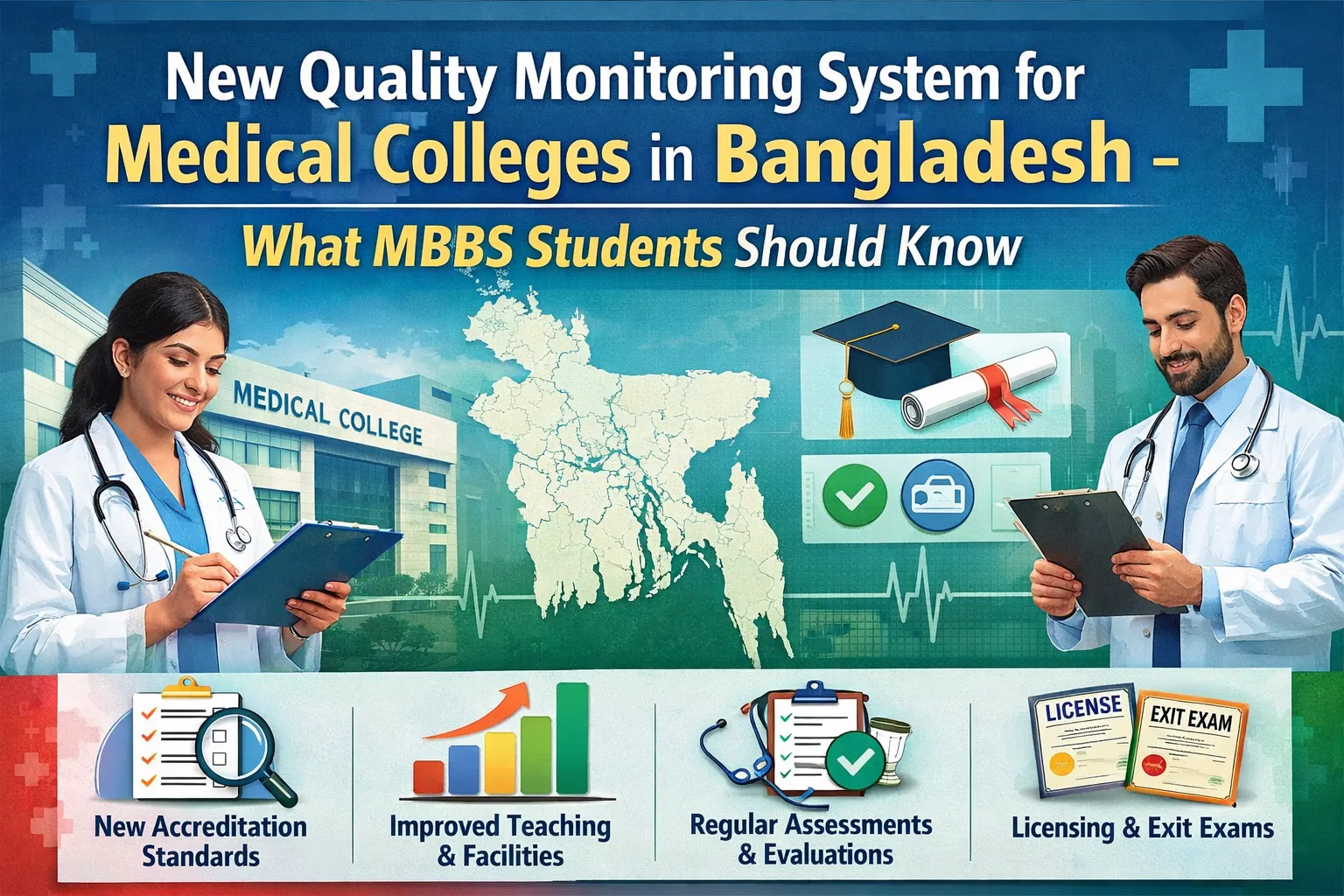
Medical education is one of the most important foundations of any healthcare system. As the demand for skilled medical professionals continues to rise worldwide, countries are focusing on improving the quality of their medical education systems. Bangladesh has also taken significant steps in recent years to strengthen oversight and improve standards across medical colleges.
These developments are particularly important for international students planning to pursue MBBS in Bangladesh. A stronger quality monitoring framework is being implemented to ensure that medical colleges meet academic standards and provide adequate clinical training to produce competent doctors.
These reforms are part of a broader initiative aimed at aligning Bangladesh’s medical education system with international standards and improving the global recognition of its medical degrees.
Why Quality Monitoring is Important in Medical Education
The strength of any healthcare system depends largely on the quality of its medical education. If medical colleges fail to maintain high academic standards, it can directly affect the competence of future doctors and ultimately the quality of healthcare services.
To prevent such issues, governments and regulatory authorities regularly evaluate the performance of medical colleges. These evaluations ensure that institutions maintain:
- Proper infrastructure
- Qualified faculty members
- Modern laboratories
- Adequate clinical exposure for students
With the increasing number of medical colleges and international students in Bangladesh, strict academic monitoring has become even more essential.
The new monitoring framework aims to ensure that every medical institution follows established academic standards and provides the necessary training for students to become capable medical professionals.
Strengthening Medical Education Governance
Bangladesh’s medical education system operates under the supervision of national health and education authorities that regulate curriculum, admission processes, and the functioning of medical colleges.
The new monitoring system focuses on improving transparency and accountability within medical education institutions.
Authorities will regularly assess the performance of medical colleges to identify areas that require improvement. Institutions will be required to maintain proper academic documentation, ensure qualified teaching staff, and provide adequate clinical training opportunities for students.
A standardized academic monitoring approach also helps ensure that students receive a consistent quality of education regardless of the medical college they attend.
Regular Institutional Evaluations
Under the new quality monitoring system, medical colleges will undergo regular institutional evaluations to maintain their standards.
These evaluations assess multiple aspects of a medical institution, including:
- Academic curriculum
- Faculty qualifications
- Student–teacher ratio
- Laboratory facilities
- Hospital training infrastructure
Teaching hospitals associated with medical colleges are also evaluated to ensure that students receive proper clinical exposure during their education.
Such evaluations help identify areas where institutions can improve their academic and clinical training systems.
Regular reviews also help authorities verify that medical colleges consistently meet the standards required for professional medical education.
Improving Clinical Training Standards
Clinical training is one of the most critical components of medical education. Without sufficient hospital exposure, students cannot develop the practical skills needed to diagnose and treat patients.
The new monitoring system places a strong emphasis on improving clinical training facilities and internship programs.
Medical colleges are expected to maintain well-equipped teaching hospitals where students can gain real patient experience.
These hospitals allow students to receive training in departments such as:
- Medicine
- Surgery
- Pediatrics
- Obstetrics and gynecology
Authorities also aim to ensure that students spend sufficient time in clinical environments so that they graduate with strong practical experience.
Quality of Medical Degrees and Global Recognition
Another key objective of the monitoring system is to WHO strengthen the international credibility of Bangladesh’s medical education.
Many medical universities in Bangladesh are listed in the World Directory of Medical Schools, an international database of recognized medical institutions.
Being listed in this directory allows graduates to pursue further education or medical licensing examinations in different countries.
Maintaining compliance with global academic standards is particularly important because a large number of international students enroll in Bangladeshi medical colleges every year.
A strong quality monitoring system helps protect the international reputation of the country’s medical education.
Impact on Indian Medical Students
A large proportion of international students studying medicine in Bangladesh come from India. For these students, regulatory compliance is extremely important.
Foreign medical graduates who wish to practice medicine in India must follow guidelines issued by the National Medical Commission.
The new monitoring system helps ensure that Bangladeshi medical colleges align their academic programs with these requirements. This includes maintaining appropriate course duration, clinical training hours, and internship programs.
Compliance with these standards helps ensure that graduates remain eligible for medical licensing examinations and professional registration in India.
Improving Infrastructure and Learning Facilities
Improving infrastructure is another major focus of the new monitoring system.
Medical colleges are encouraged to upgrade their:
- Classrooms
- Laboratories
- Libraries
- Digital learning platforms
Modern medical education requires access to advanced equipment, updated research resources, and current clinical information.
Many institutions are also developing simulation laboratories where students can practice clinical procedures before working with real patients.
These improvements help create a more modern and effective learning environment for medical students.
Benefits for International Students
The implementation of stronger quality monitoring systems offers several advantages for international students studying in Bangladesh.
Key benefits include:
- Greater transparency in medical education standards
- Improved clinical training opportunities
- Enhanced infrastructure and academic facilities
- Better international recognition of medical degrees
These advantages make Bangladesh an increasingly attractive destination for students who want to pursue MBBS abroad without compromising on educational quality.
Alignment with Global Healthcare Standards
Healthcare systems worldwide are evolving rapidly due to technological advancements and new medical research.
Medical education systems must adapt to these changes to prepare students for modern medical practice.
The new monitoring reforms aim to align Bangladesh’s medical education with global healthcare standards by emphasizing:
- Competency-based medical education
- Strong clinical exposure
- Modern educational infrastructure
These initiatives also encourage collaboration between medical colleges, healthcare institutions, and international academic organizations.
As a result, Bangladesh is gradually strengthening its position in global medical education.
Future Outlook of Medical Education in Bangladesh
The establishment of a structured quality monitoring system represents an important milestone for Bangladesh’s medical education sector.
The primary objective is to ensure that medical colleges maintain high academic standards while producing competent and responsible doctors.
These reforms are expected to:
- Improve institutional accountability
- Strengthen clinical training programs
- Enhance global recognition of medical degrees
As demand for medical education continues to grow in South Asia, these improvements may also attract more international students to Bangladesh.
Conclusion
Quality monitoring plays a crucial role in maintaining the credibility and effectiveness of medical education.
Bangladesh’s new evaluation system for medical colleges demonstrates the country’s commitment to strengthening healthcare education and preparing medical graduates for professional practice.
Through regular institutional assessments, improved clinical training standards, and upgraded infrastructure, Bangladesh is building a more transparent and reliable medical education system.
For students planning to pursue MBBS in Bangladesh, these reforms provide reassurance that their education will meet recognized academic standards.
As Bangladesh continues to improve its medical education framework, the country is increasingly becoming one of the most affordable and reliable destinations for international students aspiring to build a career in medicine.