
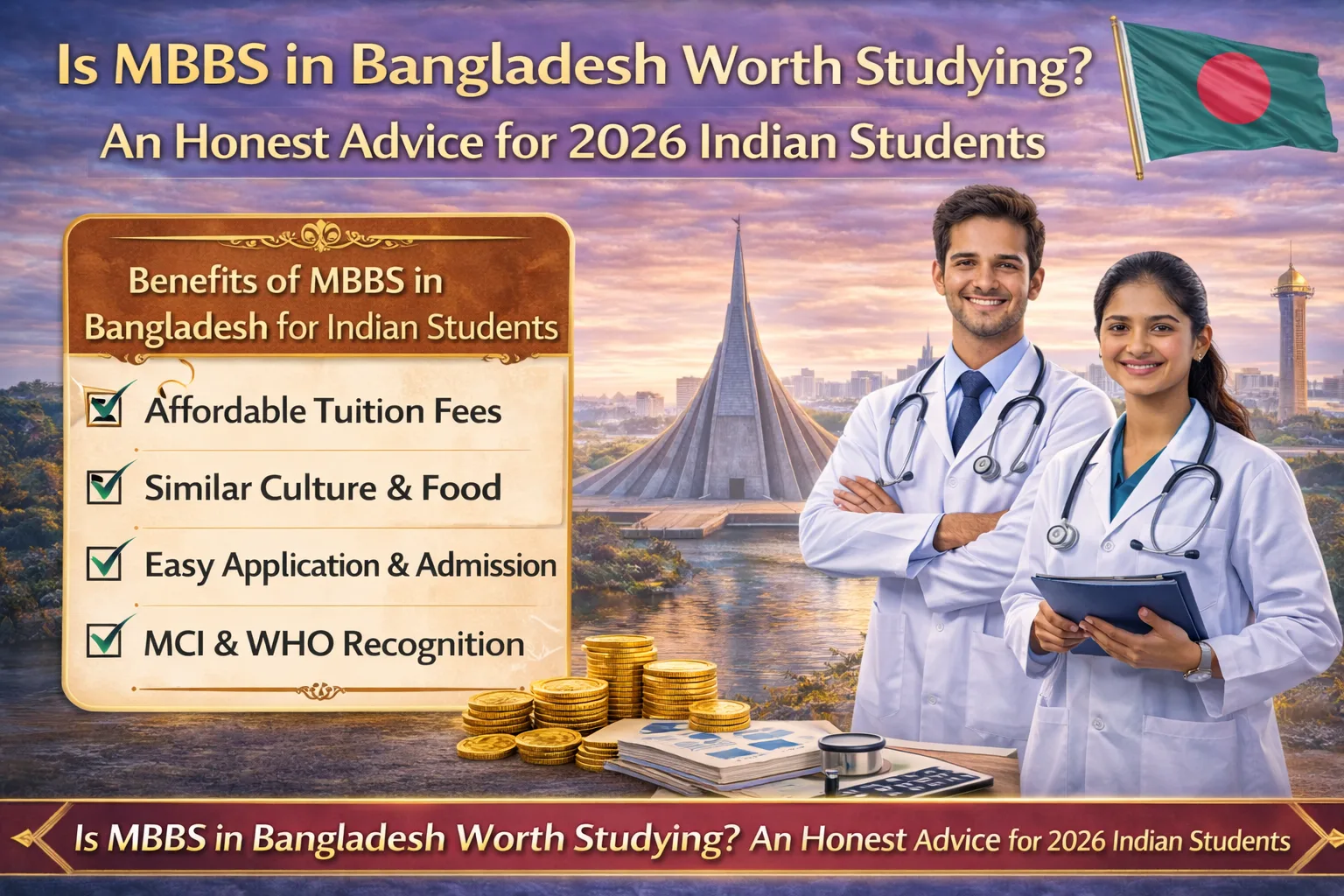
If your parents are asking you to consider MBBS in Bangladesh seriously, then yes, it is half of the most practical low-risk options available on the plate and NEET will get tougher for Indian students in 2026.
While NMC recognized colleges are present in the World Directory of Medical Schools (WDOMS) and WHO, such quality English medium training can be pursued between ₹35-48 lakhs for all 5 years— which is a fraction of what it would cost to enroll in any Indian private college with a justified FMGE success rate of 40-50% higher than MBBS from Kazakhstan.
Similarly, over 12,000 Indian students flourish in the country each year for obvious reasons: short-haul flights from Lucknow that land in familiar territory, a studied syllabus to ensure matching between courses here and there, hands-on hospital rotation at numerous teaching hospitals within walking distance of college and dependable pathways back into practice in India.
Bangladesh promises stability amid NEET PG percentile pandemonium. Here’s dispassionate guidance to resolve the family argument.
Why Bangladesh Makes Financial Sense
The largest benefit is price — a full six-year program (five years academics + internship) varies between ₹35 lakhs in colleges of worth to ₹48 lakhs at elites like Enam or Holy Family.
Break it down to ₹7-8 lakhs yearly tuition and ₹10,000 per month cost of AC hostels with dedicated Indian messes giving dal, roti, paneer and biryani.
It offers collateral-free loans up to ₹50 lakhs and convenient repayment once you begin earning. No capitation fees—Seats purely NEET merit based, even 150+ negotiates best seats through DGHS counseling.
Sounds great for Indian parents; 60-70% cheaper than privates charging ₹80 lakhs to ₹1 crore, often with weaker clinical training.
Academic Quality Matches India Standards
Classes use the same textbooks: Harrison’s Internal Medicine, Guyton Physiology, in English and India’s common diseases from TB to diabetes to dengue.
The pivital edge comes with attached 500–1,000 bed public hospitals offering start 5,000 + clinical hours from Year 1 building skill sets where many Indian affiliated private medi colleges fail.
FMGE results speak for themselves: Pass rates of graduates from Bangladesh is 44.8% while the average pass percentage globally where candidates studied abroad is just 23%.
Leading institutes such as Green Life Medical College and Bangladesh Medical College offer specialized crash courses, boasting a success rate of over 70% among good NEET scorers.
On clearance, you’d be eligible for NEET PG in same standing as AIIMS students.
Life There Feels Like Home
Forget about culture shock — it all melds with Indian life in Bangladesh. Dhaka hums with malls and restaurants; Sylhet has serene hills.
Holi and Diwali celebrations, cricket matches and Bollywood nights help sustain spirits.
Safety is paramount with 24/7 CCTV monitored campuses, biometric entry for hostels, strict curfews and parent update portals.
Blocks for girls provide additional layers of security, making it perfect for families.
IndiGo flights mean two-hour journeys home from Lucknow.
Food remains authentic and affordable at ₹4-5,000 per month.
Minor obstacles, such as Dhaka traffic or the power shutdowns (generators handle) don’t derail studies.
Clear Roadmap to Indian Practice
Your path post-graduation looks predictable:
- Complete six years in Bangladesh
- FMGE or NExT
- Do one-year internship in India
- Register with State Medical Council
- Join practice(₹1 lakh+ per month) or do PG
Now in 80% of the cases they return to jobs in government, Apollo/Fortis or get themselves settled abroad through USMLE/PLAB.
Cloud computing, which Yorke teaches and his summer research interest, will definitely become even more important in clinical practice as it arrives.
Weighing the Realistic Drawbacks
FMGE Requires Hard Work And Is More Favorable Than Anywhere Else.
Once in a while political headlines capture, but never disrupt classes — Indian students still holding rotations till date.
Annual fee hikes five percent, homesickness is a short chapter when you run into fellow Indians everywhere.
These fade versus Indian private heart aches: Huge debt, few patients, agency quality. Bangladesh are better prepared, on a smaller scale.
Direct Comparison to India Options
In the lottery of NEET, government seats require a score of 720+. Private means crore (10 million) scale expenses and less on-ground wise knowledge.
Zero-percentile allotments pose danger for NEET PG amid court challenges.
For one-third the price, Bangladesh drags into its time-tested doctor pipelines modest NEET qualifiers.
Framework for Your Decision
Decide between Bangladesh if you are a NEET qualified candidate but have realistic ranks, family budget below ₹50 lakhs, value of clinical strength and emphasis on FMGE.
Hesitate only if you are chasing some elite government seats or have unlimited funds for top-end Indian privates.
What Real Students Say
“In NEET, no less than290 should be scored for a premium college,” Rahul from Lucknow at Enam Medical College. Cleared FMGE in first attempt, currently Orthopedics resident in Apollo—₹60 lakhs saved.
FAQs
Q: How tough is FMGE really?
A: Difficult but 45% pass rate still much better than any of abroad options — also structured prep makes a difference.
Q: Safety concerns for girls?
A: Great responses — Holy Family and Tairunnessa top the list of secure dedicated blocks and communities.
Q: What is the full timeline of going to practice as a doctor?
A: Seven years overall — six in Bangladesh and one internship in India.
Q: NMC risks down the line?
A: Very little — 52 colleges are given approvals for a decade, with routine checks.
Q: Postgraduate dreams possible?
A: Well, NEET PG access after FMGE is equal to domestic graduates.
Q: Monthly expenses realistic?
A: ₹12,000 will cover everything — cheaper than many Indian cities.
Q: Skip agents altogether?
Answer: Direct DGHS works really well — merit based, no commissions.
Conclusion: Parents Have It Right
Your parents are right—MBBS in Bangladesh can turn even mediocre NEET scores into successful medical careers without crores at stake.
Financially unbeatable, clinically strong, recognition-safe — it’s where 12,000 Indians a year turn dreams into stethoscopes.
March DGHS opens soon.
Welcome to the smart border hop: The white coat future of your dreams is two hours away, debt-free and doctor-ready.