
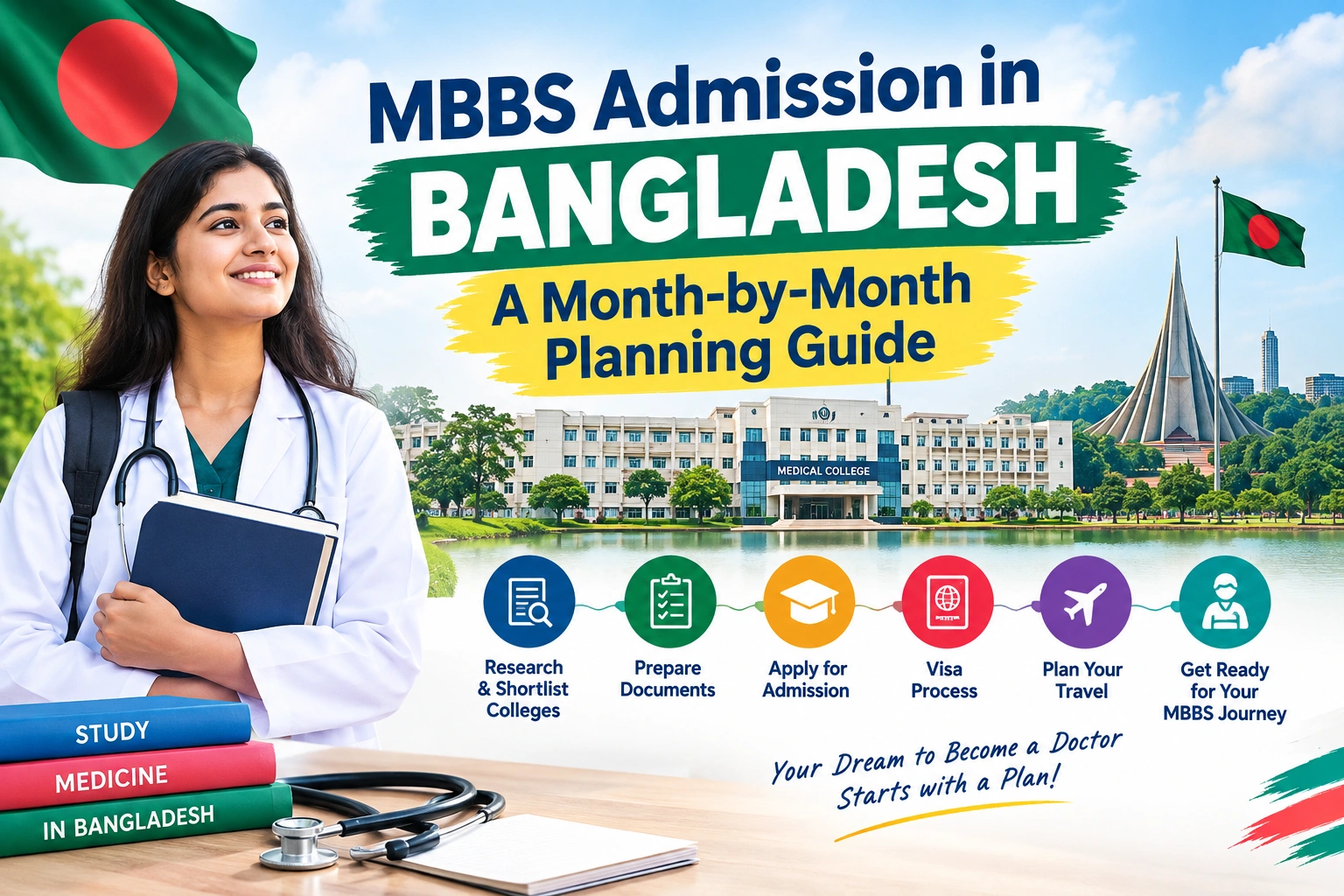
For many Indian students, MBBS in Bangladesh looks attractive for a simple reason: the country is geographically close, the medical education system is familiar in many ways, and several Bangladeshi medical colleges admit international students. But getting admission isn't something you should leave until the last minute. The paperwork, eligibility checks, university selection, financial planning and visa process can easily stretch across several months.
And honestly, this is where many students make mistakes. They start looking at colleges only after their NEET result, then discover that documents need attestation, seats are limited, or a particular college doesn't fit their long-term plans.
A better approach? Plan the admission year month by month. The exact dates can change from one admission cycle to another. For example, Bangladesh's Directorate General of Health Services published the 2025–26 foreign-student MBBS/BDS admission circular for government and non-government institutions in November 2025. So, use the current official circular as the final authority for dates and requirements.
January: Start With Basic Research
January is a good time to slow down and research properly rather than rushing into applications. If you're considering MBBS in Bangladesh, begin by making a shortlist of medical colleges that accept foreign students. Look at the university's location, teaching hospital, course structure, accommodation, estimated tuition, clinical exposure and admission requirements. Don't judge a college only by the fee quoted by an agent or website. Check the institution directly wherever possible.
You can also start with resources such as MBBS in Bangladesh to understand the general admission route and then verify important academic and regulatory information through official sources. The World Directory of Medical Schools can also be used to check whether a medical school appears in its directory. But there's a catch: WDOMS itself says that listing does not mean recognition, accreditation or endorsement. That distinction matters.
February: Check Your Eligibility
By February, your focus should shift from “Which college looks good?” to “Am I actually eligible?” Indian students generally need to meet the applicable academic requirements for studying medicine abroad, including the requirements connected with NEET. The National Medical Commission states that Indian citizens and OCI students intending to obtain a primary medical qualification outside India must qualify NEET, subject to the applicable rules. Your Class 12 subjects also matter. Physics, Chemistry, Biology or Biotechnology and English are typically part of the eligibility framework, but students should check the current rules applicable to their admission year instead of relying on an old eligibility article.
Age requirements, academic marks, NEET qualification and Bangladesh's own foreign-student admission rules should all be checked together. One more thing. Don't assume that qualifying NEET automatically guarantees admission to a particular Bangladeshi medical college. It doesn't.
March: Prepare for NEET and Keep Your Documents Ready
March can get busy because Indian students are usually preparing seriously for NEET around this period.
If you haven't already, create a document folder. Keep both scanned and physical copies of important records such as:
- Class 10 certificate and marksheet
- Class 12 marksheet and certificate
- Passport
- Passport-size photographs
- NEET-related documents
- Birth certificate or age proof
- Academic transcripts, where required
- Medical fitness documents, if requested
- Other documents specified in the Bangladesh admission circular
Keep your name, date of birth and parent details consistent across documents. Sounds minor. It isn't. A mismatch between your passport and academic certificate can create unnecessary delays later.
April: Finalise Your College Shortlist
April is mainly about comparison. Suppose you have shortlisted four or five medical colleges. Don't simply ask which one has the lowest fee. Compare tuition, hostel charges, food, examination-related costs, clinical facilities, hospital attachment and location.
Bangladesh has both government and private medical institutions, and foreign-student admission arrangements can differ. WHO's documentation on Bangladesh's health-professional education system has also highlighted the country's large medical education sector and the role of government authorities in its governance. You should also check whether your chosen institution appears in WDOMS and independently verify the institution's current status and recognition. Again, WDOMS listing by itself isn't an endorsement. For students planning to return to India, this checking becomes even more important.
May: Take NEET Seriously
May is usually the month when NEET preparation reaches a critical stage, depending on the examination calendar. Don't make the mistake of thinking, “I'm going abroad, so NEET doesn't matter.” For Indian students planning to study medicine outside India, NEET qualification is a key requirement under the current framework. The NMC specifically advises students going abroad to verify the foreign institution's fee structure, course content, duration and internship details before admission. So, your focus should be simple: perform well in NEET, keep your documents organised and continue researching Bangladesh colleges.
June: Review Your NEET Result and Admission Options
Once your NEET result is available, the decision-making becomes more practical. You can now evaluate your options based on your eligibility, budget and preferred college. For MBBS in Bangladesh, don't look at tuition alone. A medical degree involves several additional expenses, including hostel accommodation, food, visa-related costs, travel, books, examination fees and personal expenses. A rough planning budget should therefore include a buffer rather than calculating only the advertised annual tuition. Fees vary significantly between institutions and admission cycles, so it's safer to treat online fee figures as estimates until you receive the current official fee structure.
July: Begin the Application Process
July is a good month to move from research to action, provided the relevant foreign-student admission window is open. At this stage, check the latest Bangladesh government admission circular carefully. The Directorate General of Health Services has separate circulars covering foreign students for government and non-government medical institutions.
Follow the instructions exactly. Depending on the current admission cycle, the process may involve submitting academic information, passport details, photographs and other supporting documents. Don't send money to anyone simply because they promise a guaranteed seat. No genuine admission process should require you to ignore official documentation.
August: Admission Confirmation and Financial Planning
If you've received an admission offer, August is the time to verify everything before making major payments. Ask for a written fee structure. Check tuition, hostel, food and other compulsory charges separately. For example, if someone tells you that the total cost is “around ₹30 lakh,” ask what exactly is included. Tuition? Hostel? Food? Examination charges? Registration? Visa? Travel? Get it in writing.
This is one of those boring steps that can save a lot of trouble later. You should also confirm the medical college's current academic status and verify its details through reliable sources. WHO has worked with Bangladeshi health authorities on medical education quality and strategy, including curriculum, accreditation and faculty-related issues.
September: Complete Visa and Travel Preparation
Once your admission and required documentation are in place, start preparing for travel. Check passport validity, visa requirements, admission letters, financial documents and any medical or insurance documents required for your journey. Don't book expensive non-refundable travel too early unless your admission and visa position are clear. Students should also decide where they'll stay. If the college provides a hostel, ask about room type, food arrangements, security, distance from the teaching hospital and approximate annual charges. A hostel that's ₹50,000 cheaper but far from the hospital may not actually be cheaper once transport and daily expenses are added.
October: Final Verification Before Departure
October should be your verification month if your admission timeline falls around this period. Go through your documents one more time. Keep originals safely packed and maintain digital backups in cloud storage or on a secure device.
Check:
- Admission letter
- Passport and visa
- Academic certificates
- NEET documentation
- Payment receipts
- Hostel confirmation
- Travel documents
- Emergency contact information
- University contact details
Also confirm the exact reporting date with the institution. Don't rely only on a WhatsApp message from a consultant.
November–December: Settle In and Understand the Course
Once you reach Bangladesh, the admission journey isn't really over. It's just changing shape. Attend orientation, complete university formalities and understand your academic schedule. Learn where the teaching hospital is, how clinical postings work and whom you should contact if there's an academic or administrative issue. Students planning to return to India need to keep the NMC requirements in mind throughout the degree, not just at graduation.
Under the NMC Foreign Medical Graduate Licentiate Regulations, 2021, the foreign medical degree must meet specified conditions including a minimum 54-month course, at least 12 months of internship in the same foreign medical institution, English as the medium of instruction and other prescribed requirements. The regulations also provide for supervised internship in India and the applicable licensing examination requirements. NMC's current rules page also lists the FMGL Regulations and related 2026 FAQs, so students should check the latest material rather than depending on an old FMGE article.
What About FMGE and NExT After MBBS in Bangladesh?
This is probably one of the most important parts of your planning. If your goal is to practise medicine in India after completing MBBS in Bangladesh, you need to understand the rules that apply to foreign medical graduates at the time you graduate. The NMC currently states that its foreign medical graduate framework requires specific conditions relating to course duration, internship, English-medium instruction, registration in the country of qualification and the applicable licensing examination.
NExT is also part of the NMC's regulatory framework, although its operational status and implementation details can change through official notifications. So don't choose a college merely because somebody says, “You can easily clear FMGE.” Nobody can guarantee that. Instead, verify the current NMC rules, university curriculum, internship structure and registration status before paying your admission fee.
How Much Should You Budget for MBBS in Bangladesh?
There isn't one universal figure. Private medical colleges can have substantially different tuition structures, and foreign-student fees may differ from local fees. Your total cost can include tuition, hostel, food, books, examinations, registration, visa expenses, travel and personal spending.
As a broad planning exercise, students may encounter total six-year costs ranging from the mid-tens of lakhs to considerably higher amounts depending on the institution and lifestyle, but this shouldn't be treated as a guaranteed 2026–27 fee figure. Ask the college for the current official fee schedule. That's the number that matters.
Pros and Cons to Consider Before Admission
Potential advantages:
- Geographical proximity to India
- Familiar South Asian environment
- Availability of medical colleges accepting foreign students
- English-medium medical education in institutions serving international students
- Opportunity to study in a comparatively accessible overseas destination
Things that need careful checking:
- College-specific fees can vary widely
- Foreign-student seats and admission rules can change
- Hostel and living costs add to the total budget
- Recognition and regulatory requirements need independent verification
- Returning to India involves meeting NMC requirements
WHO has also noted the importance of improving quality, curriculum, accreditation and faculty development within Bangladesh's medical education system. That doesn't mean every institution is the same. Far from it. That's exactly why college-level research matters.
FAQs About MBBS Admission in Bangladesh
Is NEET required for Indian students for MBBS in Bangladesh?
Yes, Indian citizens and OCI students intending to pursue a primary medical qualification abroad are required to qualify NEET under the applicable NMC framework.
How long is MBBS in Bangladesh?
The exact structure should be checked with the individual medical college and current admission rules. Indian students should also ensure that the course and internship satisfy the NMC requirements applicable to foreign medical graduates, including the minimum course and internship durations prescribed under the FMGL framework.
Is MBBS in Bangladesh recognised in India?
A foreign medical degree doesn't automatically give an Indian graduate the right to practise medicine in India. Students must satisfy the applicable NMC requirements and licensing conditions after graduation.
Can Indian students apply to private medical colleges in Bangladesh?
Yes, Bangladesh publishes foreign-student admission circulars covering non-government medical colleges. The current admission cycle should always be checked through the Directorate General of Health Services.
Should I check WDOMS before selecting a college?
Yes, it is a useful verification step. However, WDOMS clearly states that a listing isn't itself recognition, accreditation or endorsement, so students need additional verification.
When should I start planning my admission?
Ideally, start several months before the expected admission window. January or February is a comfortable starting point because it gives you time to research colleges, prepare documents, complete NEET requirements and compare the actual costs before applications begin.
Conclusion
Planning MBBS in Bangladesh month by month makes the whole process less stressful. Instead of trying to solve eligibility, college selection, documents, fees, admission and visa formalities in a few weeks, you handle one part at a time. Start early. Verify every important claim. Keep a financial buffer. And most importantly, don't select a medical college only because somebody promises a low fee or guaranteed admission.
Use official sources such as the NMC, NEET, WDOMS and Bangladesh's relevant government authorities alongside college information. You can also use MBBS in Bangladesh as a starting point for course and admission information. A little planning now can save you a lot of confusion later. And for medical education, that extra checking is worth it.