
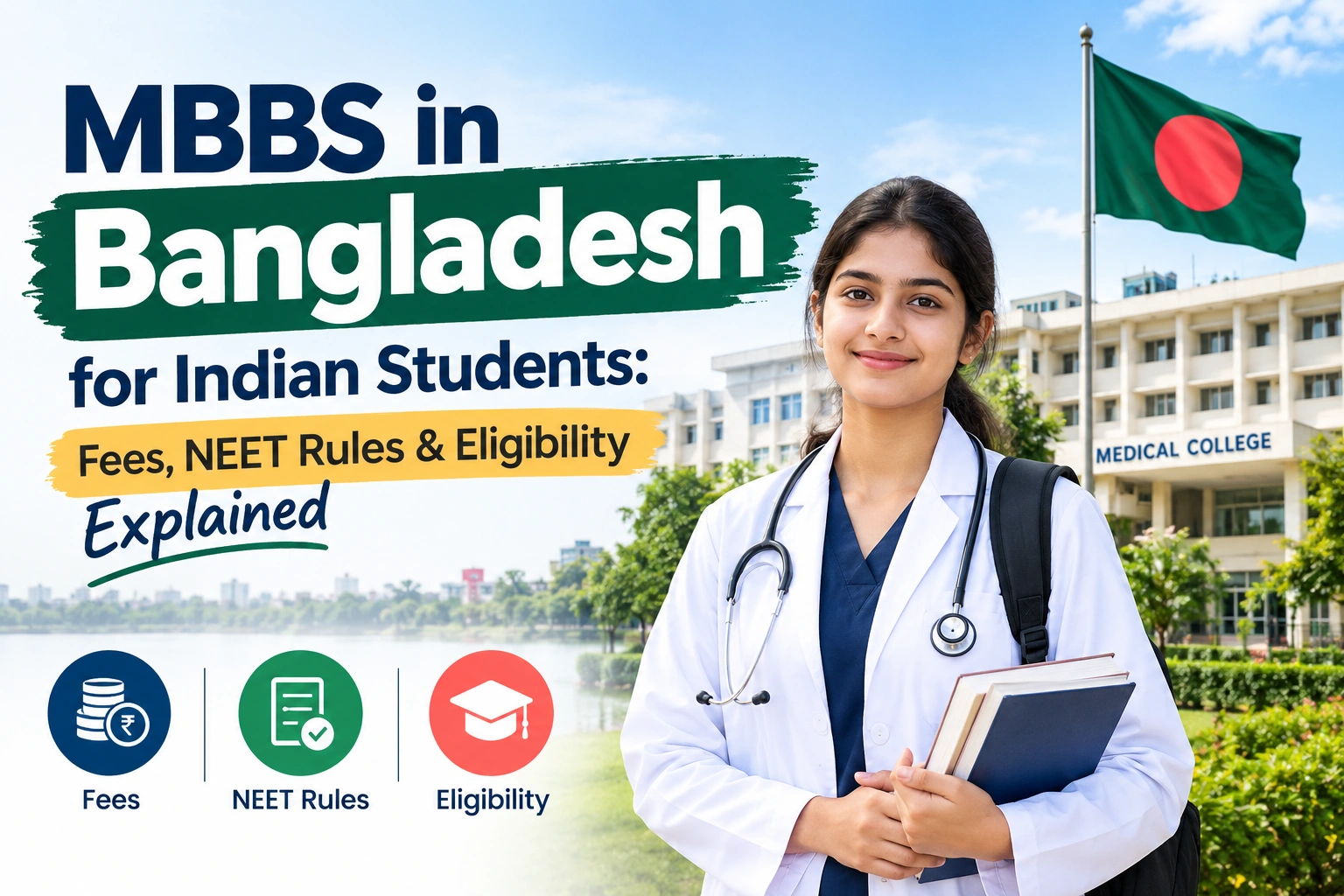
Every year, thousands of Indian students look outside the country for a medical seat. Not because they want to leave India — most would rather stay, honestly — but because seats here are limited and private college fees can run into a crore or more. That's where MBBS in Bangladesh enters the conversation. Close to home, culturally familiar, and considerably cheaper than most private colleges back in India. But is it actually a smart move? Depends on who you ask, and depends on which college. Let's get into the real details.
Why Bangladesh, Specifically?
Geography helps. A flight from Kolkata to Dhaka takes less than an hour. Food habits, weather, even language in border regions — none of it feels alien. Parents worry less about sending an 18-year-old to a country that's basically next door. Then there's the fee factor. MBBS in Bangladesh typically costs somewhere between ₹25-40 lakhs for the entire course, all inclusive — tuition, hostel, mess, the works. Compare that to a private medical college in India where fees alone can touch ₹1-1.5 crore, and you'll see why so many families start looking eastward. This may sound surprising, but it’s true. — Some Bangladeshi medical colleges actually have better clinical exposure per student than certain Indian private colleges, simply because patient load is high and student batches are kept smaller.
Eligibility Criteria — What You Actually Need
Nothing overly complicated here, but skipping a step can cost you a seat.
- Minimum 50% in Physics, Chemistry, Biology (English also mandatory) at 10+2 level. For reserved categories, it's usually 40%.
- Age should be 17 years or above by December 31st of the admission year.
- A valid NEET qualifying score. Not clearing NEET simply isn't an option anymore — more on that below.
Documents-wise, keep your 10th and 12th mark sheets, passport (valid for at least 2 years), NEET scorecard, and passport-size photos ready well in advance. Bangladeshi universities don't wait around for late paperwork.
The NEET Angle — Non-Negotiable Now
This part trips people up constantly. A lot of students still think NEET is "only for Indian colleges." Wrong. As per NEET guidelines published by the National Testing Agency, any Indian student wanting to pursue MBBS abroad — including in Bangladesh — must qualify NEET. No exceptions. You don't need a high rank though. Unlike Indian government colleges where competition is brutal, Bangladesh doesn't ask for a specific NEET cutoff rank for admission. Just qualifying is enough in most cases. That's a huge relief for students who scored decently but not spectacularly. Honestly, this is the part most consultancies don't explain properly. Students assume a low NEET score means no options at all. That's just not true for MBBS in Bangladesh — qualifying marks matter more than rank here.
Fees Structure — University Wise Comparison
Fees genuinely vary. Some colleges are budget-friendly, some sit on the premium side. Below is a rough comparison — treat these as approximate figures, and please verify current numbers directly with the college or through mbbs in bangladesh before making decisions.
|
University |
Approx Total Fees (5 yrs) |
Location |
|
Dhaka National Medical College |
₹28-32 lakhs |
Dhaka |
|
Ad-din Sakina Medical College |
₹25-30 lakhs |
Jessore |
|
Eastern Medical College |
₹30-35 lakhs |
Comilla |
|
Jalalabad Ragib-Rabeya Medical College |
₹32-38 lakhs |
Sylhet |
|
Community Based Medical College |
₹27-33 lakhs |
Mymensingh |
Fees kam hain. Bahut kam. Lekin har jagah nahi — some colleges quietly add "development charges" or hostel deposits that aren't part of the advertised fee. Yahan thoda dhyan dena zaroori hai. Always ask for a written fee breakdown before you sign anything.
Hidden Costs Nobody Talks About Enough
A few things people forget to budget for:
- Hostel and mess charges — sometimes billed separately, roughly ₹1-1.5 lakh per year.
- Bangla language course — mandatory in the first year for many colleges, costs vary.
- Visa renewal fees — annual, small but recurring.
- Travel costs — going home during breaks adds up over five years.
- Internship stipend gaps — not all colleges pay equally, some barely pay anything.
None of this is dealbreaker-level money. But add it up over five years and it changes your total budget by a good ₹3-5 lakhs easily.
Course Duration and Structure
The MBBS program in Bangladesh runs for 5 years academically, followed by a 1-year mandatory internship — so total 6 years, same as most global MBBS structures. The first year usually includes basic sciences plus that Bangla language module I mentioned. Clinical postings start around year three, which is actually earlier than in a lot of Indian colleges.
Recognition — NMC, WHO and WDOMS Status
This is where students absolutely cannot afford to be careless. Before enrolling anywhere, check whether the college is listed with the National Medical Commission (NMC), the regulatory body that decides whether your foreign degree will even be recognized in India. The NMC website carries updated lists — don't rely on a college brochure or an agent's word for this.
Also worth checking: whether the institution appears in the World Directory of Medical Schools (WDOMS), maintained jointly with recognition from WHO. Global recognition matters if you ever plan to practice, or even apply for higher studies, outside India. Most established Bangladeshi medical colleges — especially the ones affiliated with Bangladesh Medical and Dental Council — are listed properly. But new or lesser-known colleges? Verify first. Every single time.
FMGE / NExT — What Happens After You Return
Getting the degree isn't the finish line. Indian students who complete MBBS in Bangladesh (or any foreign country) must clear the Foreign Medical Graduate Examination, soon transitioning fully into the NExT exam format, before they're allowed to practice medicine in India. This exam isn't easy. Pass percentage has historically hovered somewhere in the 15-25% range for FMGE, though it fluctuates yearly. It tests everything you studied — pharmacology, pathology, medicine, surgery, all of it — in a single sitting. Some colleges genuinely prepare their students well for this. Others don't bother at all, treating the exam as "your problem, not ours." Ask current students or alumni about this before choosing — it matters more than the campus photos on a college website.
Admission Process — Step by Step
Not overly complex, but timing matters a lot.
- Step 1: Appear for NEET and qualify (even a modest score works for most colleges).
- Step 2: Shortlist colleges based on NMC/WDOMS recognition, fees, and location.
- Step 3: Apply directly or through a trusted consultancy — application windows usually open around August-September.
- Step 4: Submit documents, pay initial admission fee.
- Step 5: Apply for Bangladesh student visa (processing generally takes 2-4 weeks).
- Step 6: Travel, complete local registration, begin classes — sessions typically start in October or November.
Missing the September-October window often means waiting an entire year. Students underestimate this constantly.
Pros and Cons — A Fair Look
What works in favor of MBBS in Bangladesh:
- Significantly lower fees than Indian private colleges
- No donation or capitation fee culture, unlike many private Indian colleges
- Geographic and cultural proximity to India
- Reasonably good clinical exposure due to high patient density
What doesn't:
- FMGE/NExT pass rates remain a genuine concern
- Not every college is equally well-equipped — some really lag behind
- Political instability in the region occasionally disrupts academic calendars
- Language barrier exists initially, even with the Bangla course
Look, no destination is perfect. The idea is to weigh trade-offs honestly instead of getting swayed by an agent's sales pitch.
Frequently Asked Questions
Is MBBS in Bangladesh valid in India?
Yes, provided the college is recognized by NMC and listed in WDOMS. Degree validity depends entirely on this — always confirm before admission, not after.
What NEET score is required for MBBS in Bangladesh?
There's no strict cutoff rank demanded by most colleges. Qualifying NEET with the minimum passing marks is generally sufficient.
How much does MBBS in Bangladesh cost in total?
Roughly ₹25-40 lakhs for the complete 5-year program, though it varies by college and can shift year to year. Always confirm current fees directly.
Do I need to clear FMGE after returning?
Yes. It's mandatory for practicing medicine in India after completing an MBBS abroad, including from Bangladesh.
Is the medium of instruction in English?
Yes, classes are conducted in English. A basic Bangla course is added mainly to help with patient interaction during clinical years.
Can I get direct admission without NEET?
No. NEET qualification is compulsory as per current regulations — this rule applies uniformly to all countries, not just Bangladesh.
Conclusion
MBBS in Bangladesh isn't some shortcut or a "backup plan for weak students," which is honestly how a lot of people still frame it. It's a legitimate, budget-friendly path — as long as you pick the right college, verify recognition status yourself, and stay realistic about the FMGE/NExT hurdle waiting on the other side. Do your homework. Talk to current students if you can, not just consultants. And if you want college-wise details, updated fee structures, or help comparing options for MBBS in Bangladesh, mbbs in bangladesh is a good place to start digging deeper.