
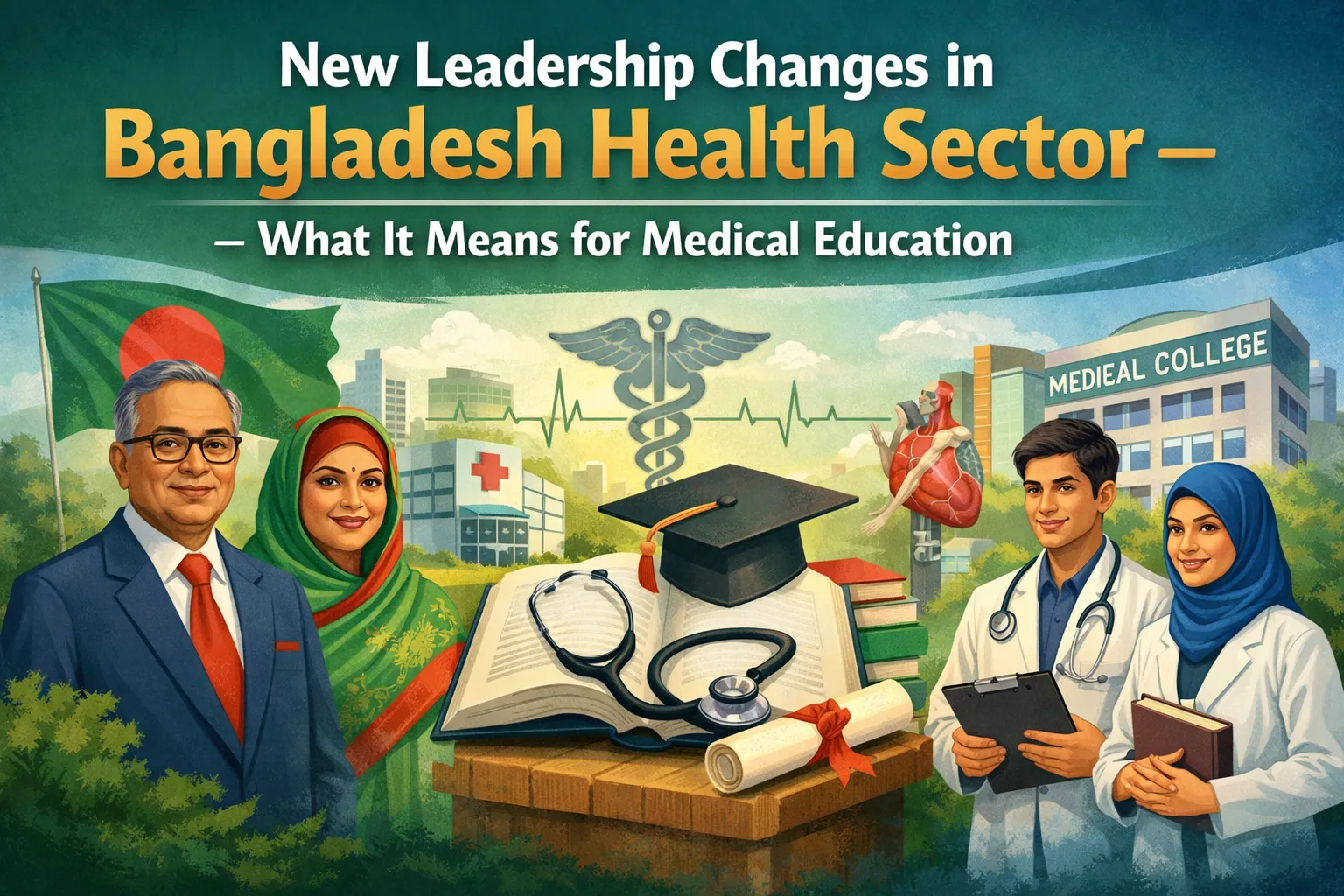
In 2026, Bangladesh’s health sector is undergoing significant evolution. With new political leadership, administrative reshuffling, and reforms in policy, the healthcare —and more importantly medical education— is changing faster than ever.
For students aspiring to study MBBS in Bangladesh, such leadership shifts are more than just political news—they affect admission policies, education standards, infrastructure growth and international acceptance of medical qualifications directly.
THE END OF AN ERA IN BANGLADESH’S HEALTH LEADERSHIP
Since the elections in 2026 to political changes, Bangladesh has seen a change in leadership. Changes in health sector priorities with the passage of the interim government under Muhammad Yunus to a newly elected government.
In such a gap, health services reforms and structural improvements were also being discussed. Now, with new leadership in place, the eye turns toward:
- Strengthening healthcare systems
- Expanding medical workforce
- Reforming medical education
Good leadership is crucial for instituting long-lasting reforms in the health sector, experts have said.
Significant Leadership Changes in the Health Sector
A few significant leadership transitions directly relevant to medical education have occurred.
New Administrative Appointments
There have also been changes to leadership positions within the Ministry of Health and affiliated agencies.
For instance, Md Sayedur Rahman had executive powers over the health ministry, and decided the trajectory of policy and reforms.
Changes in technical leadership have taken place as well. Another lease of administration control was when Md Abu Jafor's tenure came to it conclusion in March 2026.
This led to revitalizing medical universities and in 2026 F. M. Siddiqui was a maker in academic leadership role.
tell why leadership is important to medical education
Instructional medicine is also inextricably tied to government policy and administrative decisions. Leadership changes often lead to:
- Curricula and Training Standards Updates
- New accreditation systems
- Increased focus on faculty quality
- Infrastructure development
In Bangladesh, the Directorate General of Medical Education and other institutions serve a vital function in governing medical education and training systems.
Today, new leadership is pushing these institutions to embrace more standardized and global systems.
Focus on Healthcare Workforce Expansion
So expanding the healthcare workforce is one of the major priorities under this new leadership.
According to reports, the government is considering:
- Recruit thousands of healthcare professionals
- Enhance the services available at local health centers
- Enhancing accessibility of health care across regions
This has direct implication in medical education as:
👉 More doctors needed = An increased focus on quality of medical education
👉 A greater demand for qualified graduates
👉 More opportunities for students to experience clinical exposure
This presents a more vibrant and opportunity-laden scenario for MBBS seekers in Bangladesh.
Push Toward Medical Education Reforms
New leadership is also focusing on reforms to medical education.
Key areas of focus include:
- Modernizing medical curriculum
- Strengthening practical and clinical training
- 🔍 Ensuring the professional advancement of healthcare providers
These conversations address the urgent need to modernize medical education systems and improve how future doctors are trained.
This means students can expect:
- Updated teaching methods
- Better academic resources
- Increased emphasis on practical medical abilities
More Attention on Quality and Infrastructure
Leadership changes are also driving more stringent quality control measures.
Medical colleges are now being assessed on the criteria of 491462:
- Infrastructure standards
- Faculty availability
- Hospital training facilities
Challenges such as weak infrastructure and lack of system-wide reforms have been prolonged and recognized as a central issue for the health sector.
Through the new leadership, we hope to cover these deficiencies with:
- Investment in healthcare infrastructure
- Better management systems
- Transparent accreditation processes
This results in better learning environments for students opting MBBS in Bangladesh.
Alignment With Global Healthcare Goals
Bangladesh is also trying to align its health sector with global initiatives like Universal Health Coverage (UHC).
Long-term health system development strategies and reform roadmaps are being actively supported by the World Health Organization (WHO) in Bangladesh.
This alignment affects medical education in a number of significant ways:
- Focus on public health training
- Emphasis on community healthcare
- Integration of global best practices
MBBS education in Bangladesh will ensure a modern system which is now more compatible with the global healthcare industry.
Impact on International Students
Leadership reshuffling can also driving international student policies.
For Indian students, this means:
- More Structured Admission Systems
- Policies are becoming increasingly transparent and regulated
- Improved Academic Standards
- There are stricter monitoring of quality at colleges
- Better Global Recognition
- Obtaining the medical degrees based on international standards
However, students planning to pursue medical studies abroad have to comply with NMC guidelines.
MBBS in Bangladesh – Its Long-Term Effects
These positive changes in leadership are hoped to have a very fruitful impact in the long run.
In the coming years:
- Medical colleges will be more competitive worldwide
- Education quality will improve significantly
- International student enrollment may increase
This will establish Bangladesh further on the map of medical education.
All of this makes it more stable, educationally superior and better career prospects for students wishing to pursue MBBS in Bangladesh.
Conclusion
Also in 2026, the introduction of new leadership in the health sector of Bangladesh heralds a new chapter for professional medical education.
New policymakers, administrative reforms, and an emphasis on quality and global alignment are helping to steer the country in this direction.
These changes come as a welcome relief, especially for those students who are planning to do MBBS in Bangladesh. They are a sign of higher quality medical education system, which now steadily moving towards global recognition in a more structured and transparent manner.
Both for it is indeed a bright future, as the country continues with various reforms and set its sights to become a destination for aspiring medical talents