
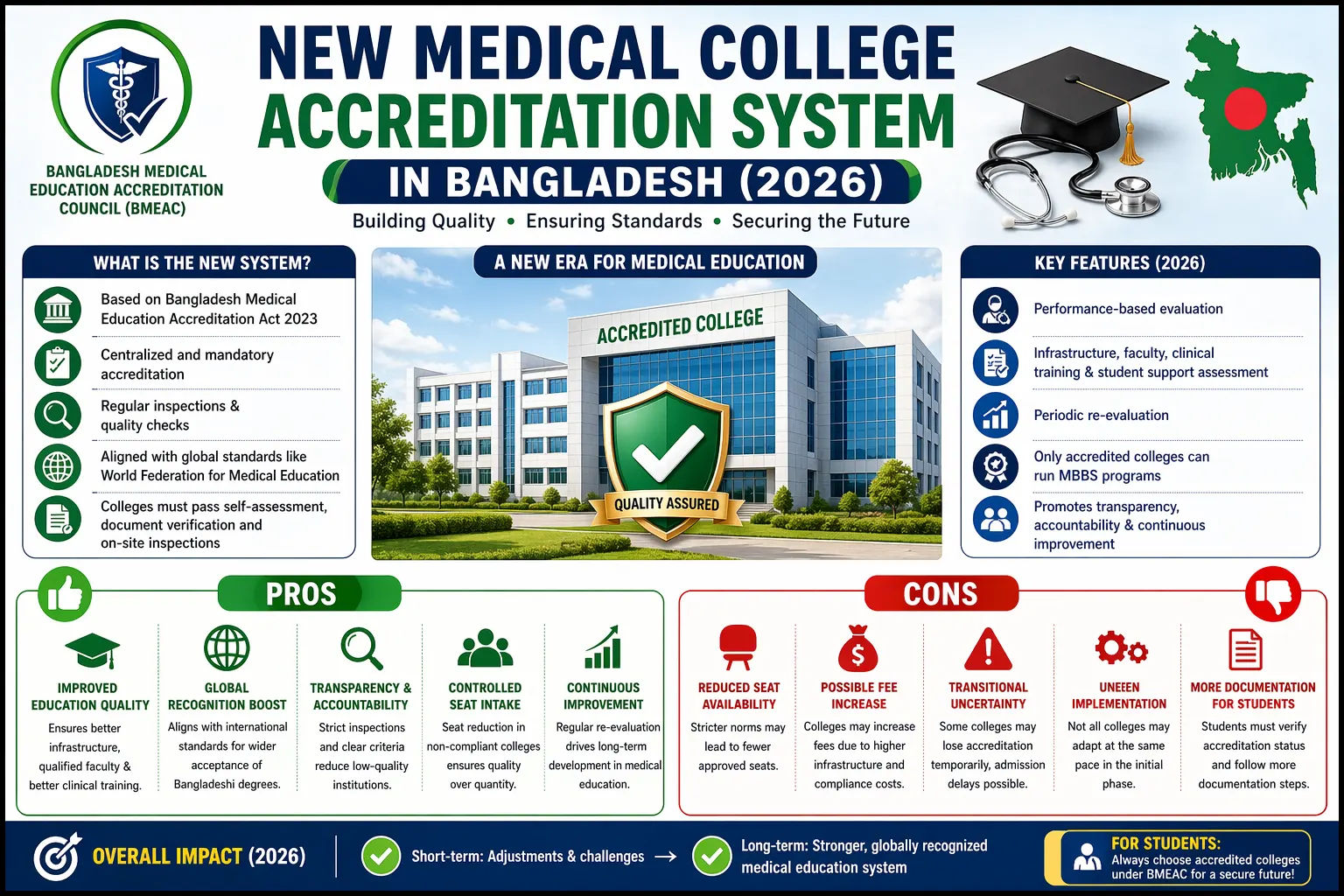
In 2026, Bangladesh introduced a revamped medical college accreditation system aimed at improving the quality, transparency, and global credibility of MBBS education. This reform marks a shift from a one-time approval model to a continuous evaluation framework, ensuring that institutions consistently meet defined standards.
What is the New Accreditation System?
The updated system follows a centralized and structured evaluation process where medical colleges are assessed through:
- Detailed institutional documentation
- Regular on-site inspections
- Periodic reassessment and renewal
Unlike earlier practices, accreditation is no longer permanent. Colleges must maintain standards continuously to retain recognition.
Key Evaluation Criteria:
- Faculty qualifications and teaching quality
- Infrastructure, laboratories, and facilities
- Hospital tie-ups and patient flow
- Curriculum delivery and academic outcomes
Advantages of the New System
1. Improved Education Quality
The biggest benefit is the standardization of medical education. Colleges must now meet strict benchmarks, resulting in:
- Better teaching methodologies
- Updated laboratories and infrastructure
- Structured academic systems
2. Stronger Global Recognition
The reform aligns Bangladesh’s medical education with global standards set by organizations like:
This improves:
- Eligibility for licensing exams (like FMGE/NExT in India)
- Opportunities for global medical careers
- Acceptance for higher education abroad
3. Continuous Monitoring & Transparency
Regular inspections ensure institutions remain accountable.
Benefits include:
- Increased transparency for students
- Real-time quality control
- Continuous institutional improvement
4. Better Clinical Exposure
Hospitals attached to colleges must meet strict patient-flow and training standards.
This ensures:
- More hands-on clinical experience
- Improved practical knowledge
- Better preparation for real-world medical practice
5. Increased Trust Among Students
Students and parents can now make more informed decisions due to clear accreditation status.
Challenges of the New System
1. Risk of College De-Recognition
Colleges failing to meet standards may lose accreditation.
This can lead to:
- Admission restrictions
- Uncertainty for currently enrolled students
2. Transition Phase Confusion
Since the system is new, some institutions are still adapting.
Students may face:
- Confusion about accreditation status
- Difficulty comparing colleges
3. Increased Competition
With weaker colleges being filtered out:
- Demand for top colleges increases
- Seats become more competitive
4. Pressure on Institutions
Colleges must continuously invest in:
- Infrastructure upgrades
- Faculty development
- Hospital improvements
This may be challenging for smaller institutions.
5. Stricter Responsibility for Students
Students now need to be more cautious and verify:
- Accreditation status
- Listing in global directories
- Compliance with Indian regulations (if planning to return)
What This Means for Students
If you’re planning MBBS in Bangladesh:
- Always choose accredited colleges
- Verify recognition with National Medical Commission
- Ensure listing in World Directory of Medical Schools
- Don’t select colleges based only on low fees
The new system improves quality—but demands smarter decision-making.
Final Verdict
The 2026 accreditation reform in Bangladesh is a major step toward enhancing medical education standards. It brings:
Better quality education
Strong global recognition
Improved clinical training
However, it also introduces:
Stricter rules
Higher competition
Greater responsibility for students
Simple takeaway:
Earlier, it was easier to get admission—but quality varied.
Now, quality is higher—but choices must be made carefully.
For serious medical aspirants, Bangladesh is becoming a more reliable destination—provided you choose the right, accredited college.