
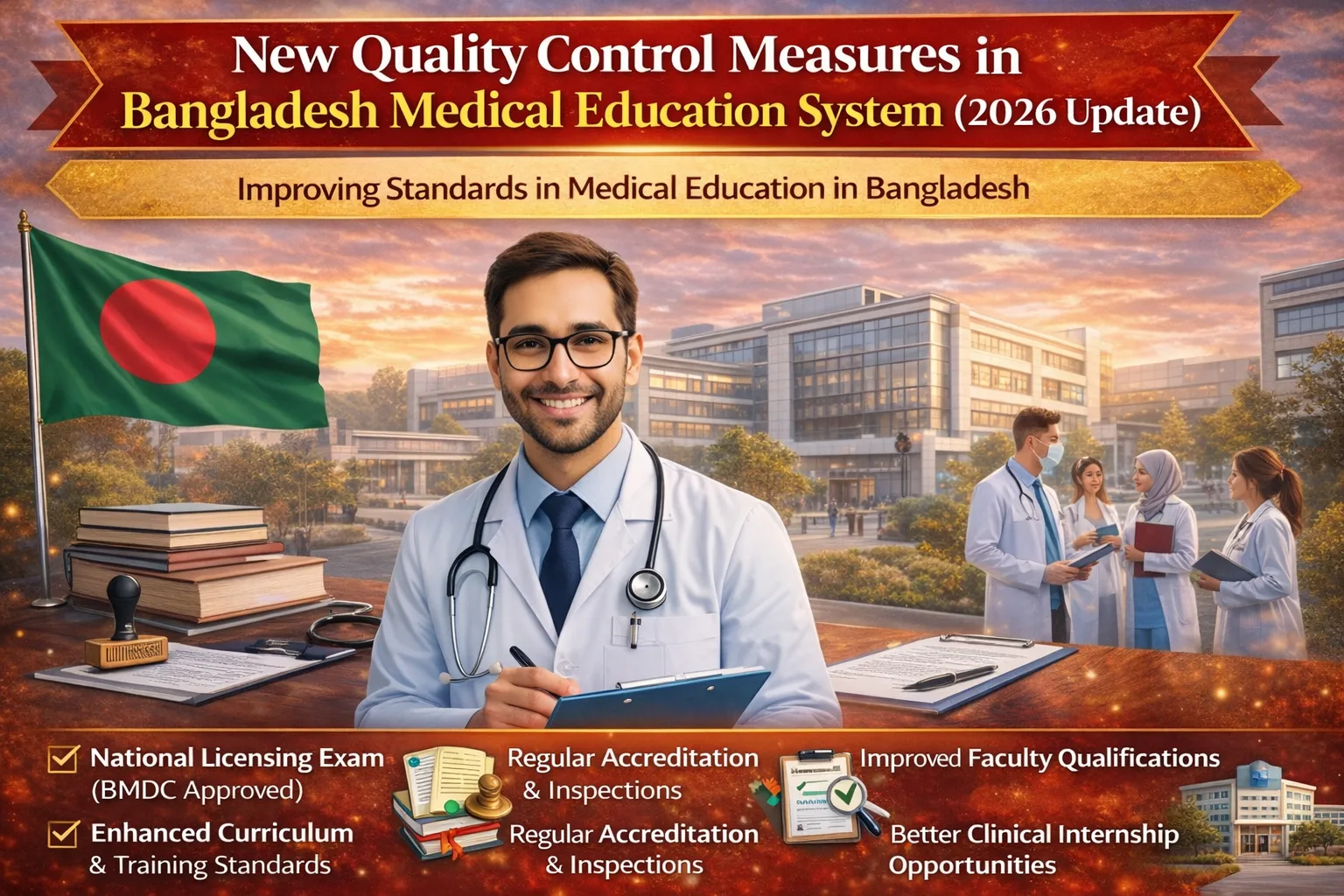
In an effort to improve medical education, Bangladesh has undertaken quality control measures. As the quantity of medical colleges has intensified and more international students wish to study in our country, it has become crucial for our nation to retain uniform academic standards.
These are especially useful for the students going to Bangladesh for MBBS. The new measures are intended to improve transparency, academic monitoring and clinical training standards across the world’s medical institutions. Thus, it is envisaged that the credibility and global acceptance of medical education in Bangladesh will gradually escalate.
The 2026 update represents Bangladesh’s greater dedication to international standards aligning with the regionalization of medical education while also prioritizing that medical graduates continue receiving appropriate training and practical clinical experience.
Why Bangladesh Is Raising Standards for Medical Education
Bangladesh has been ramping up its medical education sector over the last 10 years. Also, new government and private medical colleges are also being established to satisfy the growing demand of national and international healthcare professionals.
But rapid growth also raised questions about how widely and consistently standards were being applied. Variations in infrastructure, faculty availability and hospital training capacity pointed to a need for more regulation.
ACTs also addressed such concerns by implementing structured accreditation and monitoring systems to assess medical colleges regularly and ensure that they meet necessary educational standards.
Such reforms help guarantee that medical institutions provide comprehensive and trustworthy education and clinical training, therefore benefitting those students pursuing MBBS in Bangladesh.
Setting up Bangladesh Medical Education Accreditation Council
Among the most significant reforms is the establishment of Bangladesh Medical Education Accreditation Council (BMEAC). Bimec is an autonomous body under Bangladesh Medical Education Accreditation Act to monitor the accreditation of medical colleges in Bangladesh.
The council evaluates if applicants fulfill specific requirements for standards of faculty, laboratory infrastructure, academic resources and teaching hospital facilities.
Since now, medical colleges will have to go through formal accreditation review before they can admit new batches of MBBS students. Only institutions that can deliver quality medical education are allowed to remain open.
Out of particularly for MBBS in Bangladesh and consequently should lay themselves open to benefit, medical institutions have a ASMAB (accreditation board) which thereupon raise the trust factor.
Updated Quality Assurance Framework
Bangladesh has further implemented its national Quality Assurance Scheme (QAS) for undergraduate medical education.
Streamlining the Academic Monitoring
The new framework aims to focus on key areas including:
- self-assessment by the institutions
- external academic audit feel
- a uniform teaching pattern
These processes help the medical colleges to have consistent academic output and enhance their educational ecosystem.
To ensure that institutions are equipping students with requisite laboratories, lecture halls, libraries and clinical training facilities regular inspections are carried out.
These measures guarantee that students in Bangladesh MBBS programs are educated at or above local and international quality standards.
Conformance With Global Requirements Related to Medical Education
One other major goal of the new quality control measures is to bring Bangladesh’s medical education system in line with global standards.
International entities highlight the need for adequate accreditation systems to align health professionals such as medical graduates with contemporary health patterns.
However, that does not mean we should violate medical college rules as there is a global one Medical College list — World Directory of Medical Schools (WDOMS) — where many Bangladesh-based Medical colleges are included.
International health organizations, including the World Health Organization (WHO) , also insist on enhancing medical education structures of countries to cater for growing global demand for healthcare practitioners.
Medical education in Bangladesh is aligned with global standards and internationally recognized for students pursuing MBBS.
Monitoring Infrastructure and Clinical Training
Improvement infrastructure and clinical training of medical colleges was one of the key areas that will come under the purview of new reforms.
Now authorities assess whether institutions have:
- adequate patient exposure in their affiliated teaching hospitals
- up-to-date laboratory facilities
- experienced staff to teach
Medical colleges that do not meet these requirements may be directed to improve their infrastructure or decrease the number of students they admit.
Thus, it guarantees that the students studying MBBS in Bangladesh are given enough practice-based education throughout the studies.
The reason why medical students need strong clinical exposure is that this gives them practical skills in diagnosing and treating conditions before they leave into professional practice.
International Students: The Role of Regulatory Compliance
However, international students seeking to study medicine abroad need to ensure that their education is recognized by the medical authorities in their home countries.
Indian students, for instance, are required to adhere to the guidelines set forth by the National Medical Commission (NMC) while pursuing medicine abroad.
It is vital for students intending to return to India and take medical licensing exams to pick a recognized medical college that meets these standards.
The recent steps have also created more reassurance for those seeking to do MBBS in Bangladesh because of the improved regulatory system.
Title: Long-Term Benefits of the Quality Control Reforms
The increased quality control measures will continue to pay dividends for the Bangladeshi medical education sector in the long-run.
- The first is that it will help ensure consistency of academic standard across institutions of medicine nationally. Colleges must uphold accreditation standards so they will have to keep upgrading their facilities and improving faculty training.
- Second, it will improve the international prestige of Bangladeshi medical universities. Hence, with the improvement of academic quality, Bangladesh will attract considerable numbers of international students for medicine.
- Third, it will bring the health care systems by ensuring competence of medical graduates with respect to knowledge, clinical skills and ethical training required in modern day medical practice.
Hence, students studying MBBS in Bangladesh will find an education system that not only focuses on a strong academic foundation but also prepares them for clinical practice.
Conclusion
Bangladesh’s new quality control measures mark a watershed in the country's medical education system by strengthening academic standards and institutional accountability.
Ensuring the quality of medical education Bangladesh is seeking to ensure that medical colleges with accredited and high-quality education through the establishment of accreditation councils, updated quality assurance frameworks and alignment with global standards.
This has made students to pursue a bachelor of medicine, bachelor of surgery degree in Bangladesh with more assurance on the reputation and standard of medical education provided by Bangladeshi universities.
Make no mistake: Bangladesh is on track to emerge as a better and more credible destination for medical education in the coming years if we can continue with improved regulation, infrastructure and academic governance.