
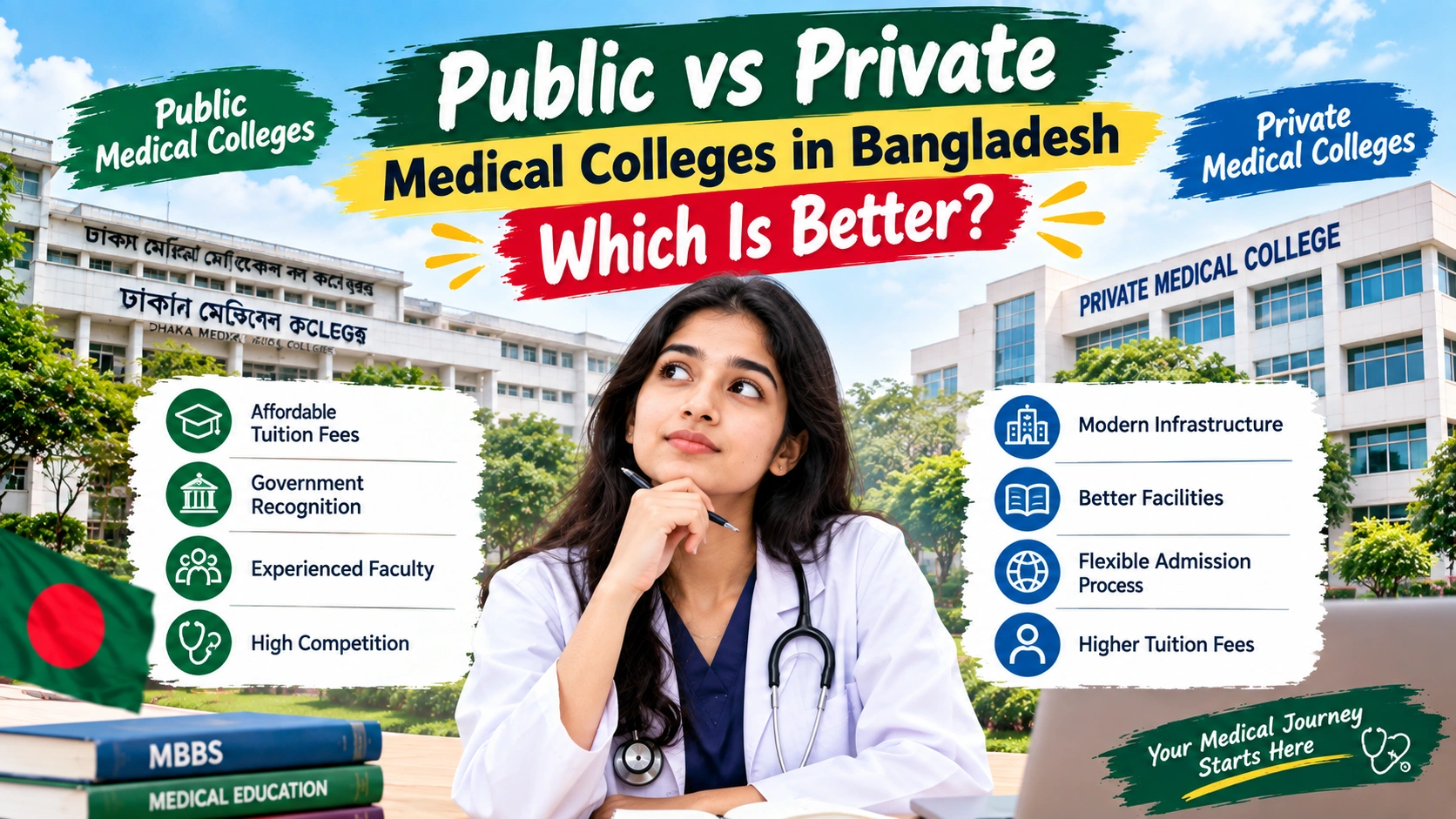
Choosing between a public and private medical college can change your entire MBBS experience in Bangladesh. Not just the fee. Your clinical exposure, campus facilities, admission route, hostel setup, and even the kind of hospital environment you train in can be quite different. For Indian students considering MBBS in Bangladesh, this is one comparison worth doing before paying any admission amount. Public colleges usually win on affordability and patient exposure, while private colleges can offer more predictable admission options and better-controlled campus facilities. But there's a catch. Not every college in either category offers the same academic experience.
Public vs Private Medical Colleges in Bangladesh: Quick Comparison
So, which one is actually better? There isn't one universal answer. It depends mainly on your budget, academic profile, preferred location, and how much importance you give to hospital exposure.
|
Factor |
Public Medical Colleges |
Private Medical Colleges |
|
Tuition Cost |
Generally lower |
Generally higher |
|
Competition |
High |
Usually more manageable |
|
Clinical Exposure |
Often very high |
Depends on attached hospital |
|
Infrastructure |
Varies by college |
Often newer facilities |
|
Patient Load |
Usually strong |
Varies considerably |
|
Hostel |
Usually available |
Available in many colleges |
|
Admission |
More competitive |
Comparatively flexible |
|
Total Cost |
Lower in many cases |
Higher |
|
Best For |
Budget-conscious students |
Students wanting more college options |
For an Indian student, this table gives the broad picture, but college-level research matters much more than the public/private label itself.
What Are Public Medical Colleges in Bangladesh Like?
Public medical colleges are government-run institutions and are generally considered the more economical route for medical education. Colleges such as Dhaka Medical College, Chittagong Medical College, Rajshahi Medical College and Mymensingh Medical College have long-standing reputations and large affiliated teaching hospitals. The biggest practical advantage is patient exposure. Government hospitals often handle a huge number of patients every day, so students can see a wide variety of clinical cases during their training. That's valuable. Sometimes more valuable than having a fancy classroom.
For students planning MBBS in Bangladesh, public colleges can therefore be attractive if clinical learning and lower overall cost are priorities. However, admission isn't necessarily simple just because the college is government-run. Seats are limited, requirements can vary for foreign students, and the admission process follows government rules and annual circulars. Students should check the latest DGME requirements rather than relying on an old consultant brochure.
What About Private Medical Colleges?
Private medical colleges have become a popular option for international students because there are more institutions to consider and the admission process can be comparatively straightforward, subject to eligibility and government rules. Colleges such as Bangladesh Medical College, Enam Medical College, Green Life Medical College and Popular Medical College are examples of private institutions with established teaching hospitals and medical education programs. Several Bangladesh medical schools also appear in current WDOMS listings, but students should check the exact institution rather than assuming every college has identical recognition or eligibility status. The biggest downside is cost. For foreign students, private MBBS packages can commonly fall around the US$40,000–50,000 range for the academic program and associated expenses, although the exact amount varies by college, hostel, admission fee, tuition structure and annual policy. Some colleges may quote a package, while others separate tuition, internship, hostel and other charges. Read the fee sheet carefully. A lower headline price doesn't always mean a lower final bill.
MBBS Fees: Public vs Private in Bangladesh
This is where the difference can become significant. Public colleges generally have lower tuition structures, but foreign-student fees aren't always identical to what Bangladeshi students pay. Government rules and annual foreign-student admission circulars can affect tuition and other charges, including arrangements for SAARC students. Private colleges are easier to compare using package costs, but even here, don't compare only the first-year payment. Ask for the full five-year academic fee, hostel cost, internship charges, food, examination fees and any refundable deposits.
|
Expense |
Public College |
Private College |
|
Tuition/Academic Fees |
Lower in many cases |
Approx. US$40,000–50,000 package range in some colleges |
|
Hostel |
Usually comparatively affordable |
Often US$500–1,000+ per year depending on setup |
|
Food |
Separate |
Separate or partly included |
|
Books & Equipment |
Additional |
Additional |
|
Admission Charges |
Depends on annual rules |
College-specific |
|
Internship/Other Fees |
Check official circular |
May be separately charged |
These figures are only planning ranges, not guaranteed 2026–27 quotations. Always ask the college for the latest written fee structure before making a payment.
Which Has Better Clinical Exposure?
Public colleges usually have the edge here, especially institutions attached to busy government hospitals. A large patient load can mean exposure to common diseases, emergency cases, medicine, surgery, obstetrics and other departments in a real working environment. But private doesn't automatically mean poor clinical exposure. Some private colleges have their own large teaching hospitals and can provide excellent hands-on learning. The real question is not "public or private?" It's "How many patients does the attached hospital actually see, and how involved are students in clinical training?" Honestly, this is something many students forget to ask.
Recognition Matters More Than the College Type
A public college isn't automatically the right choice for an Indian student, and a private college isn't automatically risky. Recognition and eligibility should be checked college by college. The World Directory of Medical Schools (WDOMS) is useful for checking whether a medical school is listed. Current WDOMS information includes numerous Bangladesh institutions, including Dhaka Medical College, Chittagong Medical College, Bangladesh Medical College and several private colleges. You should also check the National Medical Commission (NMC) requirements applicable to Indian students before admission. Don't treat a consultant's WhatsApp message saying "NMC approved" as sufficient proof. Verify the college and the applicable rules yourself. The WHO has also discussed medical education quality and accreditation systems in Bangladesh, including the roles of national regulatory and educational bodies.
NEET and Eligibility for Indian Students
Indian students generally need to meet the applicable NEET requirement for studying medicine abroad. The current rules should always be checked against the official NEET portal and NMC regulations because admission requirements can change. Apart from NEET, students normally need qualifying Class 12 education with the required science subjects, meet the minimum academic requirements, provide valid documents and satisfy the university and Bangladesh government admission conditions. Some admission cycles may also have specific age, document or application requirements. Don't apply based on last year's checklist. Medical admission rules aren't something you want to guess.
MBBS Duration and Internship
The basic MBBS pathway in Bangladesh generally involves about five years of academic medical education followed by a compulsory internship period, making the overall journey roughly six years. The exact internship arrangements and requirements for foreign students should be confirmed with the college and relevant authorities. This matters particularly for Indian students because finishing the degree abroad isn't the final step. If your plan is to practise in India, you'll need to satisfy the applicable NMC rules and licensing requirements in force at the time you graduate. The regulatory framework can change, so students starting in 2026 should not assume that the rules will be identical when they finish.
Public vs Private: Pros and Cons
Public Medical Colleges
Advantages:
- Lower cost in many cases
- Strong patient exposure
- Established government teaching hospitals
- Good option for students focused on clinical experience
- Long-established institutions available
Disadvantages:
- Limited seats
- Competitive admission
- Facilities can vary between colleges
- Administrative procedures may take time
- Foreign-student admission depends on government rules
Private Medical Colleges
Advantages:
- More colleges and admission options
- Often newer infrastructure
- Many have dedicated teaching hospitals
- Potentially smoother campus administration
- Several institutions actively admit international students
Disadvantages:
- Higher total cost
- Hospital exposure varies significantly
- Hostel and other charges can increase total expenses
- College quality isn't uniform
- Some facilities may look impressive but still have limited patient volume
Admission Process for Indian Students
The process usually starts with checking eligibility and NEET requirements, followed by selecting colleges that meet the relevant recognition and regulatory conditions. Students then prepare academic documents, passport details, photographs, NEET documents and other required paperwork. Depending on the admission cycle, applications may be submitted through the prescribed government or institutional route, followed by document verification, selection and payment. For MBBS in Bangladesh, don't rush the payment stage. First confirm the exact college name, university affiliation, teaching hospital, fee breakdown, hostel arrangement and refund policy in writing. A few hours of verification can prevent a very expensive mistake.
Hidden Costs Students Should Calculate
Tuition isn't your only expense. Your actual budget should also include accommodation, food, local transport, books, medical equipment, examination-related expenses, visa or documentation costs where applicable, flights home and personal spending. For a private college, a quoted package of around US$42,000–49,000 may sound like the complete cost, but you still need to confirm exactly what that package includes. Hostel duration is particularly important. Is it five years? Is internship accommodation included? Are meals included? Are electricity or maintenance charges separate? Small things add up.
Public or Private: Which One Should You Choose?
If your main priority is lower cost and high patient exposure, a good public medical college can be the stronger choice. If you want more college choices, modern infrastructure and a potentially more predictable admission route, a reputable private college may suit you better. My practical advice is simple: don't choose based only on the words "government" or "private." Compare the specific college, attached hospital, total fee, recognition status, clinical exposure and student support. That's a much safer way to evaluate MBBS in Bangladesh.
FAQs
Is MBBS cheaper in public medical colleges in Bangladesh?
Usually, yes. Public medical colleges generally have lower fee structures, although foreign students may be subject to separate government-approved fees and conditions. Always check the current admission circular.
Are private medical colleges in Bangladesh good for Indian students?
Some are. The quality varies by institution, so check the university affiliation, teaching hospital, WDOMS listing, applicable NMC requirements and clinical exposure before choosing.
Is NEET required for MBBS in Bangladesh?
Indian students should meet the applicable NEET requirement for studying medicine abroad. Check the latest NMC rules and official NEET information before applying.
Which is better for clinical exposure, public or private?
Public colleges often have an advantage because government hospitals can have very high patient volumes. However, a private college with a strong attached teaching hospital can also provide excellent clinical exposure.
What is the approximate cost of private MBBS in Bangladesh?
For foreign students, some private colleges have quoted total academic and related packages in roughly the US$40,000–50,000 range, but the actual amount differs by institution and admission year. Get the latest written fee structure before paying.
Is Bangladesh a good option for Indian students studying MBBS abroad?
It can be, particularly for students looking for geographical proximity, similar food and cultural familiarity, and an established medical education system. But the individual college matters enormously. Check recognition, fees, hospital exposure and current NMC requirements before making the decision.
Conclusion
There isn't a simple winner in the public-versus-private debate. A strong public college can be excellent for affordability and clinical exposure, while a well-established private college can offer good infrastructure and a more accessible route for international students. For Indian students, the smarter approach is to shortlist three or four colleges and compare them side by side. Check the latest fees. Verify WDOMS status. Read the NMC requirements. Look at the attached hospital. Then make the decision. That's the approach that makes MBBS in Bangladesh a calculated education choice rather than just an overseas admission decision.