
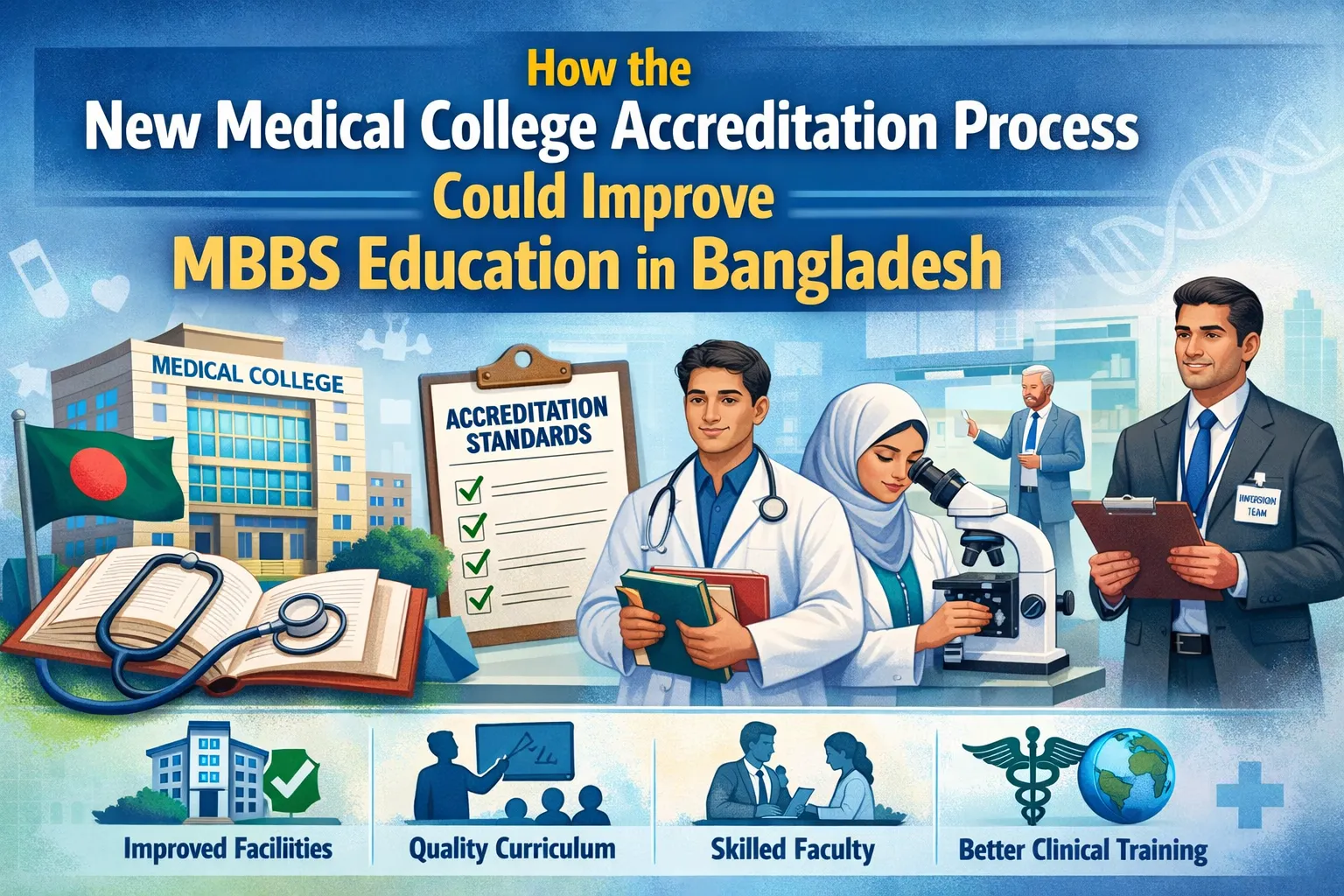
The Future of Healthcare Systems begins at Medical School Focusing on quality: The countries focus on the quality of medical education, which means that when they go out to teach good doctors who serve society. Bangladesh has taken a significant step towards the advancement of medical education in recent times by adopting a system based on accreditation for its medical colleges.
Through this new accreditation framework, it seeks to ensure that medical institutions uphold. These improvements coming especially for the international students to study MBBS in Bangladesh are a great news as it assures of high quality education and internationally recognized medical degrees.
Clarifying how the new accreditation system works is one way to help students understand why Bangladesh has become an increasingly trustworthy destination for medical studies.
Quality Assurance: An Increasingly Important Theme in Medical Education
As medical education directly influences the quality of healthcare professionals who join the workforce, it must be rightly regulated. Not all of the doctors must only have great theoretical knowledge, they must know clinical practice and be able to understand ethics as well.
Accreditation systems have been instituted in many countries to ensure that medical colleges meet agreed-upon academic standards. These systems review institutions on a regular basis to confirm that they fulfill the necessary requirements for education, infrastructure, faculty competency and clinical training resources.
A similar purpose is to be served by Bangladesh’s new accreditation mechanism. The authorities hope that by developing structured check methods, students looking for MBBS in Bangladesh will receive prime quality atmosphere at par with the worldwide requirements.
Formation of Bangladesh Medical Education Accreditation Council
With the establishment of Bangladesh Medical Education Accreditation Council, a new era in medical education reform has begun in the country. This council has been launched to facilitate the accreditation and evaluation of medical colleges across Bangladesh.
The council basically reviews the standards of institutes who are running MBBS course regarding structural set up of curriculum, quality of teaching provided, hospital based training facilities and system for students support.
As a result, there is now an institution in Bangladesh that has a comprehensive system for monitoring the activities of medical colleges.
This forces institutions providing MBBS in Bangladesh to constantly assess themselves and motivates them to maintain the academic as well as professional standard.
Comprehensive Evaluation of Medical Colleges
Now, medical colleges will have to undergo an elaborate assessment process.
The process usually starts with the medical college submitting a self-assessment report. Details of the infrastructure, faculty members, laboratories and associated teaching hospitals of the institution are present in this report.
Accreditation specialists then review the report, and conduct inspections of the college to confirm what is stated and determine whether conditions meet accreditation standards.
These assessments provide regulators with insight into whether the institution offers an environment that promotes effective medical education.
Colleges that meet the necessary criteria get accredited; those that do not can be required to upgrade their facilities or academic practices.
Steps to enhance quality of MBBS courses
The accreditation system also aims to upgrade the academic standard of MBBS programmes in the country.
Medical colleges have to prove that their curriculum includes relevant medical topics and adhere to standard hospital education guidelines. These include anatomy, physiology, biochemistry, pathology, pharmacology and clinical medicine.
The academic curriculum for MBBS students in Bangladesh follows a planned scheduling system combining theory and practical-centric exposure.
(7) Accreditation organizations review the methodologies of instruction, evaluation protocols and educational resources in order to ensure that students receive a complete medical education.
Enhancing the Quality of Faculty and Pedagogy
Faculty experience and qualifications are pivotal to quality of medical education. A dedicated team of professors, lecturers and clinical instructors are critical in introducing students to the complexities of medicine.
Over the years, medical college : The adequacy of qualified teaching staff is a must for accreditation.
Institutions must show they have teachers with the right medical degrees, practical experience, as well as teaching experience.
This will entice the faculty members to modify their teaching methods and stay abreast with contemporary medical literacy.
This focus on the quality of faculty can greatly improve the learning experience for students pursuing their MBBS in Bangladesh.
Expanding Clinical Training Opportunities
Theoretical knowledge and classroom curriculum are important, but clinical training is a significant part of medical education because this is where students learn to apply concepts at the patient bedside in real health systems.
The accreditations are rigorous, and the hospitals attached to medical colleges need to be very thorough in terms of clinical exposure.
Hospitals need to have an adequate number of patients, subspecialties and advanced medical facilities for students to observe and practice under supervision.
To train for these needs, medical students learn skills needed to diagnose patients and plan treatment, and their communication with the patients.
Stronger training opportunities for MBBS in Bangladesh international students can provide significant professional growth opportunities.
Better Infrastructure and Learning Resources
Modern facilities are a critical precondition for medical education. Students are able to work with laboratories and recreate experiments using modern day medical equipment.
Books available in these libraries include updated medical textbooks and research material that help students update their knowledge in the latest contexts of medicine.
During the accreditation process, it checks whether medical colleges provide sufficient facilities for students — from classrooms and laboratories to hostels and recreational areas.
It goes a long way in reinforcing the learning process for students who pursue MBBS in Bangladesh.
These goals have been informed by international standards for medical education (IS-09)
Another long-term goal of the accreditation reform in Bangladesh is to gradually bring its medical education system to align with global standards.
Medical colleges with strong accreditation practices become more international. The World Directory of Medical Schools assists medical graduates to pursue licensing examinations in her countries across the globe - already many institutions of Bangladesh are enlisted in here.
High educational standards for medical professionals are also stressed by global health organizations like the World Health Organization.
As for Indian students it is equally essential that the medical institution they choose abides by the eligibility guidelines mentioned by the National Medical Commission.
Accreditation that is at the higher end of the range facilitates graduates in fulfilling such requirements when pursuing a medical career abroad.
Protecting Students From Low-Quality Institutions
The new accreditation process also has a bigger advantage as it keeps the students safe from enrolling in institutions which offers poor facilities or trainings.
However, if a college fails to maintain the required standard at any point of time, it may be restricted from admitting new students or asked to upgrade its infrastructure.
This guarantees students who are investing in their medical education get a diurnal academic motif.
Such safeguards ensure international students considering MBBS in Bangladesh have more confidence in the credibility of medical institutions.
Impact Over Time: The System of Medical Education in Bangladesh
This was a huge step for Bangladesh’s medical education, as the introduction of a broad accreditation system in one country.
With its attention to quality assurance, faculty development and clinical training, the country is investing in its capacity to produce highly trained medical professionals.
In the longer run these steps will help solidify Bangladesh as a regional hub for medical education.
Future medical college students from outside Bangladesh are likely to see the country more as a reliable and credible destination for MBBS degrees.
Conclusion
One of the most important steps taken is the introduction of new medical college accreditation process in Bangladesh. The System of Accreditation will guarantee uniform quality of medical colleges for education through evaluating institutions [of medical education] on the basis of standards of academics, faculty credentials, [physical] infrastructure and clinical training facilities.
Reforms in medical education (MBBS) enable students to practice medicine effectively and efficiently.
As the accreditation framework evolves, Bangladesh's medical education system will receive further improvement and help students as well as the world health community.