
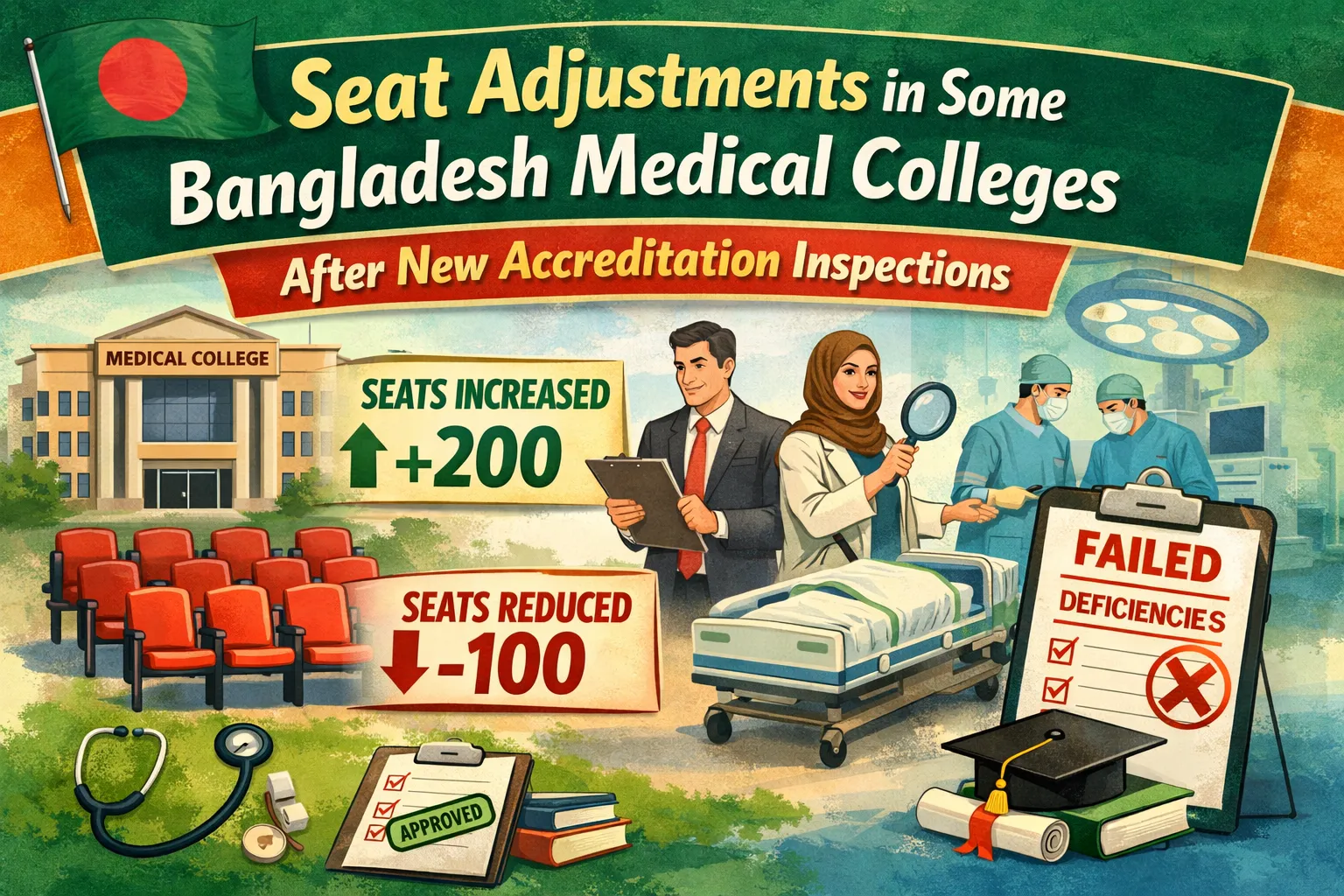
At present, there is a major transformation in the medical education system of Bangladesh which is happening as the authorities are strengthening quality control throughout all the medical colleges. Perhaps, the most prominent and immediate development after the new accreditation inspections had been changes in MBBS seat capacity of some medical institutions.
The changes are a part of larger exercise by the government to enhance infrastructure, faculty standards and standardise clinical training in the medical colleges. For students from abroad planning to get MBBS admission in Bangladesh, the seat structure will give them an overview of the country’s commitment to retaining optimal quality in medical education.
Why Seat Adjustments Are Happening
There are over 100 MBBS colleges in Bangladesh both public and private. This expansion opened doors for students, but there were concerns regarding availability of infrastructure, faculty and hospital facilities to offer education to large number of students in each institution.
To mitigate the consequences of these issues, government enacted the Bangladesh Medical Education Accreditation Act 2023 to establish a new accreditation system for medical institutions which would implement a structured assessment mechanism.
Medical colleges are now evaluated on the basis of:
- Classroom capacity
- Teaching staff availability
- Laboratory facilities
- Hospital infrastructure and patient flow
If a college falls short of the standards, regulators may limit how many students it is eligible to enroll.
Few Declines in Medical College Seats
Seat maneuvers have already occurred in several institutions, as per the recent admission circulars.
The authorities had in October reduced the total number of MBBS seats to 33,704 in government and private medical colleges for the academic session 2025–2026. In fact, approximately 572 seats were chopped in medical colleges due to limited infra and faculty shortage.
With regard to government medical colleges, their total seat count dropped from 5,380 seats to about 5,100 seats.
The agency made the decision after finding that some institutions had not been able to provide enough resources for students they admitted.
This shows that the regulators are closely monitoring the educational standards with respect to MBBS Bangladesh.
Preventing Overcrowding in Medical Colleges
Classrooms and hospitals are overcrowded, which is one of the big reasons for seating reductions.
Classrooms built for 200 students were allegedly packed with more than 250 in some colleges. Regulators determined such crowding could harm the quality of education and clinical training.
This will allow more faculty contact for each student and enhance access to clinical training facilities.
How Accreditation Inspections Work
The process of accreditation inspection generally involves a series of steps.
Medical colleges have to prepare a detailed self-assessment report which includes their infrastructure, faculty strength, curriculum and hospital facilities.
Then the documents are reviewed by expert committees to determine if the institution meets required review standards.
Finally, teams inspect the campus and affiliated hospitals to verify with what is said in the report.
Depending on the findings of these inspections, regulators may approve existing seat capacity or increase it in colleges that have good infrastructure while reducing seats where things are out of place.
Impact on International Students
The news of MBBS seats adjustment may seem daunting for international students who are planning to pursue MBBS in Bangladesh. These adjustments of policy are broadly seen as an improvement.
Intake of overcrowded colleges, thereby improving:
- Faculty-to-student ratios
- Access to labs and training facilities
- Clinical training opportunities in hospitals
These reforms, in the end, try to improve the quality of medical development.
Improving Clinical Training Opportunities
Arguably the most essential part of medical training is clinical exposure. Doctors need body history through working with patients, with hospital overviews and preparation.
When there aren’t enough hospital spaces available, clinical training can be restricted if too many students are admitted to a college.
Clinical exposure or clinical implication for students who do their MBBS course in Bangladesh as needed which regulations also help to support with seat arrangements.
The hands-on experience is critical to learning the skills needed to make diagnoses and formulate treatments in medical practice.
Strengthening Bangladesh’s Medical Education Reputation
A second aim of the accreditation reforms was to bolster Bangladesh’s global standing in medical education.
Medical colleges that preserve strong infrastructure, good faculty members as well as having the right clinical training setup will provide them recognition on an international basis.
This is primarily due to the fact that many medical universities in Bangladesh are WDOMS listed and follow global health standards advocated by WHO etc.
Further, Indian students must also take note that in order to practice medicine in India, the course has to be recognized by the National Medical Commission (NMC).
Enhancing the accreditation standards means that Bangladeshi medical institutions continue to fulfil these global needs.
Will Some Colleges Add Seats in the Future?
Even though some colleges have fewer seats now, better-prepared institutions may find they will actually be able to take in more students going forward.
Medical colleges with robust infrastructure, qualified faculty, and large teaching hospitals in place may get the nod to admit more students.
This does not mean that seat adjustments are universally a reduction — sometimes they redistribute student capacity to institutions that are able to deliver better training.
What Applicants Should Think About Before Applying
Check Factors when Seeking Admission in Medical College in Bangladesh for MBBS Students.
They should verify that:
- The institution has proper accreditation
- The college owns a teaching hospital with good patient flow
- Faculty strength is adequate compared to student number.
- The institution is included in well-known international catalogs
: Good accreditation enables students to have a good academic structure and are less likely to go through difficulties in qualifying & entry-level exams.
Conclusion
Accreditation inspections new to Bangladesh are the cause of adjust seat allocation in some medical colleges. This includes a push for less intake in poorly-resourced institutions and better school and clinical training facilities, as regulators try to ensure that aspiring doctors are learning in adequate environments.
These reforms are important for students studying MBBS in Bangladesh as it shows the government’s efforts to ensure a high academic standard and strengthen the global recognition of medical degrees from Bangladesh.
While admitting fewer candidates in the interim may restrict opportunities, over time this is forecast to result in better training, improved clinical exposure and internationally respected medical qualifications.