
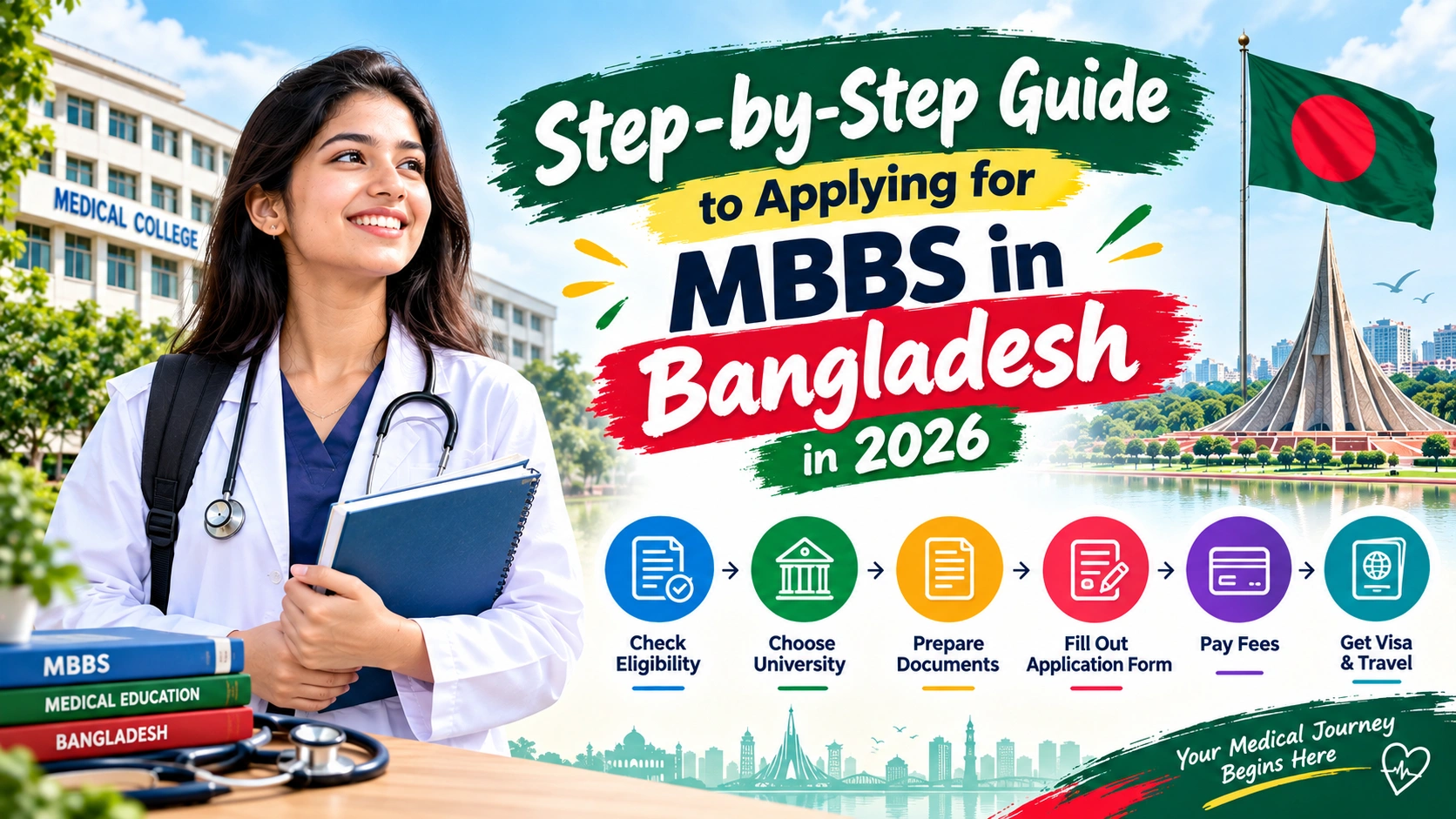
For many Indian students, choosing MBBS in Bangladesh isn't really about going thousands of kilometres away for medical school. Bangladesh is close, the teaching environment is familiar, and several medical colleges have long been admitting international students. But there’s one catch — getting admission isn't simply a matter of filling out a college form and paying the first fee. The foreign-student process follows Bangladesh's rules, and Indian students also need to keep Indian medical regulations in mind from day one. So, if you're planning for the 2026 intake, here's the process in plain English.
Step 1: Check Whether You Meet the Basic Eligibility
Start here. Not with college selection. For Indian students, the usual academic requirement is a science background with Physics, Chemistry and Biology, along with the required school-level qualifications. Bangladesh's foreign-student admission rules can also specify minimum academic scores and documentation requirements for the particular intake. For example, a recent DGME foreign-student notice for non-government colleges required equivalent O/A-level qualifications, a minimum combined GPA of 7.00 and at least 3.50 in Biology for the stated system. Indian applicants should also satisfy the eligibility conditions applicable to foreign medical education in India. NMC guidance requires students to pay attention to age and qualifying academic requirements, rather than assuming that admission by a Bangladeshi college automatically makes them eligible to practise in India.
Step 2: Qualify NEET-UG Before Applying
Yes, NEET matters. Indian students planning to study medicine abroad should qualify NEET-UG as required under the applicable Indian rules. The NMC's current information confirms NEET-UG as the relevant entrance examination for MBBS eligibility, while the qualifying percentile can vary according to category and the applicable year's rules. You can check the latest examination information directly through the official NEET website. Don't rely on an old Telegram message or a consultancy PDF from three years ago. Medical admission rules change.
Step 3: Shortlist the Right Medical Colleges
Now comes the part students usually enjoy — comparing colleges. Bangladesh has government and private medical colleges, and the fee structure can be very different between institutions. You should compare at least these points before paying anything:
- University affiliation
- Current recognition and regulatory status
- Clinical hospital and patient exposure
- Course duration
- Medium of instruction
- Hostel and accommodation
- Total tuition and other charges
- Internship arrangements
- International student support
- Eligibility for future registration in India
WDOMS listings show Bangladesh medical schools offering MBBS programmes, with examples showing a five-year curriculum and English as the language of instruction. For Indian students, don't choose a college only because an agent says, "This one is cheap." Cheap can become expensive if the programme doesn't fit the requirements you'll need later.
Step 4: Check NMC and WDOMS Information Carefully
This step can save you years of trouble. Before finalising MBBS in Bangladesh, check the medical college's current details and then compare them with the requirements applicable to foreign medical graduates in India. The NMC college and course search is useful for understanding India's regulatory framework, while WDOMS can help you verify whether a particular medical school has a listing. But don't confuse a WDOMS listing with an automatic guarantee of Indian registration. They're not the same thing.
NMC's Foreign Medical Graduate Licentiate Regulations are particularly relevant. Current NMC material specifies requirements including at least 54 months of education in a single foreign medical institution and a 12-month internship at the same foreign university, along with other conditions covering curriculum, clinical training and medium of instruction. Honestly, this is one of the most overlooked parts of the whole admission process.
Step 5: Understand the 2026 Application Window
Foreign-student admission isn't necessarily open throughout the year. For the 2024–25 cycle, Bangladesh's DGME notice for foreign students stated that online applications were accepted from 5 December 2024 to 15 February 2025. The dates for the 2026 cycle can be different, so students should wait for the official DGME announcement rather than treating the previous dates as fixed. The official DGME foreign-student application portal is the place to watch. At the time of checking, its portal stated that applications were not currently being accepted. For a 2026 applicant, the practical approach is simple: keep your documents ready before the application window opens.
Step 6: Prepare Your Documents
Don't leave paperwork until last week.
A typical foreign-student application can require documents such as:
- Passport
- Passport-size photographs
- Class 10 certificate and marksheet
- Class 12 certificate and marksheet
- Physics, Chemistry and Biology marks
- NEET scorecard
- NEET admit card, where applicable
- Birth certificate or age proof
- Medical fitness documents, if required
- Passport or nationality documents
- Academic transcripts
- Attested certificates
- Other documents requested by DGME or the selected college
Bangladesh's foreign-student rules have required academic certificates to be properly attested by competent authorities, and successful applicants may need to present original certificates during admission. Make scanned copies too. Clear ones. Not photographs taken at an angle with half the certificate missing.
Step 7: Submit the Foreign-Student Application
Once the application portal opens, complete the online form carefully. You may have to provide personal details, academic information, passport information and your preferred medical colleges. The exact process depends on the intake notification issued by Bangladesh's Directorate General of Medical Education.
Don't submit random information just to finish the form quickly. A spelling difference between your passport, marksheet and application can create unnecessary verification problems later. If an application or equivalence fee is required, pay it only through the method mentioned in the official notice. A previous DGME foreign-student notice, for example, specified a non-refundable US$100 equivalence fee.
Step 8: Wait for Selection and Admission Instructions
After submission, applicants may need to wait for the official selection process and further instructions. This is where students sometimes get impatient. They'll receive a message from an agent saying, "Pay today or the seat will be gone." Don't panic. Ask for the official admission document, fee structure and payment instructions. Verify the college name, programme, university affiliation and the amount being requested before transferring money.
Step 9: Calculate the Full Cost, Not Just Tuition
The advertised tuition figure isn't your complete budget. For MBBS in Bangladesh, students should generally budget for tuition plus admission charges, hostel, food, books, examination fees, medical insurance or health-related expenses where applicable, visa-related costs, travel, local transportation and personal expenses. Private medical colleges may have total five-year costs running into several tens of thousands of US dollars, depending heavily on the institution and package. Government or SAARC-related arrangements can be different. Don't use one college's package as the standard for every college.
A sensible approach is to ask for a written five-year cost sheet before admission.
|
Expense |
What to Check |
|
Admission fee |
One-time or instalments |
|
Tuition |
Annual or semester-wise |
|
Hostel |
Included or separate |
|
Food |
Included or separate |
|
Internship fee |
Check whether charged separately |
|
Examination fee |
College/university specific |
|
Visa/travel |
Usually separate |
|
Personal expenses |
Depends on lifestyle |
Step 10: Understand the MBBS Duration and Internship
A Bangladesh MBBS programme commonly has a five-year academic duration, as reflected in WDOMS listings for multiple Bangladeshi medical schools. But Indian students shouldn't stop at the phrase "five-year MBBS." The bigger question is what happens after the degree. Under the current NMC framework, foreign medical graduates have to satisfy specific requirements relating to education, clinical training and internship before seeking registration in India. NMC's FMGL framework includes a 12-month internship requirement at the same foreign medical institution, alongside other conditions. The licensing route in India has also been changing, so students should check the latest NMC rules applicable to their admission year instead of assuming that an older FMGE/NExT explanation will remain unchanged.
Pros and Cons of Studying MBBS in Bangladesh
Why Students Consider Bangladesh
- Close to India
- Comparatively familiar food and culture
- English-medium medical education in many institutions
- Established medical colleges
- Potentially lower travel costs than distant destinations
- Large patient populations can provide clinical exposure
What You Should Think About
- Private college fees can be substantial
- Admission rules can change between academic years
- Documentation needs careful handling
- College recognition and regulatory status must be checked
- Indian registration requirements remain a separate issue
- Hostel, food and other charges can increase the actual budget
There isn't a single "best Bangladesh medical college" for every student. Budget, location, hospital exposure and long-term registration plans all matter.
Frequently Asked Questions
Is NEET mandatory for Indian students applying for MBBS in Bangladesh?
Indian students should qualify NEET-UG according to the applicable Indian rules for foreign medical education. Check the current NMC and NTA requirements for the year you are applying.
How long is MBBS in Bangladesh?
The MBBS academic programme is generally five years in Bangladesh, although the complete pathway for an Indian student should also account for internship and the requirements applicable to registration in India. WDOMS records for Bangladeshi medical schools commonly show a five-year programme.
How much does MBBS in Bangladesh cost in 2026?
There isn't one fixed figure. Government and private colleges can have very different structures, and international-student packages may range from the lower tens of thousands to substantially higher amounts over the full programme. Always request the latest college-specific fee sheet before paying.
Can I practise in India after MBBS in Bangladesh?
Not automatically. You must satisfy the NMC requirements applicable to foreign medical graduates, including the prescribed education, clinical training, internship and licensing requirements. Check the latest NMC regulations for your admission year.
Is WDOMS listing enough for Indian registration?
No. A WDOMS listing is useful for verifying information about a medical school, but it shouldn't be treated as a guarantee of eligibility for registration in India. Check the NMC requirements separately.
When should I start preparing for the 2026 intake?
Ideally, several months before the expected application window. Keep your passport, academic certificates, NEET documents, photographs and attestation requirements ready before applications open.
Final Thoughts
Applying for MBBS in Bangladesh in 2026 can be fairly straightforward if you treat it as a proper admission process rather than a quick overseas seat booking. First check eligibility. Then qualify NEET, shortlist colleges, verify regulatory information, prepare documents and apply through the proper foreign-student channel. Most importantly, think beyond admission day. The medical college you choose today can affect your clinical training, internship and registration pathway years later. For the latest 2026 admission notices, always cross-check the official DGME information and the current NMC regulations before making a financial commitment. A little verification now is much cheaper than fixing a wrong admission later.