
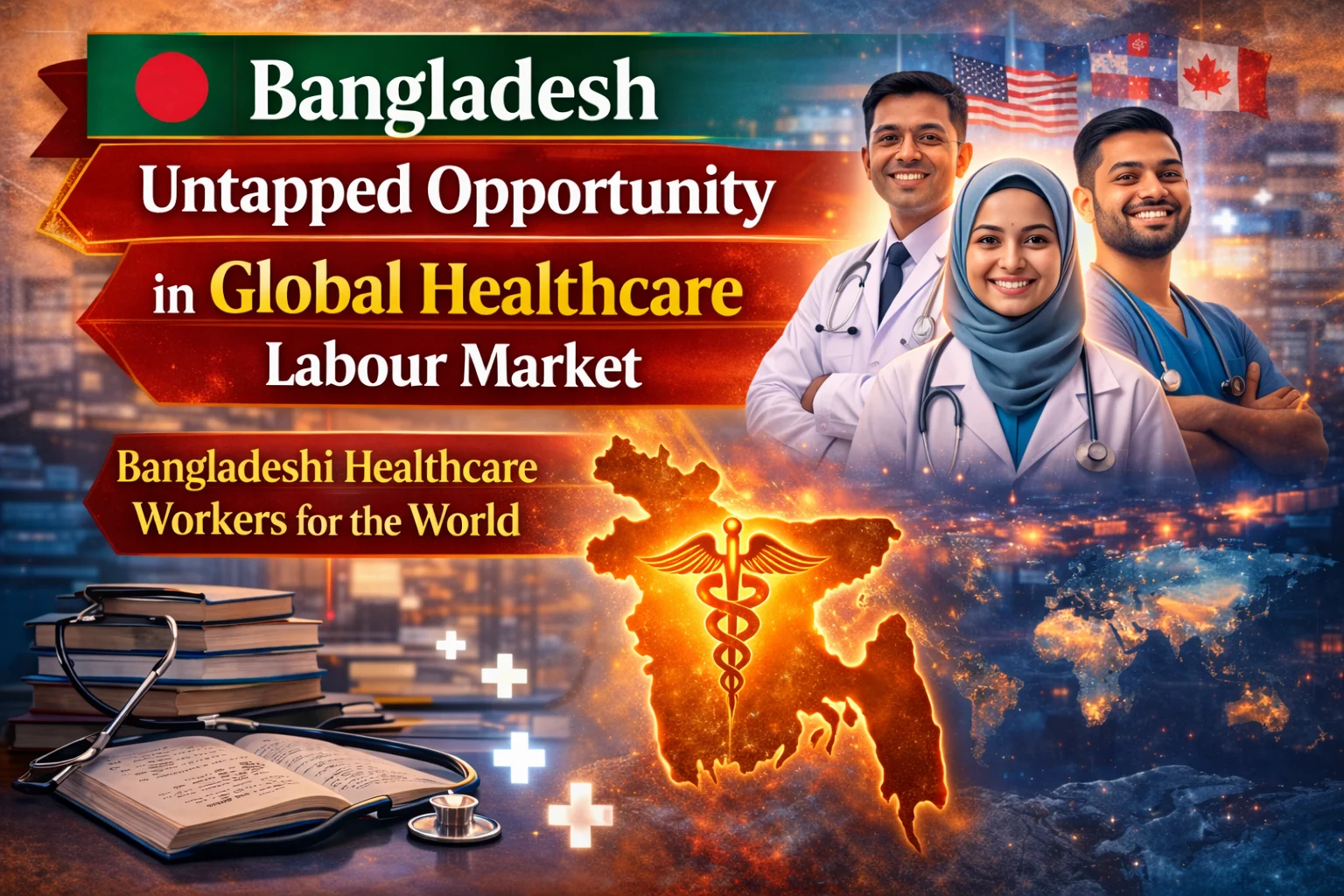
The world is facing a silent healthcare crisis.
Hospitals across Europe are struggling with staff shortages. The UK and is recruiting doctors internationally. The Middle East is expanding hospital infrastructure faster than it can hire professionals. Even countries like Canada and Australia are unable to meet healthcare workforce demand.
Amid this global shortage, one country remains strategically positioned — yet under-recognized:
Bangladesh,
Often discussed as an affordable destination for medical education, Bangladesh also represents a powerful — and largely untapped — contributor to the global healthcare labour market, especially for students pursuing MBBS in Bangladesh.
Let’s explore why this matters.
The Global Healthcare Workforce Crisis
Global health estimates indicate that millions of additional healthcare workers will be required this decade.
The shortage is driven by:
- Rapid aging populations in Europe and East Asia
- Rising chronic disease burdens
- Expansion of universal healthcare systems
- Post-pandemic burnout and early retirements
- Increased cross-border migration of healthcare workers
Countries such as:
- The United Kingdom
- Germany
- Australia
- Gulf nations
are actively recruiting foreign-trained doctors.
The demand is clear. The supply pipeline is not.
Why Bangladesh Has Strategic Potential
Over the past two decades, Bangladesh has quietly strengthened its medical education system.
Many of its medical colleges are listed in the:
Recognition frameworks aligned with the World Health Organization (WHO) further support international academic credibility.
But recognition alone is not the real advantage.
The real strength lies in the nature of training.
Clinical Exposure: Bangladesh’s Competitive Edge
Bangladesh’s biggest advantage is high patient volume.
Government and private teaching hospitals handle a significant number of real cases daily. For students, this means:
- Early clinical exposure
- Hands-on ward training
- Real-time diagnosis experience
- Exposure to diverse disease patterns
In many Western systems, students observe extensively before engaging. In Bangladesh, supervised practical engagement happens earlier.
This builds:
- Clinical confidence
- Diagnostic adaptability
- Practical competence
These are critical traits when appearing for international licensing exams.
Cost-Effective Education with Competitive Outcomes
Medical education in developed countries is expensive.
Bangladesh offers:
- Affordable tuition structure
- English-medium instruction
- Curriculum closely aligned with South Asian standards
For Indian students, recognition by the:
- National Medical Commission (NMC)
ensures eligibility to return and appear for licensing examinations in India. - This combination of affordability and regulatory alignment creates both domestic and international career flexibility.
Expanding Cross-Border Medical Careers
Today’s medical graduate is globally mobile.
Students completing MBBS in Bangladesh may pursue:
- Licensing exams in India
- PLAB for the UK
- USMLE for the United States
- Gulf country licensing pathways
- Postgraduate specialization abroad
International recognition allows graduates to compete in multiple labour markets — a critical advantage in times of global healthcare shortage.
Bangladesh as a Regional Healthcare Hub
Bangladesh is not only positioned to export talent but also to strengthen its domestic healthcare ecosystem.
Key growth indicators include:
- Expanding hospital infrastructure
- Rapid growth in private healthcare
- Emerging medical tourism
- Competitive treatment costs
This dual model — strengthening domestic capacity while contributing internationally — defines its untapped potential.
The Strategic Advantage for Indian Students
For Indian students, MBBS in Bangladesh offers:
- Cultural familiarity
- English-medium learning
- Curriculum similarity with India
- International recognition pathways
Unlike destinations with language barriers, Bangladesh provides a smoother academic transition.
In a healthcare labour market driven by mobility, ease of adaptation becomes a strategic advantage.
Challenges Bangladesh Must Address
To fully establish itself as a global healthcare workforce contributor, Bangladesh must focus on:
- Increasing research output
- Expanding international academic collaborations
- Strengthening postgraduate specialization programs
- Enhancing global institutional branding
- Standardizing training audits
The foundation exists — strategic reform can elevate its position significantly.
Policy Implications & Strategic Growth
If policymakers invest in:
- Faculty development
- Simulation-based training labs
- International accreditation partnerships
- Digital health education
- Telemedicine integration
Bangladesh can transition from being viewed merely as an affordable education hub to becoming a globally trusted supplier of medical professionals.
Countries facing shortages are increasingly signing bilateral recruitment agreements. Bangladesh has the manpower — structured global positioning is the next step.
Healthcare as Global Currency
In the 21st century, healthcare professionals are strategic national assets.
Countries with surplus trained doctors benefit through:
- Remittance inflows
- Medical diplomacy
- International soft power
- Economic contribution
Bangladesh’s rapid economic rise suggests healthcare could become its next major global contribution.
Institutions offering MBBS programs are central to that transformation.
Final Thoughts
The global healthcare labour market is expanding rapidly.
Developed nations need doctors.
Emerging economies need affordable training models.
Healthcare systems require adaptable professionals.
Bangladesh stands at a strategic intersection.
The real question is not whether Bangladesh has a role in the global healthcare workforce.
The real question is:
How quickly can it scale, standardize, and position itself as a major global contributor?
For students pursuing MBBS in Bangladesh, the opportunity extends beyond affordability — it connects to a global healthcare ecosystem that increasingly values mobility, competence, and clinical readiness.
In a world that urgently needs doctors, Bangladesh may well become a gateway to international medical careers.