
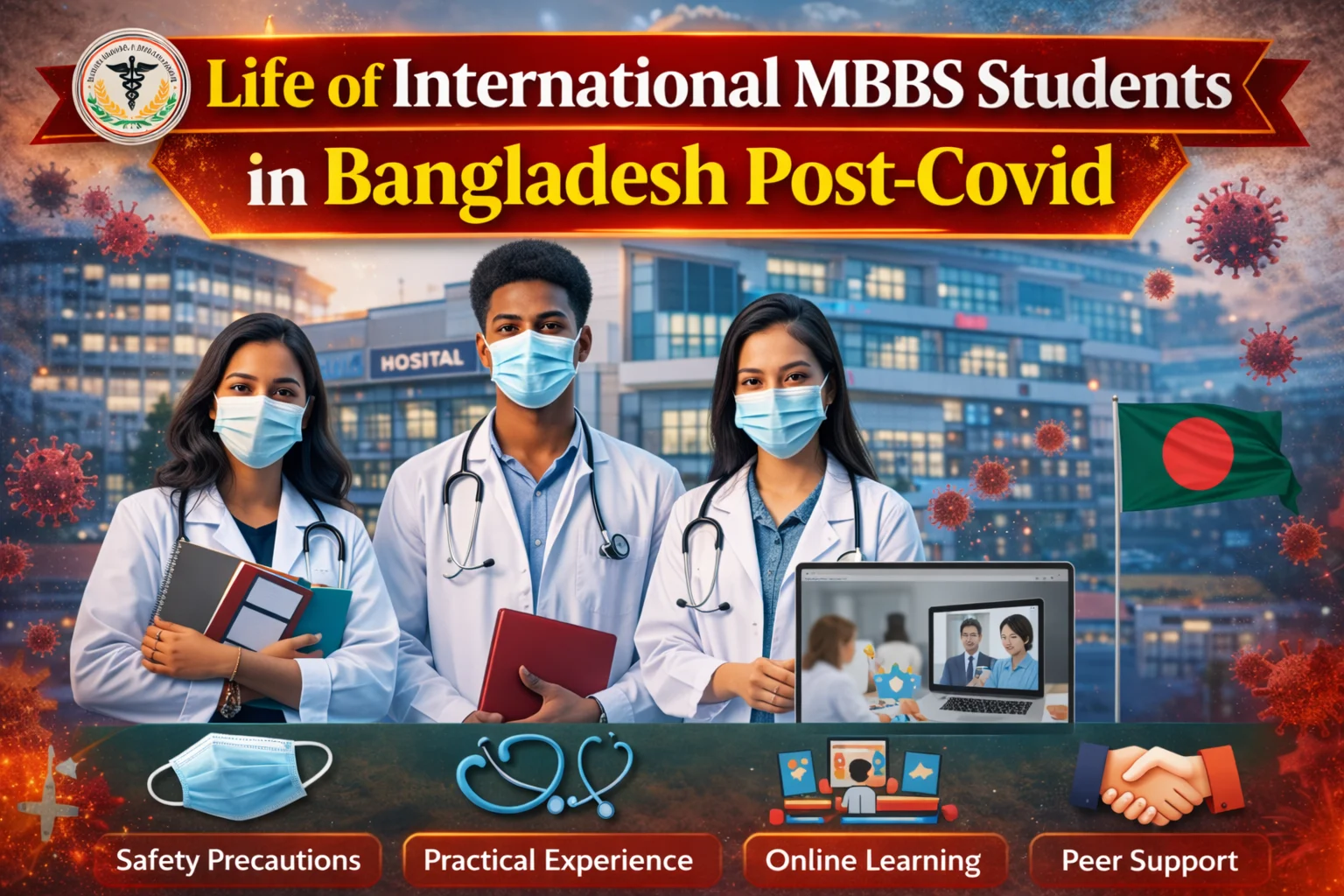
and academic uncertainty.
For students pursuing MBBS in Bangladesh, life before and after Covid is undeniably different.
But here’s the important truth:
The current reality is far more stable and structured than many assume.
Let’s explore the ground realities of international MBBS life in Bangladesh post-Covid — calmly and practically.
The Immediate Post-Covid Transition
When borders reopened and students returned to campus, the transition wasn’t effortless.
Students had to adjust to:
- Offline exams after long online study periods
- Restarting clinical postings after gaps
- Catching up on missed practical exposure
- Following new health protocols
However, most medical colleges responded faster than expected.
Institutions introduced:
- Bridge academic schedules
- Revision modules
- Gradual reintroduction to hospital postings
Rather than pushing students directly into full clinical duty, colleges adopted phased reintegration.
Academic Life: More Structured Than Before
One major post-Covid shift has been improved academic structure.
Colleges now emphasize:
- Fixed academic calendars
- Recorded lectures for backup
- Tighter attendance monitoring
- More frequent internal assessments
The unpredictability of the pandemic forced institutions to build continuity systems.
For international students, NMC this has resulted in:
- Greater clarity
- Reduced academic confusion
- Better tracking of syllabus completion
Clinical Exposure: Fully Restored — and Stronger
Clinical training was the biggest concern during Covid.
Post-pandemic, wdoms hospital systems are fully operational again.
Students now report:
- Increased patient inflow
- Longer clinical postings
- More supervised ward exposure
- Frequent case discussions
Bangladesh’s naturally high patient load has once again become a major advantage.
Students are back to active learning — not just theoretical preparation.
Hostel & Campus Life
Campus living has evolved — but positively.
Most institutions implemented:
- Improved hygiene standards
- Regular health monitoring
- Cleaner mess facilities
- Regulated entry systems
Initially, restrictions felt strict. Over time, they created:
- Safer living environments
- More organized campus routines
- Reduced stress for parents
For international students far from home, structured environments provide reassurance.
Mental Health Awareness
The psychological impact of Covid affected students globally.
WHO International MBBS students experienced:
- Isolation during lockdowns
- Travel uncertainty
- Academic anxiety
- Homesickness
Post-Covid, colleges are more responsive.
Many now offer:
- Academic counseling
- Faculty mentorship access
- Flexible internal scheduling when needed
Students frequently mention that faculty members are now more approachable than before.
Health & Safety Systems
Campus health infrastructure has significantly improved.
Most medical colleges now ensure:
- On-campus medical facilities
- Emergency response protocols
- Clear communication during advisories
Institutions operating under globally aligned frameworks — including those recognized in the World Directory of Medical Schools and guided by standards supported by the World Health Organization — follow structured health norms.
This has increased parental confidence.
Regulatory Stability for Indian Students
Post-Covid, one major concern was degree validity for Indian students.
Clarity has improved under the guidelines of the:
- National Medical Commission
Students who:
- Complete full course duration
- Fulfill internship norms
- Study in recognized institutions
remain eligible for licensing pathways in India.
Regulatory stability has restored confidence among families.
Social & Cultural Life
Campus life has largely normalized.
Students are once again experiencing:
- Cultural festivals
- Student association events
- Sports activities
- Local travel during breaks
India and Bangladesh share cultural similarities, making integration smoother compared to distant destinations.
Language barriers are minimal. Food habits are familiar. The environment feels culturally comfortable.
Financial Stability Post-Covid
One overlooked factor is cost control.
While education expenses rose sharply in Western nations post-pandemic, Bangladesh remains comparatively affordable.
Key advantages include:
- Stable tuition structures
- Moderate living costs
- Controlled hostel fees
For middle-class families, financial predictability is critical.
Digital Learning Is Here to Stay
One lasting benefit of Covid is blended learning.
Students now benefit from:
- Recorded lectures for revision
- Online academic platforms
- Digital exam preparation tools
Hybrid systems improve concept retention and time management without reducing academic seriousness.
Ongoing Challenges
To remain realistic, some challenges persist:
- Backlog-related academic pressure
- Emotional fatigue from past disruptions
- Adjustment difficulties for students who began during online phases
However, these are transitional — not structural — issues.
Most students stabilize within one or two semesters.
Student Perspective: Was Continuing Worth It?
A common sentiment among returning international students:
“The initial period was difficult, but education now feels more serious and organized.”
Post-Covid reforms have increased:
- Academic discipline
- Clinical focus
- Institutional resilience
Medical education today feels more structured than pre-pandemic years.
Final Thoughts
Post-Covid life for international MBBS students in Bangladesh reflects:
- Stronger academic systems
- Restored clinical exposure
- Improved safety protocols
- Clearer regulatory pathways
Covid disrupted global medical education — but it also forced institutions to evolve.
In Bangladesh, that evolution has resulted in a more disciplined, clinically grounded, and resilient environment for international medical students.
For those pursuing MBBS in Bangladesh today, the path is more stable, more structured, and better prepared for future uncertainties than it was during the pandemic years.