
MD Doctor: In the last two decades, a lot of Indian students have left asking abroad to study medicine due to limited government-controlled MBBS seats in India. In response, nations in Eastern Europe, Central Asia and Southeast Asia welcomed international students with low-cost medical programs.
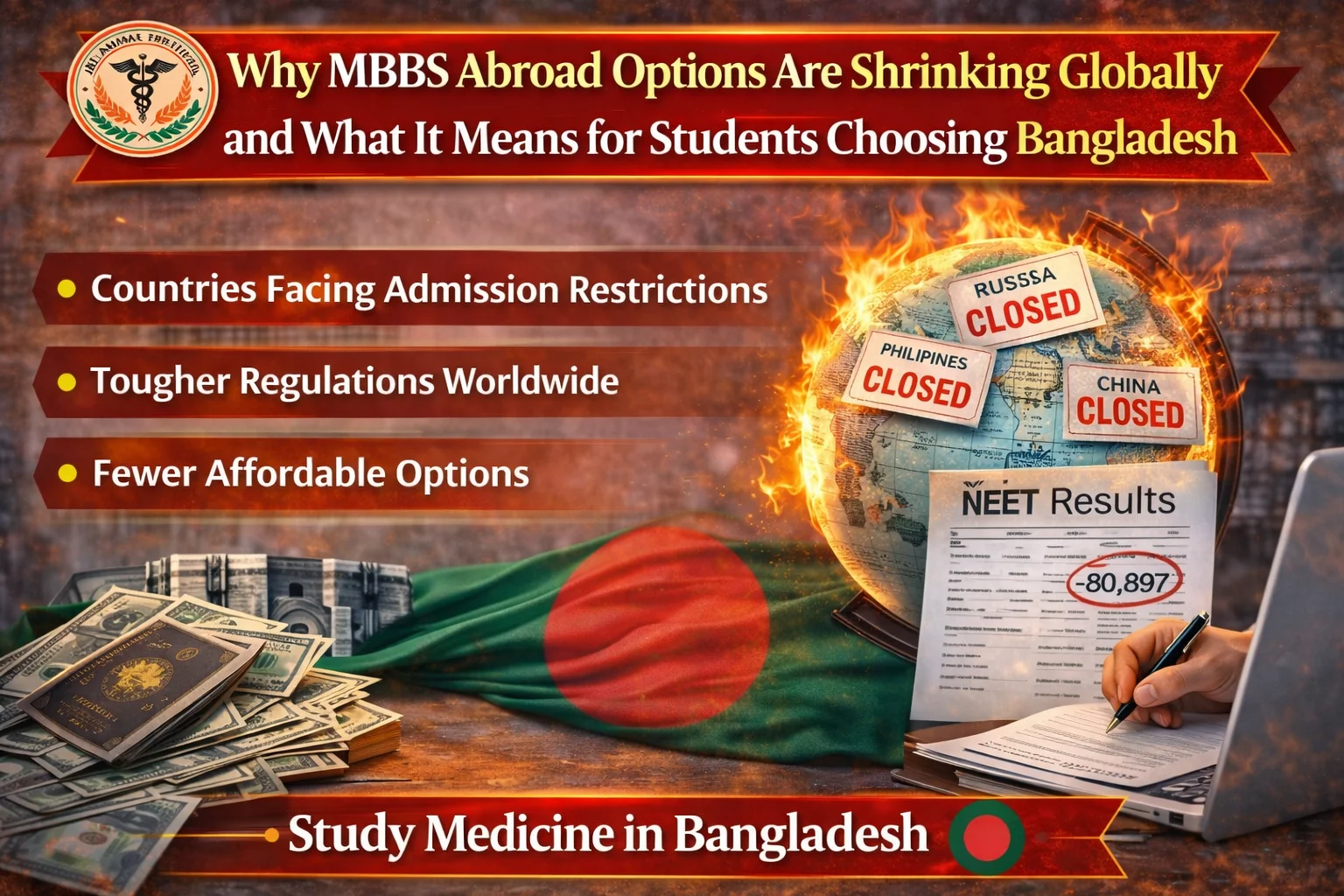
But recently the global MBBS abroad options have become slim. Tightening regulations, geopolitical conflicts, licensing requirements and quality concerns are narrowing the list of places for would-be doctors to safely go.
This worldwide transition will be a benefit for the students who are going to study MBBS in Bangladesh that is clearing Bangladesh, all over the world it is one of such a country where the education system never been compromised. By understanding these changes, students can make better decisions about their medical education.
Major Reasons Behind MBBS Abroad Increasing Preferences
Due to limited availability of medical seats, thousands of Indian students qualify for NEET every year but are unable to secure a seat in Government Medical Colleges. The reality is that a tiny number of candidates can get into government colleges, and private colleges are often extremely expensive.
Several states in India offer private MBBS seats at the exorbitant rate of ₹1 crore or greater prompting several students to turn to international destinations.
Countries such as Russia, Georgia, Kazakhstan, China, Nepal and Bangladesh have been popular destinations for students seeking affordable medical degrees since the inception of this concept.
But Now, the International scenario of MBBS abroad is changing fast.
Foreign Medical Graduates Subject to Tighter Regulations
The introduction of stricter regulations by medical authorities has also contributed to the shrinking of MBBS options abroad.
India has its own rules, called as the Foreign Medical Graduate Licentiate (FMGL) regulations launched by the National Medical Commission (NMC), which are extremely rigorous for students studying medicine abroad.
Under these rules, foreign MBBS programmes must follow certain criteria:
- Such courses must be at least 54 months of pure schooling.
- The whole program has to be in English.
- Students are required to do an internship in the country where they had studied.
- Graduates must also be eligible for a medical license in their country.
Otherwise, getting registed in India may be difficult for these students.
Due to these regulations, many foreign universities that earlier admitted Indian students aren't being viewed as safe destinations anymore.
Geopolitical Conflicts Disrupting Medical Education
One other important reason that reduces MBBS abroad is international political instability.
Several countries have become popular destinations for medical education but in recent years have been adversely affected by geopolitical conflicts.
Such is the case now in Ukraine, where an ongoing war has significantly hindered medical education for thousands of international students. Most universities were forced online and many students had to move from country to country just to keep studying.
Likewise, political upheaval in certain countries has created worrisome conditions for foreign students. Such situations create uncertainty about visas, travel and hospital training.
Such disruptions complicate and impede the students’ progression towards completion of their training smoothly, because medical education is interwoven with continuous clinical exposure (1).
Language Barriers in Many Countries
Another challenge for international scholars has been language barriers.
Many countries will press English-medium medical programs but in practice, clinical training happening in the local language. This has hindered communication with patients and limited opportunities for clinical learning.
In some countries for instance, hospitals speak only local languages in clinical rotations. This generates difficulties for international students who are not able to effectively communicate with patients.
Because clinical exposure is another critical dimension of medical education, language barriers can undermine the teaching process.
Quality Concerns and FMGE Results
The quality of medical education in certain foreign universities also leads to extensive scrutiny which is another reason why MBBS abroad options are becoming limited.
Since the FMGE (Foreign Medical Graduate Examination) conduct in India reflects a significant variation in training quality across two nations.
The overall FMGE pass rate remains quite low in the country, with only about 25% of candidates passing this exam over the last few years.
A low pass rate sometimes betrays issues like:
- Weak clinical training
- Inadequate hospital exposure
- Language difficulties
- Differences in curriculum
Due to these reasons, students and regulatory bodies are getting more sensitive while finalizing MBBS abroad destinations.
Why Bangladesh Is Becoming a Safer Option
Many traditional destinations have become unpredictable, and Bangladesh is emerging as a hot spot for international students.
The basic reason is the medical education of Bangladesh is a replica of Indian Medical Education. This similarity makes it easier for students to adapt to the academic structure.
There are many Advantages of MBBS in Bangladesh for students opting for it.
Similar Medical Curriculum to India
The MBBS curriculum of Bangladesh is nearly identical to Indian medical education system. You are already familiar with subjects, exam patterns and clinical trainings structure.
Easier for students to prepare for the licensing exams in India post-graduation.
Strong Clinical Exposure
Medical colleges in Bangladesh are usually combined with large teaching hospitals, and students see real patients every day.
Since Bangladesh has a high population and crowded hospitals, students receive significant clinical experience during their training.
Arguably one of the most critical components to shaping future physicians is clinical exposure.
Recognition by Global Medical Bodies
Another advantage is international recognition.
All the MBBS in Bangladesh medical universities are present in WDOMS (World Directory of Medical Schools) and recognized by global health organizations (WHO).
Graduates are eligible to take the medical licensing exams in various countries.
Better FMGE Performance
FMGE Test Performance of Bangladesh Compared to other MBBS DestinationsMost of the MBBS destinations in Asia performing weaker than Bangladesh in FMGE.
Because the curriculum follows closely with Indian students, pass rates for students graduating from Bangladesh are also higher.
It bridges the gap between foreign medical education and India’s licensing requirements.
Factors Students Must Know Before Choosing MBBS Abroad
The landscape of medical education across the globe is constantly changing and students applying abroad need to think critically before making their decision.
Key factors to consider include:
- Whether the NMC guidelines are followed by the university
- If the program is half or fully provided in English
- Whether or not the university offers great training in a hospital setting
- The global acceptance of the degree
Making the right choice of country and a university can significantly influence a student’s medical profession.
The Future of MBBS Abroad
It is expected that the trend of declining MBBS abroad option will continue for next few years.
Rates of these standards have been updated for medical education by regulatory authorities around the world to improve educational training and health security.
Although this might limit the number of destinations they can choose from, it also protects students from dangerous and lower-quality programs.
However, students will flock to countries with notable medical education systems and prestigious universities.
Conclusion
The international scene for MBBS overseas is swiftly shifting. As regulations become stricter, geopolitical conflict increases, languages and communication barriers remain immutable and quality concerns are raised; the pool of credible destinations for international medical students declines.
This means for future doctors choosing the right country has never being more important.
MBBS in Bangladesh is one of the safe options left with similarity of course structure as per India, adequate clinical exposure, affordable tuition fees and international recognition.
Global options for MBBS abroad are at their lowest ever and Bangladesh is quickly proving to be the beacon of hope for students who wish to pursue their dream of becoming a doctor.