
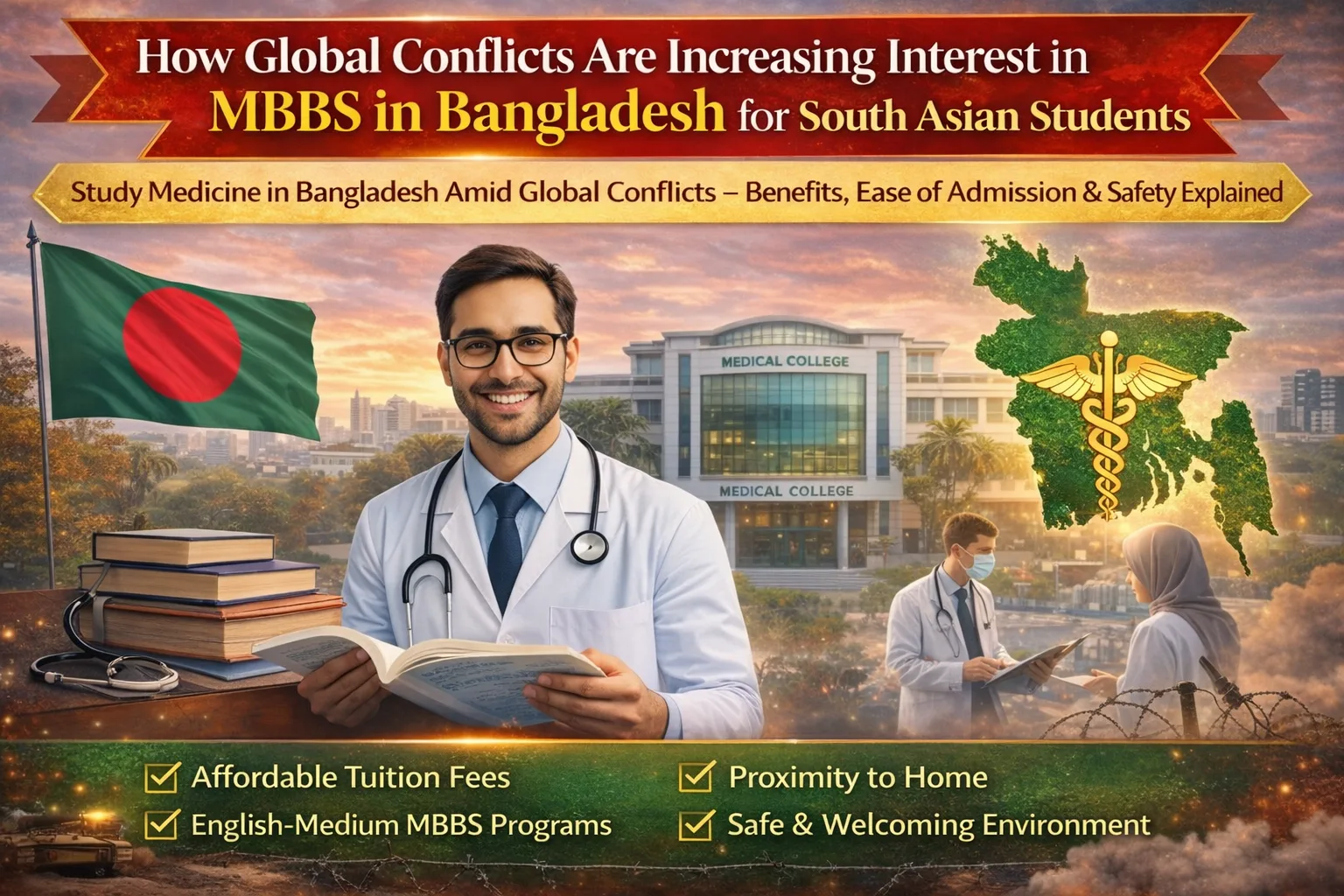
In recent years, the trends of international education begin to be affected by global conflicts and geopolitical tensions. Countries that had previously been attractive choices for medical studies now face disruptions from political unrest, safety concerns or sudden policy shifts. Consequently, students and parents now often prefer safety, stability and predictability when selecting a country for higher education.
As a result, many South Asian students are seeking safer, more regionally stable destinations. One avenue that is steadily emerging as a viable and proven solution is pursuing MBBS in Bangladesh, which has earned the distinction of becoming a trustworthy alternative for many of those students who want to undertake medical education abroad without facing such risks posed by these volatile sections.
Bangladesh’s increasing appeal mirrors how global events are transforming the decisions of international students—especially in South Asia.
International Education: The Effects of Global Conflicts
In recent years, warfare and geostrategic tension have disqualified many regions from being one of the major receivers of international students. Political turmoil, travel limitations and safety concerns have made certain locations less desirable to students seeking long-term education programs.
When disruptions of this type happen, students frequently have to rethink their plans on the fly. Families turn to be even more careful, starting to prefer countries with relatively good political environment and public safety.
The United Nations and other global organizations have repeatedly stressed that conflicts can tear through economies or societies and also disrupt education systems, forcing students to seek alternatives in safer areas.
Since medical education typically takes five to six years, students are especially cautious about selecting countries with signs that their studies will not be disrupted by sudden political or security problems.
Research, Components and Importance for Stable Destinations
One of the most important aspects for students who seek going into medicine is stability. These medical programs require attendance over many years, along with clinical training in hospitals, as well as continuous access to educational infrastructure.
As a result, countries that have political stability and consistent educational policies are increasingly appealing for international students.
Bangladesh is all one of these destinations that have cracked it. The medical sector of the country is continuously blooming with an influx of international students enrolling in various medical universities and colleges.
When students contemplate doing their MBBS in Bangladesh, they often cite the country’s relatively stable academic environment and predictable admission procedures among the primary factors that make it an attractive destination for them.
Why South Asian Students Choose Their Regional Options
Geography is another factor behind the move to Bangladesh. A lot of South Asian students tend to study in countries closer to them, with easier routes and minimum cultural differences.
Bangladesh has strong cultural, linguistic and historical ties with a number of the neighbouring countries. This familiarity provides a fall-back mechanism for students, making studying abroad less overwhelming.
An additional advantage for international students is that medical colleges in Bangladesh offer MBBS programs are offered in English which, unlike other countries/regions offering medical education, gives the international student a significant headway.
All these reasons enable MBBS in Bangladesh to be a quite convenient and easily available option for the students who seek to pursue medical studies abroad with proximity to their motherland.
Recognition and Global Academic Standards
Most students cross-check the recognition status of these universities in international medical directories and regulatory authorities when choosing a country for medical education.
Most medical universities in Bangladesh are also included in the world listing of schools.
Similarly, The World Health Organization (WHO) and other international medical organizations have also called for global strengthening of medical education systems as the demand for healthcare providers increases.
As a result of this recognition framework, students trained in recognized medical education institutions are able to acquire post-graduate training or apply for licensing examinations outside the borders where they have received their education.
But this is an academic structure that South Asian students are drawn to
Another major driving force behind South Asian students flocking to Bangladesh is the similarity of medical education systems, with some neighboring countries following the same trend.
In general of course the MBBS in Bangladesh involves a few years of sitting through lectures and reading textbooks before moving on to a couple more years of going through clinical training at teaching hospitals.
The way forward : This modality enables the students of medicine to have exposure to practical real world applications while still studying their core theoretical subjects.
Practical learning is an addition point for the students seeking to pursue MBBS in Bangladesh as academic coursework and hospital-based training combine together.
Increasing Awareness Through Education Outreach
With the momentum of global students has shifted, Bangladesh educational institutions are actively competing in their medical programs for international students.
International Education fairs, and student outreach programs in South Asia are often attended by universities and education representatives.
Things like these help students to understand the admission process better, academic curriculum and facilities offered at Bangladeshi medical colleges.
Such measures are helping to slowly cement Bangladesh's place as a destination for international medical education.
The Role of Regulatory Compliance
Medical students aspire to practice after graduating from foreign universities.
Indian students wishing to pursue medical studies abroad, for instance, seek whether their prospective medical institution adheres to the National Medical Commission guidelines.
That's absolutely critical for students who want to take licensing examinations and then go out to practice after graduation — let alone why addictions need to be an acceptable standard in any institution of higher learning.
Hence, applying for a reputable medical college is still salient for students aspiring to study their medicine abroad.
Historical Trends in Global Health Education
The effects of global conflicts on international education are likely to continue having an effect on students' decisions for years to come.
Countries with stable and safe environments are likely to see an increase in international students as factors such as safety and stability weigh heavily on students.
Bangladesh’s increasing popularity in medical education, along with a stable academic environment and globally recognized institutions has allowed it to emerge as another feasible hub for South Asian students.
Well, MBBS in Bangladesh is a thing for students who are looking for something more cost-effective but also want to make sure that their academic standing is high as well.
Conclusion
Geopolitical uncertainties and global conflicts have started to redefine patterns of international education. Students and families now weigh safety, stability, and long-term academic reliability more heavily in their choice of study destination.
With this scenario in flux, Bangladesh also stands to be an increasingly appealing destination for South Asian students seeking their education abroad specifically for MBBS.
MBBS in Bangladesh is becoming an eye-catcher as a genuine option for aspiring doctors because of its recognized universities, inclusion in the World Directory of Medical Schools(WDOMS), increasing global outreach, and compliance with regulatory bodies like the National Medical Commission (NMC).
It is anticipated that Bangladesh will continue to serve as a central destination for students pursuing medical education in a secure and accessible environment, following the characteristics of global education trends.